
Lesson 12
In this lesson you will learn:
- The Perfect Passive Participle (PPP)
- The meaning of the PPP
- The formation of the PPP
- Laws of sound combination in words
- Passive and PPP of the roots learned so far
12.1. Perfect Passive Participle (PPP)
One way to form passive sentences of the past is the construction with the so-called Perfect Passive Participle (PPP).
In reality, the PPP is not a true participle, as it is not formed from a tense stem. Rather, it is a nominal formation from the root with the primary suffix -ta or -na. Therefore, in Indian grammar, one speaks of the suffix kta.
12.1.1. सकर्मकधातूनां योजना
Agent (kartṛ) in the Instrumental (tṛtīyā) -- direct object (karman) in the Nominative (prathamā) -- Perfect Passive Participle
In this case, the PPP agrees with the object in number, case, and gender.
An auxiliary verb ("to be") is not necessary.
Examples:
sādhunā svarga āptaḥ = साधुना स्वर्ग आप्तः = "(By the saint, a heaven was attained) = The saint has attained a heaven."
brāhmaṇena devīṣṭā = ब्राह्मणेन देवीष्टा = "(By the Brahmin, the goddess was worshipped with a sacrifice) = The Brahmin has worshipped the goddess with a sacrifice."
12.1.2. अकर्मकधातूनां गतिधातूनां च योजना १
Agent (kartṛ) in the Nominative (prathamā) -- Perfect Passive Participle
In this case, the PPP agrees with the agent in number, case, and gender. The Perfect Participle "Passive" has active meaning with intransitive verbs (verbs without a direct object) and verbs of motion.
Example:
kṣatriyā nagaraṃ gatā = क्षत्रिया नगरं गता = "The Kṣatriya woman has gone into the city."
12.1.3. अकर्मकधातूनां गतिधातूनां च योजना २
Agent (kartṛ) in the Instrumental (tṛtīyā) -- PPP in the Nominative Singular Neuter
Example:
kṣatriyeṇa (nagaraṃ) gatam = क्षत्रियेण (नगरं) गतम् = "(By the Kṣatriya, (into the city) was gone) = The Kṣatriya has (gone into the city)."
The construction according to Schema II is much rarer than the construction according to Schema I.
12.2. On the meaning of the PPP
Thus, while the so-called "Perfect Passive Participle" for transitive verbs has primarily passive meaning (āpta = "reached (been)") and for intransitive verbs and verbs of motion active meaning (gata = "gone"), there are some verbs for which the PPP can have both active and passive meaning:
e.g.
- gata = गत = "gone" (active); but also: gato mārgaḥ = गतो मार्गः = "a gone path" (passive)
- āpta = आप्त = "reached (been)" (passive), "having reached" (active)
12.3. Formation of the PPP
The following forms of formation occur (for each root, its PPP must be learned!):
(mostly) strong-grade root
- + -ta
- with connecting vowel -i- before: -ita
- without connecting vowel: -ta
- + -na
The feminine stems are: -tā, -itā, -nā; the neuter declines like phala n.
12.3.1. PPP in -ta (kta)
12.3.1.1. Without connecting vowel -i- (aniṭ)
aniṭ = “without (an-) the suffix preceding (-i-) t” (i.e., without the connecting vowel i).
Without a connecting vowel, the PPP is generally formed from roots ending in a vowel as well as from many other roots, without there being a fixed rule for this, regarding at which structured roots the connecting vowel occurs or does not.
A list of aniṭ roots can be found in Kielhorn, Grammar § 298.
Examples:
| Root | PPP (kta) |
|---|---|
| bhū 1 P (भू) | bhū-ta (भूत) |
| smṛ 1 P (स्मृ) | smṛ-ta (स्मृत) |
| nṛt 4 P (nṛt-ta) (नृत्त) | nṛt-ta (नृत्त) |
| nī 1 U (नी) | nī-ta (नीत) |
| man 4 Ā (मन्) | ma-ta (*mn-ta) (मत) |
| su 5 U (सु) | su-ta (सुत) |
| gam 1 P (गम्) | ga-ta (< *gm-ta) (गत) |
| ji 1 P (जि) | ji-ta (जित) |
| śru 5 P (श्रु) | śru-ta (श्रुत) |
| kṛ 8 U (कृ) | kṛ-ta (कृत) |
| tan 8 U (तन्) | ta-ta (< *tn-ta) (तत) |
| iṣ 6 P (इष्) | iṣ-ṭa (इष्ट) |
12.3.1.2. With connecting vowel -i- (seṭ)
seṭ = sa-iṭ = “with (sa-) the suffix preceding (-i-) t” (i.e., with the connecting vowel i).
Examples:
| Root | PPP (kta) |
|---|---|
| kup 4 P (कुप्) | kup-i-ta (कुपित) |
| khād 1 P (खाद्) | khād-i-ta (खादित) |
| rakṣ 1 P (रक्ष्) | rakṣ-i-ta (रक्षित) |
| vad 1 P (वद्) | ud-i-ta (< *vd-i-ta) (उदित) |
12.4. Laws of phonetic combination in the word
In aniṭ formations, the following laws of phonetic combination in the word must be observed. These laws are very important for the understanding of the entire Sanskrit morphology.
| 1. k, t, p before a voiceless stop (e.g. t, th) remain unchanged: | pt, tt, kt = प्त्, त्त्, क्त् |
| 2. ct is replaced by kt = क्त्: | muc + ta » muk-ta = मुक्त |
| 3. śt is replaced by ṣṭ = ष्ट्: | dṛś + ti » dṛṣṭi = दृष्टि dṛś + ta » dṛṣṭa = दृष्ट viś + ta » viṣṭa = विष्ट |
| 4. A voiced unaspirated stop – except j – before a voiceless sound is replaced by the corresponding voiceless unaspirated sound: | d + t(h) » tt(h) = त्त्, त्थ् (important for the 2nd present class) |
| 5. jt is replaced by kt or ṣṭ (not facultative!): | yuj + ta » yuk-ta = युक्त yaj + ta » iṣ-ṭa = इष्ट (< *yj-ta) sṛj + ta » sṛṣ-ṭa = सृष्ट sṛj + ti » sṛṣ-ṭi = सृष्टि |
| 6. Voiced aspirated stop + voiceless stop » voiced unaspirated stop + voiced aspirated stop (Bartholomae’s Aspirate Law): | bh-t » b-dh: labh + ta » lab-dha = लब्ध dh-t » d-dh: budh + ta » bud-dha = बुद्ध yudh + ta » yud-dha = युद्ध krudh + ta » krud-dha = क्रुद्ध |
| 7. h-t wird replaced by ḍh with lengthening of a preceding i or u; or by gdh. Before such a ḍh, a is replaced by o, rarely by ā: | dah + ta » dag-dha = दग्ध guh + ta » gūḍha = गूढ (guh 1 (gūhati) „etwas verbergen”) muh + ta » mug-dha / mūḍha = मुग्ध / मूढ sah + ta » soḍha = सोढ |
12.5. Word List
- budh 4 Ā (budhyate) / 1 U (bodhati), PPP buddha बुध् बुध्यते बोधति बुद्ध : to awaken, to awaken to knowledge, to recognize; PPP buddha 3 awakened, hence Buddha = “the Awakened” (not: the Enlightened)
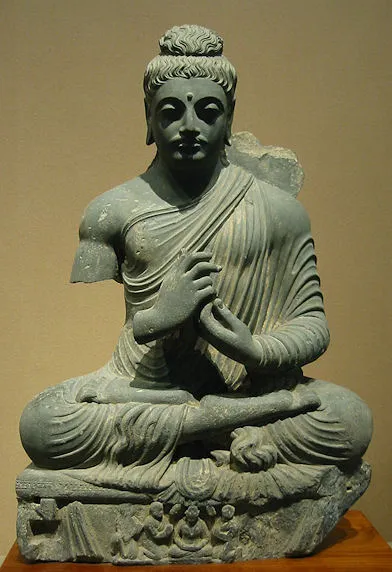
Fig.: गौतमो बुद्धः
(Image source: Details)
- dah 1 P (dahati), PPP dagdha दह् दहति दग्ध : to burn (something)
- sah 1 Ā (sahate), PPP soḍha सह् sahate soḍha : to overcome, to endure, to endure patiently = to forgive
- mṛga m. मृग : wild animal
- mārga m. मार्ग : path (paths were often game trails)
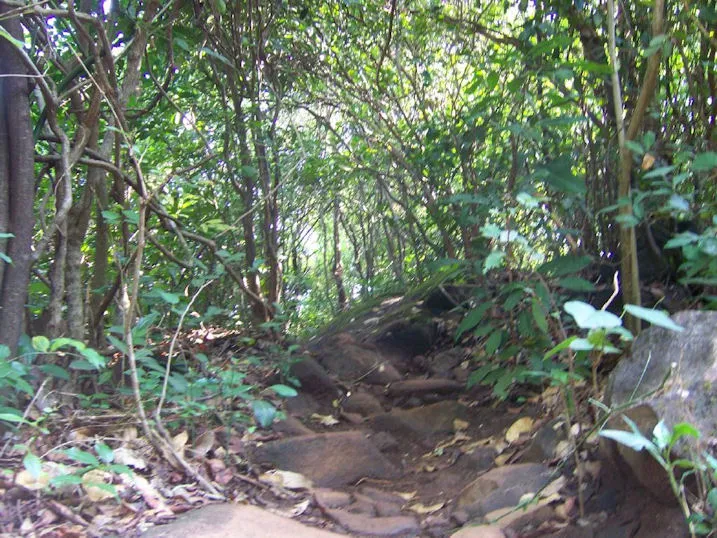
Fig.: मार्गः
(Image source: Details)
- api अपि : also (postposed)
Some roots are counted by indigenous grammarians among the 6th conjugation class, which form the present stem with nasal infix and thematic vowel a, e.g.:
- muc 6 U (muñcati), PPP mukta मुच् मुञ्चति मुक्त : to unfasten, to release, to liberate; to liberate from the cycle of rebirths (saṃsāra m.) = to save
- sic 6 U (siñcati), PPP sikta सिच् सिञ्चति सिक्त : to sprinkle
Regarding word formation:
- muc: mokṣa m. मोक्ष : release, liberation, salvation
- sic + abhi-: abhiṣeka m. अभिषेक : sprinkling of a king during the royal consecration, royal consecration
- budh: bodhi m./f. बोधि : awakening (through which a Buddha or Jina attains liberating insight)
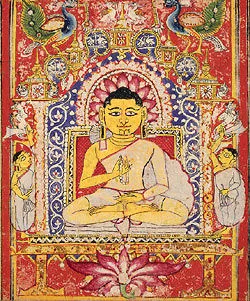
Fig.: महावीरो जिनः
(Image source: Details)
- buddhi f. (budh + -ti) बुद्धि : knowledge, organ of knowledge.
12.5.1. Passive and PPP of the roots learned so far
| Root धातु | Passiv Present 3. sg. Indikativ यक् लट् | PPP क्त |
|---|---|---|
| aś 5 Ā अश् | aśyate अश्यते | aṣṭa अष्ट |
| āp 5 P आप् | āpyate आप्यते | āpta आप्त |
| as 2 P अस् | — | bhūta भूत |
| bhaj 1 U भज् | bhajyate भज्यते | bhakta भक्त |
| bhū 1 P भू | bhūyate भूयते | bhūta भूत |
| budh 4 Ā / 1 U बुध् | budhyate बुध्यते | buddha बुद्ध |
| dah 1 P दह् | dahyate दह्यते | dagdha दग्ध |
| div 4 P दिव् | dīvyate दीव्यते | dyūta द्यूत |
| dṛś दृश् | dṛśyate दृश्यते | dṛṣṭa दृष्ट |
| gam 1 P गम् | gamyate गम्यते | gata गत |
| grah 9 U ग्रह् | gṛhyate गृह्यते | gṛhīta गृहीत |
| hṛ 1 U हृ | hriyate ह्रियते | hṛta हृत |
| i 2 P इ | īyate ईयते | ita इत |
| iṣ 6 P इष् | iṣyate इष्यते | iṣṭa इष्ट |
| jan 4 Ā जन् | janyate जन्यते | jāta जात |
| ji 1 P जि | jīyate जीयते | jita जित |
| kath 10 U कथ् | kathyate कथ्यते | kathita कथित |
| khād 1 P खाद् | khādyate खाद्यते | khādita खादित |
| kṛ 8 U कृ | kriyate क्रियते | kṛta कृत |
| krudh 4 P क्रुध् | krudhyate क्रुध्यते | kruddha क्रुद्ध |
| kup 4 P कुप् | kupyate कुप्यते | kupita कुपित |
| labh 1 Ā लभ् | labhyate लभ्यते | labdha लब्ध |
| man 4 Ā मन् | manyate मन्यते | mata मत |
| mṛ 6 Ā मृ | mriyate म्रियते | mṛta मृत |
| muc 6 U मुच् | mucyate मुच्यते | mukta मुक्त |
| nī 1 U नी | nīyate नीयते | nīta नीत |
| paś पश् | (dṛśyate) दृश्यते | (dṛṣṭa) दृष्ट |
| pat 1 P पत् | patyate पत्यते | patita पतित |
| prach 6 P प्रच्छ् | pṛcchyate पृच्छ्यते | pṛṣṭa पृष्ट |
| pūj 10 U पूज् | pūjyate पूज्यते | pūjita पूजित |
| rakṣ 1 P रक्ष् | rakṣyate रक्ष्यते | rakṣita रक्षित |
| ram 1 Ā रम् | ramyate रम्यते | rata रत |
| sah 1 Ā सह् | sahyate सह्यते | soḍha सोढ |
| sic 6 U सिच् | sicyate सिच्यते | sikta सिक्त |
| śru 5 P श्रु | śrūyate श्रूयते | śruta श्रुत |
| su 5 U सु | sūyate सूयते | suta सुत |
| svap 2 P स्वप् | supyate सुप्यते | supta सुप्त |
| tyaj 1 P त्यज् | tyajyate त्यज्यते | tyakta त्यक्त |
| uch उछ् | — | uṣita उषित |
| vad 1 P वद् | udyate उद्यते | udita उदित |
| vas 1 P वस् | uṣyate उष्यते | uṣita उषित |
| vadh वध् | vadyate वद्यते | hata हत |
| yaj 1 U यज् | ijyate इज्यते | iṣṭa इष्ट |
| yudh 4 Ā युध् | yudhyate युध्यते | yuddha युद्ध |
12.6. Exercise
A) Form passive sentences in the past tense from the active sentences of Lesson 7, Exercise A, using past tense active sentences for intransitive verbs and verbs of motion.
B) Form the corresponding PPPs from the verb forms of Lesson 10, Exercise A. Note that a form like sṛjati corresponds to PPPs in all three genders.
C) Put the sentences from Lesson 10, Exercise C, into the passive voice in the past tense.