
Lesson 10
In this lesson you will learn:
- The passive sentence (Instrumental of the Agent)
- The declension of the Instrumental (tṛtīyā)
- The cerebralization rule for -n- (word sandhi)
- The formation of the passive (yak) in the Indicative Present
- Vocabulary related to sacrifice, truth, and social roles
10.1. The Passive Sentence
Schema:
(Agent - kartṛ - in the Instrumental (tṛtīyā)) - (direct object - karman - in the Nominative) - passive verbal form
e.g. brāhmaṇena deva ijyate = ब्राह्मणेन देव इज्यते = "A Brahman worships a god with a sacrifice" (literally: "A god is worshipped by a Brahman with a sacrifice.")
This sentence is completely (!) semantically identical to the sentence:
brāhmaṇo devaṃ yajati / yajate = ब्राह्मणो देवं यजति / यजते
- In the passive sentence, the agent (kartṛ) stands in the Instrumental (tṛtīyā f. "third case ending"), and the direct object (karman n.) stands in the Nominative (prathamā f.).
- Passive sentences in which the agent is not specified usually have an impersonal meaning ("one"):
e.g. ijyate = इज्यते "One sacrifices" (literally: "it is worshipped with a sacrifice").
Even if the corresponding active sentence contained an accusative (dvitīyā) of the goal, this can be put into the Nominative (prathamā) in the passive sentence:
The active sentence rāmo grāmaṃ gacchati = रामो ग्रामं गच्छति = "Rāma goes to the village." corresponds to the passive sentences:
- rāmeṇa grāmaṃ gamyate = रामेण ग्रामं गम्यते
- alternatively: rāmeṇa grāmo gamyate = रामेण ग्रामो गम्यते
Intransitive verbs (verbs without a direct object) frequently have passive constructions, especially in polite requests:
- praviśyatām = प्रविश्यताम् = "One may enter = Please enter = Come in!"
- niṣadyatām = निषद्यताम् = "One may sit down = Please sit down = Please take a seat"
Sanskrit passive constructions are extremely frequent: the passive is, after all, easier to form than, for example, numerous present stems.
Sanskrit passive sentences generally must not be rendered in German by a passive sentence, since the German passive has a completely different stylistic function.
10.2. The Instrumental (tṛtīyā f. = तृतीया = "third case ending")
The regular endings of the Instrumental (tṛtīyā):
- Singular: -ā
- Plural: -bhis
Regular formations:
| Instrumental Singular | Instrumental Plural | |
|---|---|---|
| Feminina auf -i śruti श्रुति | śruty-ā श्रुत्या | śruti-bhis श्रुतिभिस् |
| Feminina auf -ī devī देवी | devy-ā देव्या | devī-bhis देवीभिस् |
| Feminina auf -u dhenu धेनु | dhenv-ā धेन्वा | dhenu-bhis धेनुभिस् |
Irregular Forms (Singular):
| Instrumental Singular | Instrumental Plural | |
|---|---|---|
| Maskulina auf -i kavi कवि | kavi-n-ā कविना | kavi-bhis कविभिस् |
| Maskulina auf -u paśu पशु | paśu-n-ā पशुना | paśu-bhis पशुभिस् |
| Feminina auf -ā devatā देवता | devat-ay-ā देवतया | devatā-bhis देवताभिस् |
Masculines and Neuters in -a (irregular in Singular and Plural):
| Instrumental Singular | Instrumental Plural | |
|---|---|---|
| Maskulina auf -a deva देव | devena देवेन | devais देवैस् |
| Neutra auf -a phala फल | phalena फलेन | phalais फलैस् |
Interrogative pronoun kim:
| Instrumental Singular | Instrumental Plural | |
|---|---|---|
| Masculine / Neuter | kena केन | kais कैस् |
| Feminine | kayā कया | kābhis काभिस् |
Demonstrative Pronouns:
| Pronoun | Gender | Instrumental Singular | Instrumental Plural |
|---|---|---|---|
| tad "er, sie, es; der, die, das" (Erwähnte) तद् | M/N | tena तेन | tais तैस् |
| F | tayā तया | tābhis ताभिस् | |
| etad "dieser, diese, dieses" (dem Sprechenden sehr Nahe) एतद् | M/N | etena / enena एतेन / एनेन | etais एतैस् |
| F | etayā / enayā एतया / एनया | etābhis एताभिस् | |
| idam "dieser, diese, dieses" (Nahe) इदम् | M/N | anena / enena अनेन / एनेन | ebhis एभिस् |
| F | anayā / enayā अनया / एनया | ābhis आभिस् |
Except in the Nominative and Accusative, the forms of the Neuters in -a, of the interrogative pronoun, and of the demonstrative pronouns are identical to the forms of the corresponding Masculine.
10.2.1. On the Usage of the Instrumental (tṛtīyā = तृतीया)
The Instrumental (tṛtīyā) primarily answers the questions:
- By what?
- With what?
- With whom?
It stands
- in passive sentences: Agent (kartṛ) in the Instrumental
- to indicate the means or instrument with which something is accomplished
- to indicate the path by which someone reaches somewhere
- to express connection, union, accompaniment with
- with postpositions meaning "together with, with"; e.g. saha = सह = "with" :brz.B.:br brāhmaṇena saha = ब्राह्मणेन सह = "together with the Brahmin"
Further uses of the Instrumental (tṛtīyā) follow later.
10.3. The so-called Cerebralization Law for -n- (a word sandhi)
An -n-, followed by a vowel or n, m, y, v, is replaced by -ṇ- if ṛ, ṝ, r, ṣ precede the -n- in the word or if no other sound than vowels, Gutturals, Labials, y, v, h or Anusvāra stands between these sounds and the following -n- in the word.
Therefore:
| Instrumental Singular | |
|---|---|
| guru गुरु | guruṇā गुरुणा |
| śūdra शूद्र | śūdreṇa शूद्रेण |
| īśvara ईश्वर | īśvereṇa ईश्वरेण |
| kṣatriya क्षत्रिय | kṣatriyeṇa क्षत्रियेण |
| naraka नरक | narakeṇa नरकेण |
Thus the -ṇ- is also to be explained in:
śravaṇa श्रवण
śṛṇoti शृणोति
kāraṇa कारण
brāhmaṇa ब्राह्मण
10.4. The Passive, Indicative Present (yak = यक्)
Formation:
(mostly) guṇa-grade root + -ya- + Ātmanepada ending
e.g.
| Root धातु | 3. sg. Pass. Präs. Indik. यक् लट् | 3. pl. Pass. Präs. Indik. यक् लट् |
|---|---|---|
| nī 1 U (nayati) | nīyate (नीयते) "er wird geführt" | nīyante (नीयन्ते) |
| man 4 Ā (manyate) | manyate (मन्यते) "er wird gedacht" | manyante (मन्यन्ते) |
| viś 6 P (viśati) | viśyate (विश्यते) "es wird betreten" | viśyante (विश्यन्ते) |
Note that for verbs of the 4th present class, the Ātmanepada and the passive have identical forms! Whether Ātmanepada or passive is present can only be inferred from the sentence construction in this case.
10.4.1. Special rules for the formation of the passive
Roots ending in -i or -u lengthen their vowel before the passive suffix -ya-:
- ji 1 P: jīyate, jīyante :brजीयते, जीयन्ते
- śru 5 P: śrūyate, śrūyante :brश्रूयते, श्रूयन्ते
- su 5 U: sūyate, sūyante :brसूयते, सूयन्ते
Roots with -a- between consonants (except nasals, y, r, v) remain in guṇa-grade:
- labh 1 Ā: labhyate, labhyante :brलभ्यते, लभ्यन्ते
Some roots form their passive in guṇa-grade (or in the ablaut grade of the present stem):
- āp 5 P: āpyate, āpyante :brआप्यते, आप्यन्ते
- khād 1 P: khādyate, khādyante :brखाद्यते, खाद्यन्ते
- smṛ 1 P: smaryate, smaryante :brस्मर्यते, स्मर्यन्ते
Low-grade of verbs beginning with ya, va, ra, or where these sounds stand after another consonant (Samprasāraṇa = सम्प्रसारण):
Root
धातुTiefstufe
सम्प्रसारणPassiv
यक्yaj 1 U
यज्*yj » ij ijyate
इज्यते
ijyante
इज्यन्तेvad 1 P
वद्*vd » ud udyate
उद्यते
udyante
उद्यन्तेprach 6 P
प्रच्छ्*prcch » pṛcch pṛcchyate
पृच्छ्यते
pṛcchyante
पृच्छ्यन्ते
Der traditionelle indigene Name für diese untergeordnete Bildung in Verben mit ya oder va ist Samprasāraṇa (नपुंसकम् = सम्प्रसारण).
Final -ṛ after a single consonant is replaced by -ri- before the passive suffix -ya-:
- kṛ 8 U: kriyate, kriyante :brक्रियते, क्रियन्ते
- But: smṛ 1 P: smaryate :brस्मर्यते
Some roots ending in -an have alternatively two passive stem formations:
- an -an-ya
- an -ā-ya- (the long ā is a representative of a hypothetical long nasal)
e.g. tan 8 U.
- tan-ya-te, tan-ya-nte :brतन्यते, तन्यन्ते
- tā-ya-te, tā-ya-nte :brतायते, तायन्ते (from *tn-ya-nte)
10.5. Vocabulary
gṛha n. गृह : House
gṛha n. गृह : house
grāma m. ग्राम : village
nagara n. नगर : city
yajña m. यज्ञ : sacrifice
:::
yajña m. यज्ञ : sacrifice
In India, sacrifice is primarily an honoring of the deity as a guest. By this, one obligates oneself to the deity.
Word formation: yaj 1 U + kṛt-suffix -na-.
puṇya n. पुण्य : good deed, merit
satya n. सत्य : truth
:::
- pāpa n. पाप : misdeed, evil (opposite of puṇya)
- satya n. सत्य : truth
In India, true speech was attributed with magical power; indeed, the entire cosmic order is maintained and created by true speech. For this important concept, see the fundamental work:
Lüders, Heinrich <1869 - 1943>: Varuna / Heinrich Lüders. Edited from the estate by Ludwig Alsdorf. - Göttingen : Vandenhoeck & Ruprecht. -- Vol. 2: Varuna and Ṛta. -- 1959. -- XXIII pages, pages 340 - 764
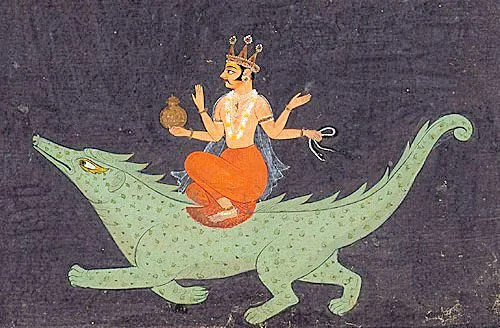
Fig.: वरुणः
(Image source: Details)
anṛta n. अनृत : untruth, lie (opposite of satya)
Word formation an- (“un-”) + ṛta n.
ṛta is a central concept in the Veda, whose translation is disputed: “truth” (Lüders, Thieme), “order” (Renou).
ṛṣi m. ऋषि : Vedic seer, author of Vedic hymns
The names of these ṛṣis are mentioned in the Brāhmaṇas as well as in separate lists of the Vedas. All Brahmins trace their origin to such ṛṣis, after whom their gotra (गोत्र) are named. For the concept of gotra, see Basham, Wonder, Chapter 5.

Fig.: विश्वामित्रः
(Image source: Details)
- vad 1 P (vadati) वद् वदति : to say, to speak
- prach 6 P (pṛcchati !) प्रच्छ् पृच्छति : to ask (someone: Acc.; about something: Acc.)
- saha सह : together with, jointly with (also in "to fight with" etc.) (Postposition with Instrumental)
10.6. Exercise
A) Form the passive for the following verb forms (with translation of the verb form):
- sṛjati (सृजति)
- yudhyate (युध्यते)
- bhavanti (भवन्ति)
- yajati (यजति)
- nṛtyati (नृत्यति)
- nayanti (नयन्ति)
- smarati (स्मरति)
- śṛṇvanti (शृण्वन्ति)
- paśyati (पश्यति) (passive is formed from dṛś!)
- jayanti (जयन्ति)
- kurvate (कुर्वते)
- āpnuvanti (आप्नुवन्ति)
- viśati (विशति)
- khādanti (खादन्ति)
- sunoti (सुनोति)
- gacchati (गच्छति)
- manyante (मन्यन्ते)
- labhante (लभन्ते)
- rakṣanti (रक्षन्ति)
- vadanti (वदन्ति)
- pṛcchanti (पृच्छन्ति)
- tanvanti (तन्वन्ति) (2 forms!)
B) Form the instrumental singular and plural for all nouns learned so far.
C) Convert the following sentences into the passive voice and translate them:
- brāhmaṇo devīm yajati. (ब्राह्मणो देवीं यजति)
- sādhuḥ svargaṃ gacchati. (साधुः स्वर्गं गच्छति)
- śūdraṃ jayati. (शूद्रं जयति)
- guruḥ phalāni khādati. (गुरुः फलानि खादति)
- gurūñchṛṇoti. (गुरूञ्छृणोति)
- ko 'gniṃ paśyati. (को ऽग्निं पश्यति)
- ayaṃ kavirmantraṃ smarati. (अयं कविर्मन्त्रं स्मरति)
- iyaṃ devī kṣatriyā rakṣati. (इयं देवी क्षत्रिया रक्षति)
- kṣatriyā viṣṇuṃ yajante. (क्षत्रिया विष्णुं यजन्ते) (2 possibilities)
- brāhmaṇo 'gniṃ karoti. (ब्राह्मणो ऽग्निं करोति)
- vaiśyā imaṃ grāmaṃ gacchanti. (वैश्या इमं ग्रामं गच्छन्ति) (2 possibilities)
- ete gurūṃstu śṛṇvanti. (एते गुरूंस्तु शृण्वन्ति)
- sādhuḥ svargamāpnoti. (साधुः स्वर्गमाप्नोति)
- brāhmāṇāḥ somaṃ sunvanti. (ब्राह्मणाः सोमं सुन्वन्ति)
- paśūllabhate. (पशूल्लभते)
- ke yodhāḥ kṣatriyaiḥ saha yudhyante. (के योधाः क्षत्रियैः सह युध्यन्ते)
D) Translate into Sanskrit:
- A Brahman goes to the village with a Vaiśya.
- He venerates Viṣṇu with a sacrifice. (Express sacrifice as yajña!)
- The Veda is called śruti. (vad)
- The warp is stretched. (2 possibilities)

Fig.: तन्तुवायः
(Image source: Details)
- The teacher asks. (Passive construction)
- The eye leads. (Passive construction)
- The poet sees a deity. (Passive construction)
- Who (fem.) tends the girl? (Passive construction)
- The Kṣatriya venerates the LORD with a sacrifice. (Passive construction, without using the word yajña)
- Through generosity, a follower of the Buddha attains heaven.
10.7. Word List 2
- makṣikā f. मक्षिका : fly, bee
- vraṇa m. व्रण : wound, error, damage
- dhana n. धन : wage, money, wealth, property
- iṣ 6 P (icchati) इष् इच्छति : to wish
- pārthiva m. पार्थिव : king
- nīca 3 नीच : low, deep
- kalaha m. कलह : dispute, quarrel
- śānti f. शान्ति : cessation, peace, tranquility
- śam 4 P (śāmyati !) शम् शाम्यति : to be calm, to become calm
- nara m. नर : man, human being
- lubh 4 P (lubhyati) लुभ् लुभ्यति : to desire
- sūkta 3 सूक्त : well said, beautifully spoken; n. song
- śiṣya m. शिष्य : student
- atra अत्र : here
- tatra तत्र : there
- bhānu m. भानु : radiance, sun
- vand 1 Ā (vandate) वन्द् वन्दते : to greet, to honor
- vṛṣ 1 P (varṣati) वृष् वर्षति : to rain
- nṛpa m. नृप : king, prince
- kṣīra n. क्षीर : milk
- mārga m. मार्ग : path
- evam एवम् : thus
- iha इह : here
- śubh 1 Ā (śobhate) शुभ् शोभते : to be beautiful, to shine
10.8. Reading and Translation Exercise
Read and translate, and convert into the passive voice:
क
१.
मक्षिका व्रणमिच्छन्ति
धनमिच्छन्ति पार्थिवाः ।
नीचाः कलहमिच्छन्ति
शान्तिमिच्छन्ति साधवः ॥
२. नरान्सृजति देवः । |
३. कवयो धनं लुभ्यन्ति । |
४. ऋषयः सूक्तानि पश्यन्ति । |
५. विष्णुमृषिर्यजति । |
६. गुरूञ्शिष्यांश्च पश्यति । |
७. स्वर्गं लभन्ते । |
८. अत्रर्षिर्भानुं वन्दते । |
९. ग्रामं गच्छन्ति । |
१०. दानानि वर्षन्ति नृपाः ॥
ख
१. सदा देवान्स्मरन्ति । |
२. ऋषिभी रामो वसति । |
३. हरिं क्षीरेण यजति । |
४. मार्गेण ग्रामं गच्छन्ति । |
५. धनेन सुखमिच्छन्ति नराः । |
६. एवं वदन्ति । |
७. शान्त्यर्षय इह शोभन्ते । |
८. कपयः फलानि खादन्ति । |
९. गजो गच्छति । |
१०. हरिर्गृहं गच्छति । |
११. सारथी रथं नयति ॥