
Lesson 42
42.1. Stems in -ṛ
42.1.1. Stems with lengthened grade in the strong stem
All masculines in -ṛ with the exception of the kinship terms listed under 1.3. This category also includes the following kinship terms:
- नप्तृ m. "grandson"
- भर्तृ m. "husband (lit. supporter)"
The majority of nouns belonging here are agent nouns formed with the कृत्-suffix -तृ.
Formation:
- Strong stem: -ār
- Weak stem
- before vowel: -r
- before consonant: -ṛ
Note the irregular formations (marked in red)!
Masculine:
दातृ m. "giver"
| एकवचनम् | बहुवचनम् | |
|---|---|---|
| प्रथमा | दाता | दातारस् |
| द्वितीया | दातारम् | दातॄन् |
| तृतीया | दात्रा | दातृभिस् |
| चतुर्थी | दात्रे | दातृभ्यस् |
| पञ्चमी | दातुस् | दातृभ्यस् |
| षष्ठी | दातुस् | दातॄणाम् |
| सप्तमी | दातरि | दातृषु |
For an explanation of the irregular formations, see Thumb-Hauschild I,2 pp. 76-81.
Feminine:
स्वसृ f. is declined like दातृ with the exception of the accusative (द्वितीया) plural: स्वसॄस्.
42.1.2. Nominal formation: कृत्-suffix -तृ
With the very common कृत्-suffix -तृ, one forms agent nouns (terms for the कर्तृ) from almost any root or causative stem.
Formation:
- strong-grade root + -tṛ
or
- strong-grade root / causative stem + i + tṛ
Examples:
कर्तृ m. "doer"
जेतृ m. "winner"
धातृ m. "creator"
रक्षितृ m. "protector"
बोधयितृ m. "awakener"

Fig.: अयं बोधयिता
(Image source: Details)
Rarely occurring neuters in -तृ have a partially independent declension (see Kielhorn, Grammar § 148).
The feminine corresponding to stems in -तृ ends in -त्री (like देवी).
e.g. कर्त्री f. "female doer"
42.1.3. Stems with strong grade in the strong stem
This category includes the following kinship terms:
- पितृ m. "father"
- मातृ f. "mother"
- दुहितृ f. "daughter"
- भ्रातृ m. "brother"
- देवृ m. "husband's brother (wife's brother-in-law)"
- यातृ f. "wife of husband's brother"
- ननान्दृ f. "husband's sister (wife's sister-in-law)"
Formation:
- strong stem: -ar
- weak stem
- before vowel: -r
- before consonant: -ṛ
Examples:
पितृ m. "father"
मातृ f. "mother"
| पुंस् (एकवचनम्) | पुंस् (बहुवचनम्) | स्त्री (एकवचनम्) | स्त्री (बहुवचनम्) | |
|---|---|---|---|---|
| प्रथमा | पिता | पितरस् | माता | मातरस् |
| द्वितीया | पितरम् | पितॄन् | मातरम् | मातॄस् |
| Rest wie दातृ | ← | ← | ← | ← |
42.1.4. Tribes on -ṛ in Compounds
As the first member of a compound, nouns on -ṛ naturally stand in their weak stem, i.e.
- before consonant: -ṛ
- before vowel: -r
42.2. Word List
प्रकृति f.: (to कृ + प्र) basic form, natural state, nature; primal matter, prime substance
अर्जुन m. proper name: Arjuna, one of the five sons of पण्डु. Hero in the महाभारत (see Basham, Wonder pp. 409 - 414)
स्था + अव 1Ā अवतिष्ठते : to stand apart from, to abstain from, to keep away, to remain, to stand
PPP अवस्थित 3: standing, located
पुरा Adv.: once, formerly
अनेक 3: many (not some)
कुमार m.: prince
दूत m.: messenger, envoy
इष् (1,4,9) Caus. इषयति : to send
सकाश m.: presence, presence
शर m.: arrow-shaft, arrow
बाण m.: arrow, target
ज्ञा + प्रति 9U प्रतिजानाति : to approve, to promise; Ā: to answer, to confirm, to assert, to recognize
चल् 1P चलति : to set in motion
Fut. चलिष्यति
Perf. Vb चचाल, चेलुर्
Pass. चल्यते
Caus. चलयति । चालयति
PPP चलित
Absol. -चल्य
Inf. चलितुम्
अधिपति m. = राजन्
आटोप m.: vanity, pride
चिन्तापर 3: absorbed in thought
अन्तरे Adv.: meanwhile
लीला f.: jest, play
यावत् Adv.: how long, during
तावत् Adv.: as long
द्विधा । द्वेधा Adv.: twofold, in two parts
शंस् 1P शंसति : to praise, to command
Fut. शंसिष्यति
Perf. I शशंस
Pass. शस्यते
Caus. शंसयति
PPP शस्त
Absol. शसित्वा । शस्त्वा
Inf. शंसितुम्
हृदय n.: heart
42.2.1. Some Kinship Terms
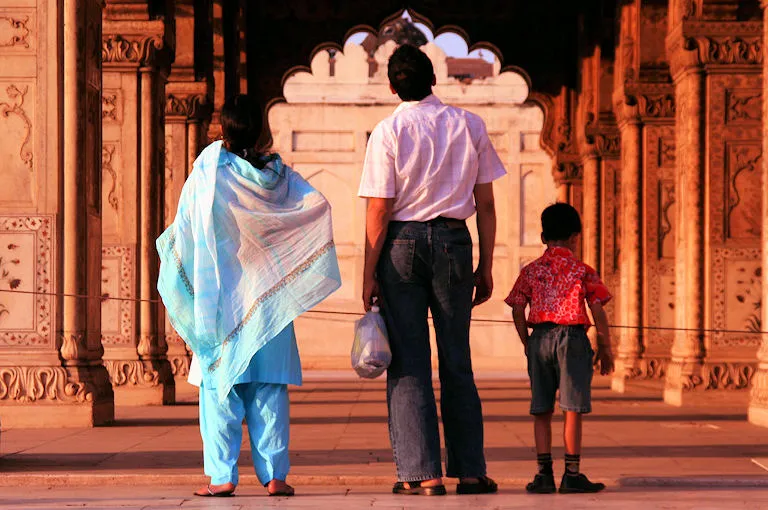
Fig.: माता, पिता, पुत्रकः
(Image source: Details)
भर्तृ m. (to भृ "to carry, to sustain"): sustainer, nourisher, husband
भार्या f., जाया f. पत्नी f.: wife (भार्या = gerundive to भृ : to be carried, to be sustained, entitled to support)
पितृ m.: father
पितृ m. plural: the deceased male ancestors, i.e.
- father, grandfather, great-grandfather
- the ancestral forefathers of humanity
Rites are performed for both, so-called श्राद्ध n. Daily, three male ancestors (paternal and maternal) are offered water and, on certain occasions, rice balls or flour balls (पिण्ड m. "balls"). This is done so that the ancestors receive food. The performance of this ceremony is one reason why a man should beget a son. Those who are connected through this पिण्ड-gift are called सपिण्ड (to whom पिण्ड is common). सपिण्ड encompasses six generations: three backwards (to the great-grandfather) and three forwards (to the great-grandson).
तात m.: papa
मातृ f.: mother
पुत्र m.: son
दुहितृ f. सुता f.: daughter
नप्तृ m.: grandson
भ्रातृ m.: Brother
स्वसृ f., भगिनी f.: Sister
देवृ m.: Brother of the husband (brother-in-law of the wife)
यातृ m.: Wife of the husband's brother
ननान्दृ f.: Sister of the husband
श्वसुर f.: Father-in-law (in ancient times: only of the wife)
श्वस्रू f.: Mother-in-law (declension follows later)
मातुल m.: Mother's brother (maternal uncle)
मातुलानी f.: Wife of the mother's brother (mother's brother's wife)
पितृव्य m.: Father's brother (paternal uncle)
पितामह m.: Paternal grandfather
पितामही f.: Paternal grandmother
मातामह m.: Maternal grandfather
मातामही f.: Maternal grandmother
42.3. Exercise
Translate:
प्रकृत्यैव यः कर्माणि क्रियमाणानि पश्यति स आत्मानमकर्तरं पश्यति ॥१॥
कृष्णस्तस्य लोकस्य पिता माता पितामहो धातास्ति ॥२॥
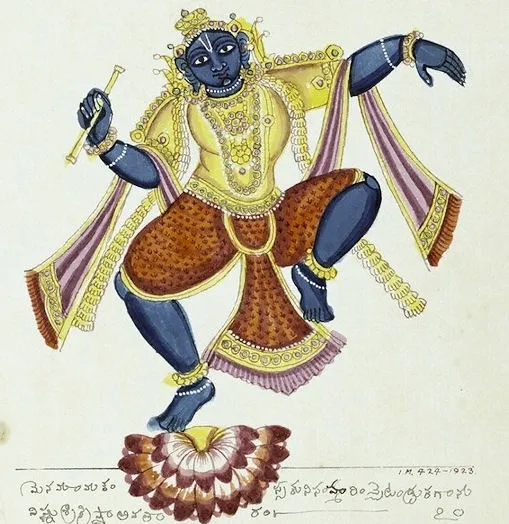
Fig.: कृष्णस्तस्य लोकस्य पिता माता पितामहो धातास्ति
(Image source: Details)
आचार्याः पितरः पुत्राश्च पितामहाः श्वशुरा नप्तरो युद्धायावस्थिताः । एतान्न हन्तुमिच्छामीत्यर्जुनो भगवद्गीतायामुवाच ॥३॥
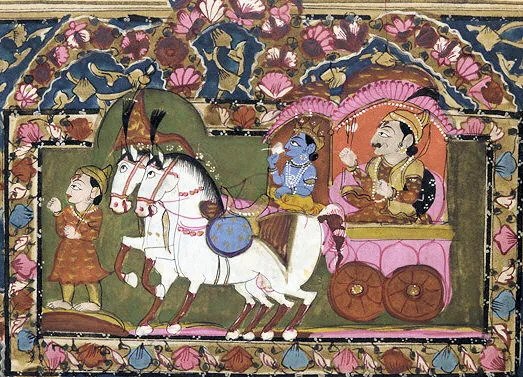
Fig.: अर्जुनो रथे सीदति । कृष्णो ऽस्य रथवाहो ऽस्ति ।
(Image source: Details)
कवयो लब्धपुत्रतायाः पितॄन्मातॄश्च तुष्टुवुः ॥४॥
भर्त्रा भार्या भर्तव्या । तस्माद्भार्येत्युच्यते ॥५॥
सत्पुत्रः पितृभ्यः पिण्डान्ददाति । पितृभिः पिण्डदानमश्यत एवं च सुखजीवो जीवितुं शक्यते ॥६॥
भ्रात्रा स्वसा न विवोड्धव्या । भातरि स्वसारं कामयमाने देवाः क्रुध्यन्ति ॥७॥
क्थं भर्तुर्भ्रातोच्यते । देवेति भर्तुर्भ्राता वक्तव्यः ॥८॥
नप्तॄणां लाभं पितैच्छत् ॥९॥
42.4. Translation Exercise
सीताविवाहः
पुरा मिथिलायां जनको नाम राजा बभूव । तस्य सुता सीता नाम । सा रूपे शीले चानुपमा बभूव । तां परिणेतुमिछ्हन्तो ऽनेके राजकुमाराः जनकाय दूतान्प्रेषयामासुः ॥
जनकस्तु तां वीर्यसम्पन्नाय क्षत्रियकुमाराय दातुमैच्छत् । अतः स तां वीर्येण क्रेतव्यामकल्पयत् । तथा हि -- तस्य सकाशे गुरुतरं किमपि धनुरासीत् । य इदं धनुरुद्धृत्यास्मिन्शरं सन्धत्ते स मम सुतां परिणेष्यतीति जनकः प्रतिजज्ञे ॥
तां तस्य प्रतिज्ञां श्रुत्वा शतशो राजकुमाराः समाजग्मुः । परं नैको ऽपि तेषां तद्धनुश्चलयितुमपि शशाक । लङ्काधिपती रावणो ऽपि साटोपं समेत्य सलज्जं प्रतिनिवृत्त इति ज्ञायते ॥
सर्वान्राजकुमारान्प्रतिवृत्तान्विलोक्य को मे दुहितुर्भर्ता भविष्यतीति चिन्तापरो बभूव जनकः । अत्रान्तरे ऽयोध्याधिपतेर्दशरथस्य पुत्रः श्रीरामः सलक्ष्मणो विश्वामित्रेण तत्रानीयत । श्रीरामो महर्षेर्विश्वामित्रस्य वचनेन लीलयैव तद्धनुरुद्धृत्य यावत्तस्मिन्बाणमारोपयति तावत्तद्धनुर्द्वेधा भग्नं बभूव ॥
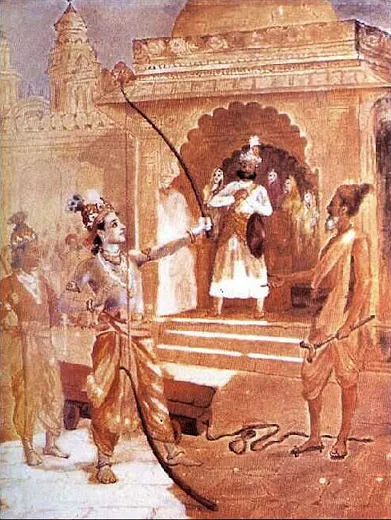
Fig.: धनुर्द्वेधा भग्नं बभूव
(Image source: Details)
साधु साध्विति श्रीरामस्य वीर्यं प्रशशंसुर्जनाः ॥
जनकस्य राज्ञो हृदयं प्रहृष्टं बभूव । ततः स दशरथादीनानाय्य महता विभवेन सीतारामयोर्विवाहोत्सवं निरवर्तयन् ॥
(संस्कृतप्रथमादर्शे)
Explanation of the red highlighted expressions:
सीता f. proper name: daughter of the king जनक from विदेह. She had emerged from the earth when the king once plowed the field, hence her name: सीता f. "furrow of the field"
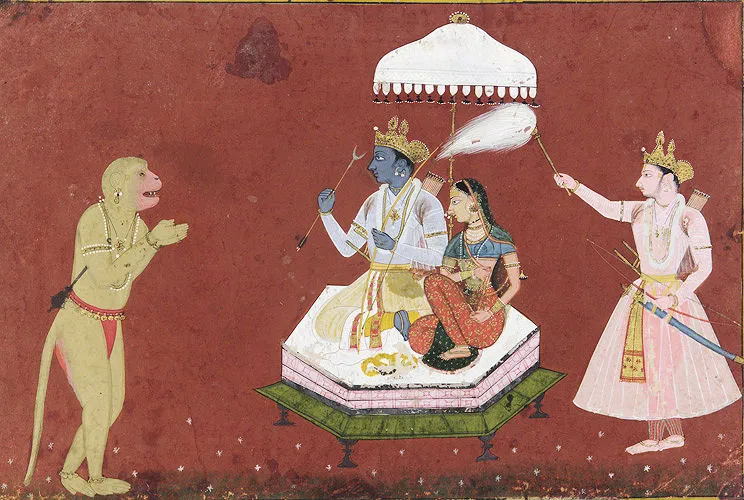
Fig.: रामः, सीता, हनुमान्, लक्ष्मनः
(Image source: Details)
मिथिला f. proper name: capital of विदेह
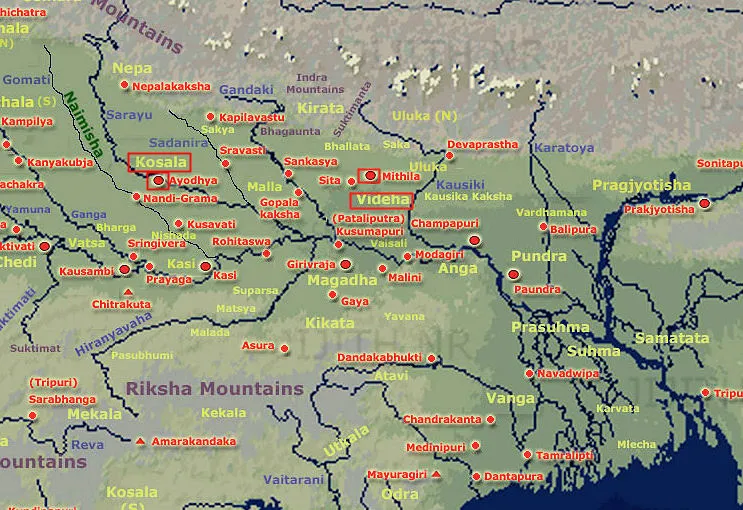
Fig.: मिथिला, विदेहः, अयोध्या, कोसलः
(Image source: Details)
जनक m. proper name: king of विदेह
गुरुतर 3: comparative to गुरु 3: heavier, very heavy
धनुस् Nom.Akk.sg.n. to धनुस् n. "bow"
शतशस् Adv.: by the hundreds
लङ्का f. proper name: identified with modern Sri Lanka (ශ්රී ලංකාව / இலங்கை)
रावण m. proper name; ruler of लङ्का, ruler of the राक्षस.
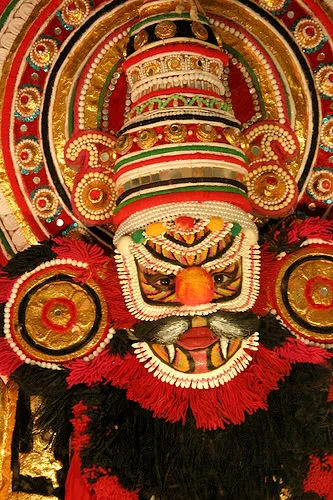
Fig.: रावणः
(Image source: Details)
अयोध्या f. proper name: capital of कोसल (see map above!)
दशरथ m. proper name: king of कोसल
राम m. proper name: son of दशरथ
लक्ष्मन m. proper name: son of दशरथ
विश्वामित्र m. proper name: ऋषि, pulled out राम and लक्ष्मन to kill demons; for this, the two receive magical weapons from him.
सीतारामयोस् Gen.Lok.Dual to सीताराम
- Fig. lekt4201: अयं बोधयिता. (Image source: Wikipedia. Public domain)
- Fig. lekt4202: माता, पिता, पुत्रकः. The Diwan I Khas, or Hall of Private Audiences at the Lal Qila (Red Fort) in Delhi. (Image source: Wen-Yan King. -- http://www.flickr.com/photos/medapt/430287982/. -- Accessed on 2009-01-04. -- Creative Commons License (Attribution, non-commercial use, share alike))
- Fig. lekt4203: कृष्णस्तस्य लोकस्य पिता माता पितामहो धातास्ति. Tiruchchirappalli = தி௫ச்சிராப்பள்ளி, ca. 1825. (Image source: Wikipedia. Public domain)
- Fig. lekt4204: अर्जुनो रथे सीदti । कृष्णो ऽस्य रथवाहो ऽस्ति । (रथ m. chariot). (Image source: Wikipedia. Public domain)
- Fig. lekt4205: रामः, सीता, हनुमान्, लक्ष्मनः. 17th century. (Image source: Wikipedia. Public domain)
- Fig. lekt4206: Location of मिथिला and विदेह, अयोध्या and कोसल. (Image source: JIJITH NR / Wikipedia. GNU FDLicense)
- Fig. lekt4207: रावणः. Yakṣagaṇa dance mask (ಯಕ್ಷಗಾನ), Karnataka (ಕರ್ನಾಟಕ). (Image source: Manohara Upadhya / Wikipedia. GNU FDLicense)
- Fig. lekt4208: धनुर्द्वेधा भग्नं बभूव. Image of राजा रवि वर्मा (1848 - 1906). (Image source: Wikipedia. Public domain)