
Lesson 54
54.1. Preliminary Remarks
With Lesson 54, the second semester begins in university instruction. From now on, the course runs only alongside the main topic of this semester: the reading of the entire Bhagavadgītā. The learning objective is such fluency in reading a medium-difficulty text that, in the last third of the semester, large parts of the Bhagavadgītā can be translated extemporaneously. At the beginning, word lists were distributed in university instruction; later, students had to use corresponding dictionaries (Monier-Williams, Apte, PW) themselves.
The course on the Bhagavadgītā will not be made available online for the time being.
The lessons of the Sanskrit course deal with topics of Sanskrit grammar that have not yet been covered.
54.2. Word Formation: कृत् Suffix -u on Desiderative Stems
On Desiderative stems (इच्छाप्रकृति) ("to wish to do something"; "to be about to do something") the suffix -u appears for the formation of nomina agentis.
(The formation of desiderative stems follows later)
Example:
युयुत्सु (yu-yudh + s + u) "eager to fight, about to fight"
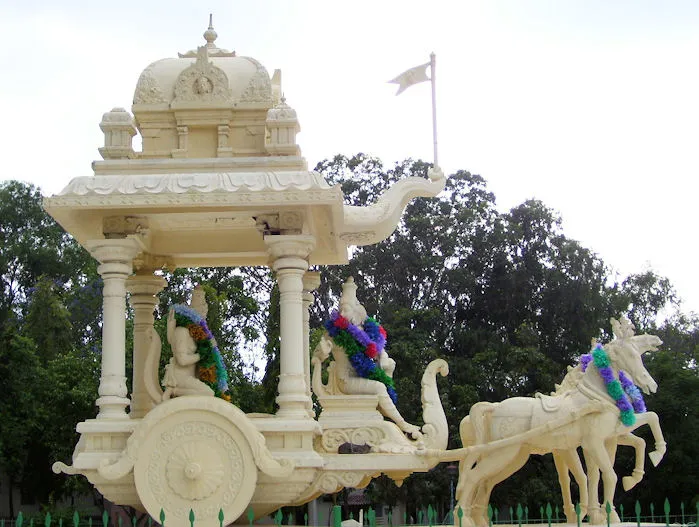
Fig.: अयुयुत्सुरर्जुनः
भगवद्गीतोपदेशः Tirupati = తిరుపతి
(Image source: Details)
54.3. Metrics II: the epic त्रिष्टुभ् and the जगती
The त्रिष्टुभ् ("Three-sigh") appears in the epics amidst the usual श्लोक sections precisely at points where mood or action experience a special surge or conclusion.
The त्रिष्टुभ् stanza consists of four eleven-syllable पाद, which do not differ from each other in structure.
The त्रिष्टुभ् has two basic schemas, depending on whether the caesura (word end, compositional boundary, or before certain suffixes like -tara, -tama, etc.) occurs after the 4th or 5th syllable of the पाद.
Schema I:
× — × — / × ◡ — — ◡ — —
Schema II:
× — × — × / × ◡ — ◡ — —
The quantity of the last four syllables is therefore the same in both schemas.
जगती basic form: like त्रिष्टुभ्, but 12-syllabic. The last 5 syllables of each Pada exhibit the following quantities:
— ◡ — ◡ —
In addition, there is the so-called typically superfluous त्रिष्टुभ् with a five-syllable initial part, which continues like a त्रिष्टुभ् with a four-syllable initial part:
— × — × / × ◡ — — ◡ — —
In later times, the forms of the त्रिष्टुभ् are established according to a strict schema of long and short syllables; the caesura no longer plays a role. The most important later forms are:
a) इन्द्रवज्रा
— — ◡ — , — ◡ ◡ — ◡ — —
b) उपेन्द्रवज्रा
◡ — ◡ — , — ◡ ◡ — ◡ — —
c) उपजाति
पाद in इन्द्रवज्रा and पाद in उपेन्द्रवज्रा are mixed into a stanza.
Memorization Verses:
स्यादिन्द्रवज्रा यदि तौ जगौ गः ।
"It is an Indravājrā if the syllables in all Pādas are ta ta ja ga ga.
उपेन्द्रवज्रा प्रथमे लघौ सा ।
"An Upendravajrā is like an Indravajrā that has a light syllable at the beginning"
अनन्तरोदीरितलक्ष्मभाजौ
पदौ यदीयावुपजातयस्ताः ।
इत्थं किलान्यास्वपिमिश्रितासु
वदन्ति जातिष्विदमिदमेवनाम ॥
"If two Pādas, which have the characteristics of Indravajrā or Upendravajrā, are involved in a verse, then they are Upajātis. Even if other meters are mixed in a verse, it is called Upajāti."
54.4. Exercise on Metrics
Determine Triṣṭubhs and Jagatīs in Bhagavadgītā II.
Example of a recitation: http://www.vaisnava.cz/gita/mp3/Bhagavad-gita02.mp3. -- Accessed on 2009-01-28
54.5. लुङ्लकारस्य रचनाप्रकाराः
What is common to all formation types of the Aorist (लुङ्) is the Augment a-, which is prefixed according to the same rules as in the Imperfect (लङ्).
In Sanskrit, only the Indicative and Prekative of the Aorist are in use.
The following formation types of the Aorist (लुङ्) exist:
- Non-sibilant (asigmatic) Aorists:
- 54.1. Root Aorist: Augment + Root + Secondary Ending
- 54.2. Thematic Vowel Aorist: Augment + Root + a + Secondary Ending
- 54.3. Reduplicated Aorist: Augment + reduplicated Root + a + Secondary Ending
- Sibilant (sigmatic Aorists: s or a syllable containing s (ṣ) precedes the personal ending
- 54.4. -s-Aorist: Augment + Root + s + Secondary Ending
- 54.5. -iṣ-Aorist: Augment + Root + i + ṣ + Secondary Ending
- 54.6. -siṣ-Aorist: Augment + Root + siṣ + Secondary Ending
- 54.7. -sa-Aorist: Augment + Root + s + a + Secondary Ending
Distribution of roots among the individual formation types can be found under the individual types
54.6. धातु-लुङ्
Formation:
Augment + Root + Secondary Ending
Ending of the 3.pl.P is -ur. Ātmanepada is not in use.
Example:
पा 1P "to drink"
| एकवचनम् | बहुवचनम् | |
|---|---|---|
| 1. तृतीयः | अपाम् a-pā + am | अपाम |
| 2. मध्यमः | अपास् | अपात |
| 3. प्रथमः | अपात् | अपुर् a-p-ur (Tiefstufe!) |
The Root Aorist is formed from only 12 roots:
- गा 3 "to go"
- घ्रा 1P "to smell"
- छो 6 "to cut" (अच्छात्)
- दा 3U "to give"
- दो 1, 4 "to cut"
- धा 3U "to place"
- धे 1 "to suck" (अधात्)
- पा 1P "to drink"
- शो 4P "to sharpen"
- सो "to finish"
- स्था 1P "to stand"
- भू 1P "to be"
The Root Aorist for भू 1P is formed as follows:
| एकवचनम् | बहुवचनम् | |
|---|---|---|
| 1. तृतीयः | अभूवम् | अभूम |
| 2. मध्यमः | अभू्स् | अभूत |
| 3. प्रथमः | अभूत् | अभूवन् (!!!) |
54.6.1. कर्मणि तृतीयपुरुषैकवचनस्य लुङ्
A special form of the root aorist is the 3rd person singular passive. This can be formed from all roots.
Formation:
Augment + Root + i
The root has the following form:
Strong grade:
- Roots with a short vowel (except a) before a simple consonant as well as जन् and most roots ending in -am
Examples:
भिद् 7U: अभेदि "he was split"
तुद् 6U: अतोदि "he was pushed"
Guṇa grade:
Roots with a final vowel
Examples:
नी 1U: अनायि "he was led"
स्तु 2U: अस्तावि "she was praised"
कृ 8U: अकारि "it was made"Roots with a before a simple consonant (except जन् and roots ending in -am)
Example:
वद् 1P: अवादि "it was said"
but:
जन् 4Ā: अजनि "she was born"some roots ending in -am
Example:
गम् अगामि
Insertion of y before the ending:
- Roots ending in -ā, -e, -ai, -o insert a y between the -ā of the root and the ending:
Example:
दा 3U: अदायि "it was given"
Nasal infix:
- some roots have a nasal infix:
Example:
लभ् 1Ā: अलम्भि alongside अलाभि : "it was received"
(The other forms of the passive are rendered in the aorist through Ātmanepada forms).
54.7. Exercise
Translate the following forms in writing and form the corresponding aorist forms:
- यन्ति
- पिबामि
- ददौ
- बभूव
- दधति
- ऐम
- पपिथ
- तिष्ठति
- इयेथ
- पप
- एष्यथ
- तस्थुः
- अधत्त
- अददाः
- अभवन्
- ददिम
- भिद्यते
- उद्यते
- स्तूयते
- कृष्यते
- जायते (Pass.)
- गीयते
- गम्यते
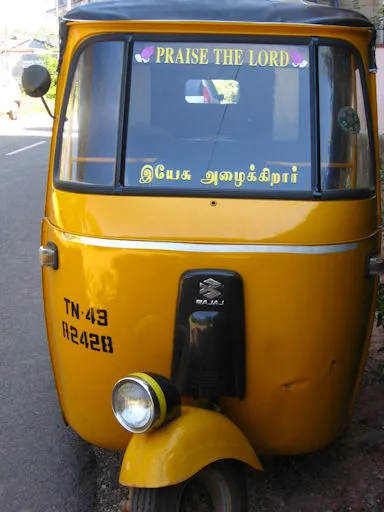
Fig.: त्रिचक्रेणेश्वरः स्तूयते
Tamil Nadu
(Image source: Details)
lekt5402: भगवद्गीतोपदेशः Tirupati = తిరుపతి [Image source: Raji Srinivas / Wikipedia. GNU FDLicense]
lekt5401: Tamil Nadu [Image source: driek. -- http://www.flickr.com/photos/driek/2411004380/. -- Accessed on 2009-01-28. -- Creative Commons License (Attribution, non-commercial use, share alike)]