
Lesson 23
23.1. The Infinitive (तुमुन्)
If one wishes to express in Sanskrit that an action is performed for the sake of another action ("in order to"), one can use the infinitive (तुमुन्) for the action for whose sake it is performed. The infinitive primarily denotes purpose or intention:
रामो गुरुवचनं श्रोतुं गतः = "Rāma has gone to hear the teacher's speech."
Note that the infinitive — with a few strictly defined exceptions — cannot stand as the subject or object of a verb:
"He learns to dance" must therefore not be translated with the infinitive ("to dance"), but one must use a verbal noun, e.g.: नर्तनमधीते (इ + अधि 2 Ā: "to learn").
The infinitive is also used with verbs and nouns meaning "to wish" or "to long for," when the agent (कर्तृ) of the infinitive and the verb are identical:
रामो गुरुवचनं श्रोतुमिच्छति = "Rāma wishes to hear the teacher's speech."
The infinitive is also used, among other things, with verbs meaning "to be able," "there is," "to know," "to begin":
साधुरधर्मं कर्तुं न शक्नोति = "A saint cannot do wrong."
अस्ति भोक्तुमन्नम् = "There is food to eat" (भुज् 7: Ā: to eat, P: to rule)
The infinitive is also used with words meaning "sufficient," "able," and with nouns meaning "ability," "power," "skill":
अस्त्यग्नेर्विभवः सर्वं दग्धुम् = "Fire has the power to burn everything."
The infinitive can also be used with words meaning "time" in expressions such as "It is time to ...":
कालो भोजनं सेवितुम् = "It is time to devote oneself to eating" = "It is time to eat"
The infinitive can be used actively and passively. A passive infinitive in German is rendered in Sanskrit by putting the verb (especially frequently शक् "to be able, can"), from which the infinitive depends, into the passive voice.
Regarding the object, the infinitive behaves like a verbal form, i.e., the direct object (कर्मन्) stands in the accusative (द्वितीया) when the infinitive is used actively, or in the case required by the relevant verb; when the infinitive is used passively, the direct object stands in the nominative.
e.g.
साधुरधर्मं कर्तुं न शक्नोति = साधुनाधर्मः कर्तुं न शक्यते = "A saint cannot do wrong."
In the 2nd person, अर्ह् + infinitive is often used as a mild command: "You should."
When the infinitive depends on a noun, it must not be combined with it into a compound. Exceptions are Bahuvrīhis, whose second member is काम or मनस्:
वक्तुकामः = वक्तुं कामो यस्य सः = "one whose wish it is to speak; one who wishes to speak".
23.2. Formation of the Infinitive (तुमुन्)
or
or
guṇa-grade root + -i- + -tum
Final consonants of the root are modified before -tum according to the same rules as before the -ta of the PPP.
Verbs with prefixes form the infinitive in the same way as simple roots.
Examples:
दिश् : देष्टुम्
रुद् : रोदितुम्
No fixed rules can be established regarding the use of the connecting vowel -i-. Essentially, the distribution of the connecting vowel in the infinitive corresponds to that in the future tense.
The following infinitives are particularly noteworthy for the roots learned so far:
गम् : गन्तुम्
प्रच्छ् : प्रष्टुम्
-ra- als Hochstufe zu -ṛ- haben im Infinitiv:
दृश् : द्रष्टुम्
सृज् : स्रष्टुम्
Die anderen Wurzeln mit -ṛ- an vorletzter Stelle haben fakultativ -ra- oder -ar-, wenn sie aniṭ sind.
23.3. The Infinitive (तुमुन्) for the roots learned so far
अद् 2P अत्तुम्
अश् 5Ā अशितुम् । अष्टुम्
अस् 2P —
अस् 4P असितुम्
आप् 5P आप्तुम्
आस् 2Ā आसितुम्
इ 2P एतुम्
इष् 6P एष्टुम् । एषितुम्
कुप् 4P कोपितुम्
कृ 8U कर्तुम्
कृष् 1P कर्ष्टुम् । क्राष्टुम्
कृष् 6U कर्ष्टुम् । क्राष्टुम्
क्रुध् 4P कोद्धुम्
खाद् 1P खादितुम्
गम् 1P गन्तुम्
जन् 4Ā जनितुम्
जि 1P जेतुम्
जीव् 1P जीवितुम्
तन् 8U तनितुम्
दह् 1P दग्धुम्
दिश् 6U देष्टुम्
दुष् 4P —
दुह् 2U दोग्धुम्
दृश् द्रष्टुम्
द्विष् 2U द्वेष्टुम्
नी 1U नेतुम्
नृत् 4P नर्तितुम्
पच् 1U पक्तुम्
पद् 4Ā पत्तुम्
पा 1P पातुम्
पा 2P पातुम्
प्रच्छ् 6P प्रष्टुम्
बुध् 1U, 4Ā बोधितुम् । बोद्धुम्
ब्रू 2U —
भज् 1U भक्तुम्
भू 1P भवितुम्
मन् 4Ā मन्तुम्
मुच् 6U मोक्तुम्
मुह् 4P मोहितुम् । मोग्धुम् । मोढुम्
मृ 4Ā मर्तुम्
यज् 1U यष्टुम्
युध् 4Ā योद्धुम्
रक्ष् 1P रक्षितुम्
रुद् 2P रोदितुम्
लभ् 1Ā लब्धुम्
लुभ् 4P लोभितुम्
वच् 2P वक्तुम्
वद् 1P वदितुम्
विश् 6P वेष्टुम्
वृत् 1Ā वर्तितुम्
श्रु 5P श्रोतुम्
सद् 1P सत्तुम्
सह् 1Ā सहितुम् । सोढुम्
सिच् 6U सेक्तुम्
सु 5U सोतुम्
सृज् 6P स्रष्टुम्
स्तु 2U स्तोतुम्
स्था 1P स्थातुम्
स्मृ 1P स्मर्तुम्
हन् 2P हन्तुम्
23.4. Vocabulary
समान ३: equal
सामान्य n.: equality, agreement
अधिक ३ : superfluous, additional, greater, better, extraordinary
विशेष m.: peculiarity, specification, differentia specifica
23.5. Exercise
A) The following roots form the infinitive without the connecting vowel -i-. Form the infinitive, observing the sound changes to:
- आप्
- इ
- गम्
- कृ
- क्रुध्
- जि
- duh (दुह्)
- दिश्
- दह्
- सृज्
- द्विष्
- नी
- पद्
- पा १
- पा २
- भज्
- कृष्
- सु
- मन्
- मुच्
- मृ
- यज्
- युध्
- वच्
- विश्
- श्रु
- प्रच्छ्
- सिच्
- स्तु
- स्था
- स्मृ
- हन्
- लभ्
- अद्
- दृश्
- पच्
- सद्
B) The following roots form the infinitive with the connecting vowel -i-. Form the infinitive for:
- आस्
- नृत्
- रक्ष्
- रुद्
- वद्
- वृत्
- कुप्
C) The following roots optionally with or without connecting vowel:
- अश्
- इष्
- बुध्
- मुह् (3 forms!)
- सह्
D) Translate and resolve the compounds:
नराः स्वर्गं लब्धुं देवान्यज्ञैर्यष्टुमिच्छन्ति ॥१॥
महापुण्यं कृत्वा गतपापजनेन नरकं गन्तुं न शक्यते ॥२॥
फलवन्ति पुण्यानीति सज्जनो ऽधर्मं कर्तुं नेच्छति ॥३॥
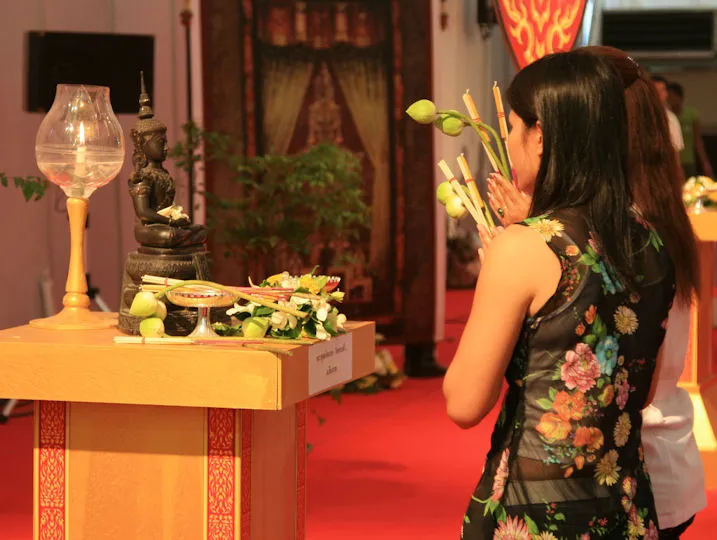
Fig.: फलवन्ति पुण्यानीति
Making merit = पुण्यकरणम्, Thailand = ประเทศไทย
(Image source: Details)
सुगतो लोकान्मोक्तुमार्यसत्यान्युपदिशति ॥४॥
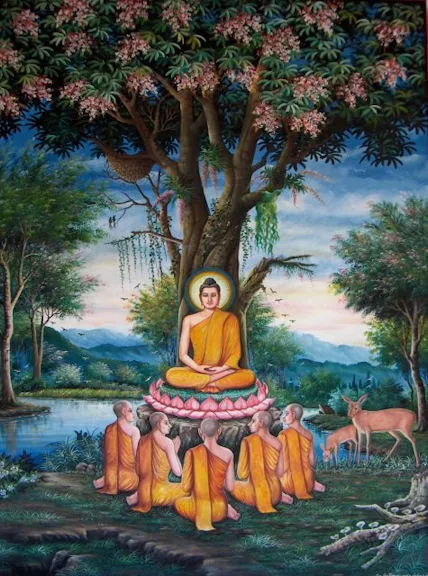
Fig.: सुगतो लोकान्मोक्तुमार्यसत्यान्युपदिशति
Chiang Mai, Thailand = เชียงใหม่, ประเทศไทย
(Image source: Details)
शूद्रजनो ब्राह्मणेन सह अत्tuम (अत्तुम्) नार्हति ॥५॥
लोभसम्पन्ननरा नृत्यन्तीं सम्पन्नरूपदासीं द्रष्टुं गताः ॥६॥
शूद्रया संगत्य ब्राह्मणो यष्टुं नार्हति ॥७॥
धर्मं श्रोतुकामा ब्राह्मणी सपुत्रा गुरुं द्रष्टुं महानगरं गता ॥८॥
C) Translate the following सुभाषितम्
आहारनिद्राभयमैथुनं च
सामान्यमेतत्पशुभिर्नराणाम् ।
धर्मे हि तेषामधिको विशेषो
धर्मेण हीनाः पशुभिः समानाः ॥
Explanation: हीन ३: PPP to हा 3: to leave ; धर्मे = locative sg. "in the ..."
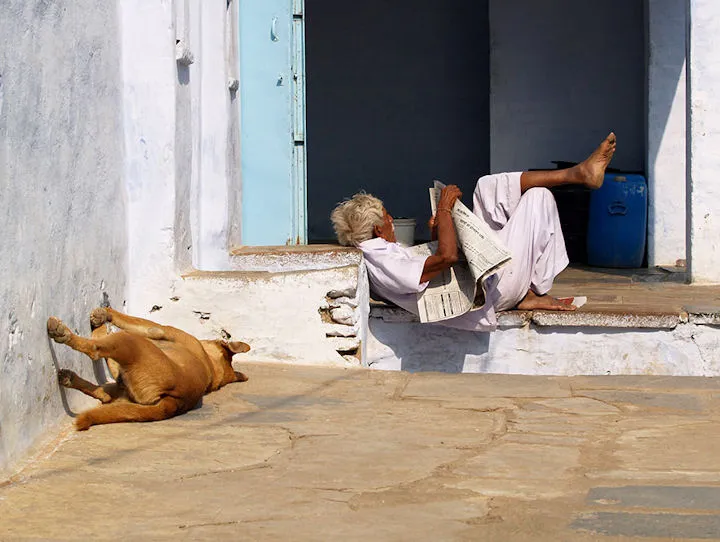
Fig.: आहारनिद्राभयमैथुनं च
Chittorgarh = चित्तौडगढ
(Image source: Details)
23.6. Review Exercise
Please do not use any aids!
A) Translate into Sanskrit:
1. The five (पञ्च) "torments" are: ignorance, false belief in the self, attachment, aversion, and clinging to the body.
2. Knowledge is acquired through obedience to a teacher, for great wealth, or in exchange for knowledge. A fourth type of acquiring knowledge does not exist.
3. A low person speaks but does not act; a good person does not speak, but acts only.
4. The auxiliary sciences of the Veda are: phonetics, ritualistics, grammar, semantics, metrics (छन्दस्), and calendar science.
5. Yoga is the cessation of the activities of the thinking organ.
6. Right prevails, not wrong; truth prevails, not falsehood; patience prevails, not anger; God prevails, not a counter-god. (Passive)
7. The "staff" brings about the acquisition and secure possession of philosophy, Veda, and economics. The wielding of this staff is politics.
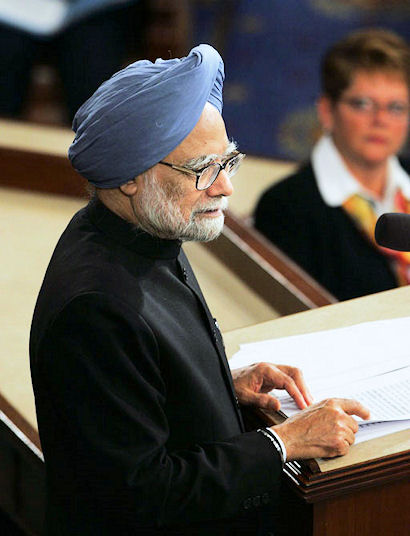
Fig.: दण्डनीतिः
Manmohan Singh = ਮਨਮੋਹਨ ਸਿੰਘ = मनमोहन सिंह, Prime Minister of India = भारत के प्रधानमन्त्री, since 2004
(Image source: Details)
8. Wife, son, and slave, these three (त्रयस्) are according to tradition without property. Whatever these come to, that belongs to the one to whom these (three) belong.
9. Mosquitoes desire a wound, rulers desire property, low persons desire conflict, good persons desire peace.
10. The specific duty of a Brāhmaṇa is: study, teaching, sacrificing as the officiant, sacrificing on behalf of others, giving and receiving; that of a Kṣatriya is: study, sacrificing as the officiant, giving, livelihood by means of weapons, protecting beings; that of a Vaiśya: study, sacrificing as the officiant, giving, agriculture, animal husbandry, and trade; that of a Śūdra: obedience to the twice-born, economic activity, work (कर्म) of craftsmen and performers.
11. Clarification of consciousness occurs on account of the meditative unfolding of loving-kindness, compassion, sympathetic joy, and equanimity, which have happiness and suffering, good and evil as objects.
12. The poor have many sons, although they do not desire them. The rich have no son. Strange is the stirring of fate.
13. Whom does not strike a woman's body (वपुस् n.) with slender waist, broad hips, red lips, black eyes, curved navel, upright breasts.
B) Decline in all cases known to you क्षत्रिया f.
C) Provide the stem forms (meaning, present class, mood, 3rd sg. present indicative, 3rd sg. passive, PPP, absolutes, infinitive) for the following verbs:
१. सह्
२. पा (2x)
३. वच्
४. हन् ॥
lekt2301: Chiang Mai, Thailand = เชียงใหม่, ประเทศไทย [Image source: Wikipedia. GNU FDL license]
lekt2302: Chittorgarh = चित्तौडगढ [Image source: by zz77. -- http://www.flickr.com/photos/zz77/2256200876/. -- Accessed on 2008-12-13. -- Creative Commons License (Attribution, non-commercial use, no derivatives)]
lekt2303: ทำบุญ = पुण्यकरणम्, Thailand = ประเทศไทย [Image source: Y-Not ?. -- http://www.flickr.com/photos/36716657@N00/519798246/. -- Accessed on 2008-12-13. -- Creative Commons License (Attribution, no derivatives)]
lekt2304: Manmohan Singh = ਮਨਮੋਹਨ ਸਿੰਘ = मनमोहन सिंह, Prime Minister of India = भारत के प्रधानमन्त्री, since 2004 [Image source: Wikipedia, Public domain]