
Lesson 19
19.1. The Relative Clause
Schema:
Relative pronoun -- relative clause containing the noun to which the relative clause refers -- (demonstrative pronoun) -- main clause
The relative clause can also stand after the main clause, but it cannot be inserted into the main clause.
The relative pronoun and the word it refers to, which — in contrast to German — stands in the relative clause, are in the case that the relative clause syntactically requires. The demonstrative pronoun is in the case that the main clause syntactically requires.
Examples:
Note: In relative clauses of general validity, the optative is often used instead of the indicative. Many of our examples would therefore preferably be in the optative.
1. The agent (कर्तृ) of the sentence is specified further by a relative clause:
यो नरः पुण्यं करोति स स्वर्गं गच्छति = यो नरः पुण्यं करोति तेन स्वर्गं गम्यते = येन नरेण पुण्यम् क्रियते तेन स्वर्गं गम्यते etc. = "A man who does meritorious deeds goes to heaven."
2. The direct object (कर्म) of the main clause is specified further by the relative clause:
यो ब्राह्मणो देवान्यजते तं देवा रक्षन्ति = "The gods protect a Brahmin who sacrifices to them as the sacrificer."
3. The specification of a noun of the main clause stands in the relative clause:
ये नराः पापं कुर्वन्ति तेषां पुत्रा धनं न लभन्ते = "Sons of men who do evil do not obtain wealth."
4. Relative pronoun and word it refers to are in the genitive (षष्ठी):
यस्य नरस्य पुत्राः पापं कुर्वन्ति स न सुखवान् = "The man is not happy whose sons do evil."
5. Relative pronoun and word it refers to are in the instrumental (तृतीया):
येन शत्रुणा ग्रामो जितस्तं द्विषन्ति = "They hate the enemy who has conquered / captured their village."
6. Relative pronoun and word it refers to are in the accusative (द्वितीया):
यं नरं देवी रक्षति स सुखमाप्नोति = "A man whom the goddess protects attains happiness."
19.2. The relative pronoun = व्यपेक्षकसर्वनाम n.
यद् "who, which, that" declined like तद्, but with regular sandhi.
| Masculine पुंस् | Neuter नपुंसक | Feminine स्त्री | ||
|---|---|---|---|---|
| Singular एकवचन | 1. Nominative प्रथमा | yas यस् | yad यद् | yā या |
| 2. Accusative द्वितीया | yam यम् | yad यद् | yām याम् | |
| 3. Instrumental तृतीया | yena येन | yena येन | yayā यया | |
| 6. Genitive षष्ठी | yasya यस्य | yasya यस्य | yasyās यस्यास् | |
| Plural बहुवचन | 1. Nominative प्रथमा | ye ये | yāni यानि | yās यास् |
| 2. Accusative द्वितीया | yān यान् | yāni यानि | yās यास् | |
| 3. Instrumental तृतीया | yais यैस् | yais यैस् | yābhis याभिस् | |
| 6. Genitive षष्ठी | yeṣām येषाम् | yeṣām येषाम् | yāsām यासाम् |
As the first member of compounds, the stem appears यद् (observing sandhi).
19.3. Word List
अर्थ m.: purpose, goal, meaning (of a word), wealth, property, assets. अर्थम् (Acc.), अर्थेन (Instr.) with Gen. or as the second member of a Tatpuruṣa compound: for the sake of ..., in order to.
अर्थ is one of the three goals of life (पुरुषार्थ), as described in secular and religious literature:
धर्म m.: acquisition of merit through doing what is right, or at least avoiding evil, which would result from non-observance of dharma
अर्थ m.: purposeful behavior, acquisition of prosperity
काम m.: sensual pleasure, esp. also in the sexual sphere
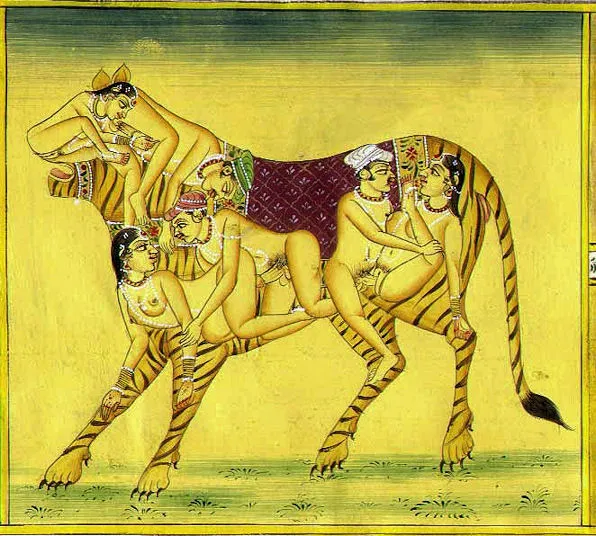
Fig.: कामः
Illustration to the कामसूत्र
(Image source: Details)
स्था 1 P तिष्ठति Pass. स्थीयते PPP. स्थित : to stand, to remain, to persist, to be located. (Traditionally counted among the 1st present class, although it is a reduplicating thematic present class, as पा 1 पिबति)
स्था + उप 1 U उपतिष्ठति : to approach, to place oneself in a respectful posture before someone
स्था + प्र 1 Ā प्रतिष्ठते : to break up, to depart
from स्था :
स्थान n.: place, (right) location, site
स्थिति f.: staying, steadfastness, persistence
गर्भ m.: womb, lap, interior, embryo / fetus. At the end of a Bahuvrīhi compound often: "interior", e.g.
धनगर्भ 3: "whose interior is money = in which money is located"
गर्भगृह n.: the innermost sanctum of a Hindu temple, which contains the most important deity image of the temple (for the construction of Hindu temples see: Volwahsen, A.: India : Buildings of the Hindus, Buddhists and Jains. -- Munich, 1968)
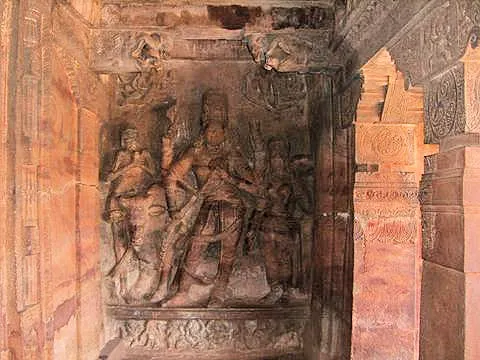
Fig.: गर्भगृहम्
Badami (ಬದಾಮಿ)
(Image source: Details)
वारिद m.: water-bearer = rain cloud

Fig.: वारिदः
Goa (गोंय)
(Image source: Details)
वा 2 P वाति Pass. वायते PPP. वान / वात : to blow
from this:
वात m.: wind
वह् 1 U वहति Pass. उह्यते PPP ऊढ : to lead, to drive (transitive)
छत्त्र n.: sunshade, umbrella
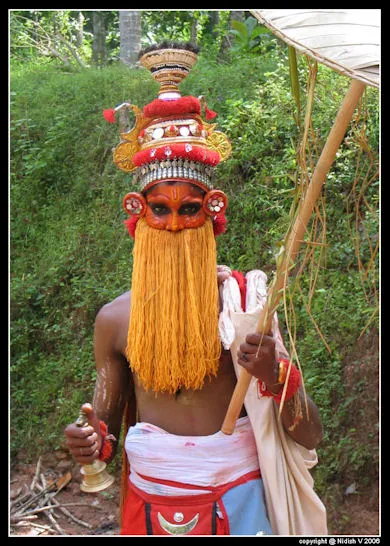
Fig.: छत्त्रम्
"Onappottan (ഓണപ്പൊട്ടന്), in traditional costume is a custom in sourthern parts of Kerala. Onappottan visists houses during the onam and gives blessings. Off late onappottan has become a rare sight, confined to villages."
(Image source: Details)
पण्डित m.: scholar, sage; 3: clever, knowledgeable (in)
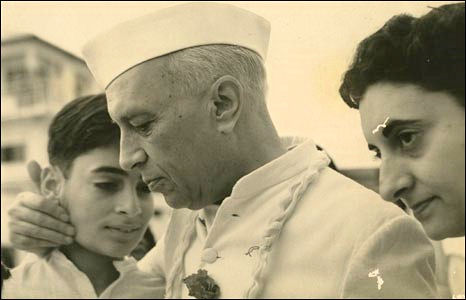
Fig.: पण्डितः जवाहरलाल नेहरू
१९५९
(Image source: Details)
सेव् 1 Ā सेवते Pass. सेव्यते PPP सेवित : reside with, inhabit (Acc., Loc.); visit, go to (Acc.); serve, tend, worship; practice, use; attend, have sexual intercourse
नि Prefix: down, into
सेव् + नि 1 Ā निषेवते : reside with, inhabit, visit
अमुत्र : there, in the other world
इह : here, in this world
विद् 6 U विन्दति Pass. विद्यते PPP विन्न / वित्त : find
भार्या f.: one to be maintained = wife
प्रिय 3: dear, pleasant
मित्र n. (!): friend
बान्धव m.: relative
हि : for, indeed (must never stand at the beginning of a sentence)
19.4. Exercise
Translate into Sanskrit:
1. The Vaiśyā woman, whose son has died, weeps.
2. Rāma sacrifices to the deity who protects him.
3. The poet praises the Kṣatriya, whose wealth he desires.
4. Fire burns the house of the man who does not honor Agni with a sacrifice.
5. The tiger-like man strikes down the Kṣatriya warriors who have been defeated by Rāma (Passive).
19.5. सुभाषितानि
Translate:
येन येन च वातेन
वारिदो वारि मुञ्चति ।
तेन तेन च वातेन
छत्रं वहति पण्डितः ॥१॥
Explanation: वारि Nom., Acc. sg. from वारि n.: water
यो धर्ममर्थं कामं च
यथाकालं निषेवते ।
धर्मार्थकामसंयोगं
सो ऽमुत्रेह च विन्दति ॥२॥
Explanation: यथाकालम् Avyayībhāva compound: at the right time; always, whenever the right time is present.
सा भार्या या प्रियं ब्रूते
स पुत्रो यस्तु जीवति ।
स जीवति गुणो यस्य
धर्मो यस्य स जीवति ॥३॥
यस्यार्थास्तस्य मित्राणि
यस्यार्थास्तस्य बान्धवाः ।
यस्यार्थाः स पुमांल्लोके
यस्यार्थाः स हि पण्डितः ॥४॥
Explanation: पुमान् Nom. sg. from पुंस् "man"; लोके Locative sg. from लोक m.: in the ...
lekt1809: Illustration to कामसूत्र [Image source: Wikipedia, Public domain]
lekt1901: Badami (ಬದಾಮಿ) [Image source: Sudarshan Bhat Khandige / Wikipedia, Public domain]
lekt1902: Goa (गोंय) [Image source: pichenettes. -- http://www.flickr.com/photos/_pichenettes_/1257016116/. -- Accessed on 2008-12-08. -- Creative Commons License (Attribution, Non-commercial, No derivatives)]
lekt1903: १९५९ [Image source: Wikipedia, Public domain]
lekt1904: "Onappottan (ഓണപ്പൊട്ടന്), in traditional costume is a custom in sourthern parts of Kerala. Onappottan visists houses during the onam and gives blessings. Off late onappottan has become a rare sight, confined to villages." [Image source: Captain Nidish. -- http://www.flickr.com/photos/captain_nidish/280389572/. -- Accessed on 2008-12-08. -- Creative Commons License (Attribution)]