
Lesson 3
In this lesson, you will learn:
- the nominative singular of the feminine
- the nominative plural of the masculine and feminine
- the formation of feminines from masculines
- vowel sandhi
- Satzsandhi von -ās
3.1. स्त्रीलिङ्गस्य प्रथमैकवचनम्
3.1.1. स-कारान्तं प्रथमैकवचनम्
The following nominal stems, which end in a vowel, also form the nominative singular with -s:
- Feminines in -i: e.g., śruti f. "hearing" -- Nom. sg.: śrutis = श्रुतिस्
- Feminines in -u: e.g., dhenu f. "milch cow" -- Nom. sg.: dhenus = धेनुस्
3.1.2. प्रत्ययहीनं प्रथमैकवचनम्
The nominative singular is formed without an ending:
- Feminines in -ā: e.g., devatā f. "deity" -- Nom. sg.: devatā = देवता
- Feminines in -ī: e.g., devī f. "goddess" -- Nom. sg.: devī = देवी
Attention! In addition, there are monosyllabic feminine root nouns in -ī, whose nominative singular ends in -s: e.g., dhī f. "thought" -- Nom. sg.: dhīs = धीस्. Also lakṣmī (लक्ष्मी) f., tarī (तरी) f. "boat" and tantrī (तन्त्री) f. "string" form the nominative singular irregularly with -s: lakṣmīs = लक्ष्मीस्.
3.2. Formation of Feminines from Masculines
Masculines in -a:
- Feminine in -ā: e.g., kṣatriya m. » kṣatriyā f. "Kṣatriya woman" = क्षत्रिया
- Feminine in -ī: e.g., brāhmaṇa m. » brāhmaṇī f. "Brahmin woman" = ब्राह्मणी
Masculines in -u:
- Feminine in -ī: e.g., sādhu m. » sādhvī f. (good, holy woman) = साध्वी
(-u- becomes -v- before a vowel, hence -u- + -ī » -vī)
3.3. पुंल्लिङ्गस्त्रीलिङ्गयोः प्रथमाबहुवचनम्
The ending of the nominative plural in the masculine and feminine is -as.
- Masculines in -a: deva- + -as » devās = देवास्
- Feminines in -ā: devatā- + -as » devatās = देवतास्
- Masculines in -i: kavi- » kave- + -as » kavayas = कवयस्
- Feminines in -i: śruti- » śrute- + -as » śrutayas = श्रुतयस्
- Feminines in -ī: devī- + -as » devyas = देव्यस्
- Masculines in -u: guru- » guro- + -as » guravas = गुरवस्
- Feminines in -u: dhenu- » dheno- + -as » dhenavas = धेनवस्
Note: e is the strong grade (guṇa) of i, o is the strong grade of u.
3.4. Vowel Sandhi
Simple vowels that differ only in length, or not at all, "merge" into the corresponding long vowel:
- -a / -ā + a- / ā- » -ā-
- -i / -ī + i- / ī- » -ī-
- -u / -ū + u- / ū- » -ū-
- (-ṛ + ṛ- » -ṝ-)
e.g.
devatā + annapūrṇā » devatānnapūrṇā "Annapūrṇā is a deity" = देवतान्नपूर्णा
(Annapūrṇā is the goddess of food and cooking; she is considered an embodiment of Pārvatī, the consort of Śiva.)
devī + indrāṇī » devīndrāṇī "Indrāṇī is a goddess" = देवीन्द्राणी
(Indrāṇī is the consort of the god Indra.)
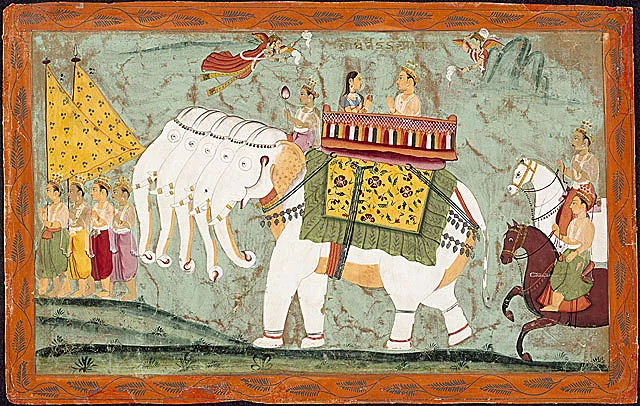
Fig.: Indra and Indrāṇī on the elephant Airavata, miniature, Rājasthān, 1670/80
(Image source: Details)
Simple vowels (except -a / -ā) are replaced by the corresponding semivowel before dissimilar vowels:
- -i / -ī » -y-
- -u / -ū » -v-
- -ṛ » -r-
(!! There are exceptions to this rule, particularly for dual forms !!)
e.g.
devī + umā » devy umā "Umā is a / the goddess" = देव्युमा
(Umā is a name for Pārvatī, the consort of Śiva)
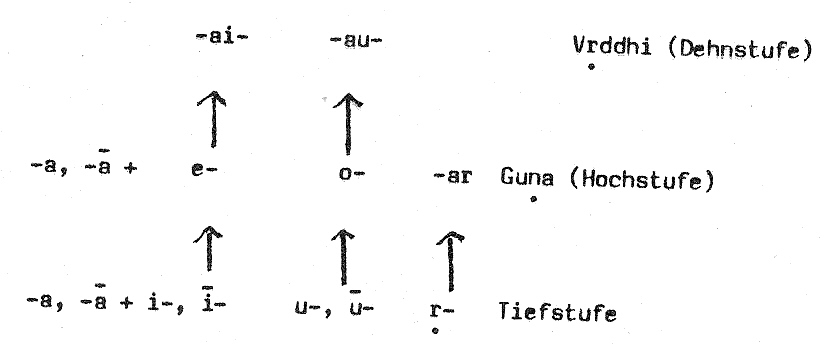
-a / -ā before a dissimilar vowel:
- -a / -ā + i- / ī- » -e-
- -a / -ā + ṛ- » -ar-
- -a / -ā + e- / ai- » -ai-
- -a / -ā + o- / au- » -au-
For this Sandhi, the following scheme applies:
(Image source: Details)
See later regarding this so-called stem gradation!
e.g.
śūdrā + itarā » śudretarā "Itarā is a Śūdra woman" = शूद्रेतरा
3.5. Sentence Sandhi of -ās
-ās wird vor allen stimmhaften Lauten durch -ā ersetzt.
e.g.
dvijās + vaiśyāḥ » dvijā vaiśyāḥ "Vaiśyas are twice-born" = द्विजा वैश्याः
3.6. Word List
Learn the following words:
śruti f. = श्रुति : hearing, the eternal tradition (designation for the Vedas and Brāhmaṇa's).
smṛti f. = स्मृति : recollection, memory, meditative recollection = mindfulness, tradition (counter-concept to śruti). Encompasses:
- the six vedāṅga n. (वेदाङ्ग)
- śikṣā f. (शिक्षा): correct pronunciation
- chandas n. (छन्दस्): meter
- vyākaraṇa n. (व्याकरण): grammar
- nirukta n. (निरुक्त) : word explanation, etymology
- jyotiṣa n. (ज्योतिष) : astronomy, calendar science
- kalpa m. (कल्प) : ritual
- śrautasūtra n. (श्रौतसूत्र) : treatises on the performance of great sacrifices
- gṛhyasūtra n. (गृह्यसूत्र) : treatises on the ceremonies and sacrifices of daily life
- dharmasūtra n. (धर्मसूत्र) and dharmaśāstra n. (धर्मशास्त्र) : treatises on law and custom (right conduct)
- the great epics mahābhārata n. (महाभारत) and rāmāyaṇa n. (रामायण)
- the purāṇa n. (पुराण)
- nītiśāstra n. (नीतिशास्त्र) : treatises on worldly wisdom
smṛti is also particularly a designation for Dharma treatises.
dhenu f. = धेनु : (milk) cow.
paśu m. = पशु : domesticated livestock, cattle (collective noun).
devatā f. = देवता : deity (abstract and concrete).
brāhmaṇī f. = ब्राह्मणी : Brahmana woman.
kṣatriyā f. = क्षत्रिया : female Kṣatriya.
kṣatriyī f. = क्षत्रियी : wife of a Kṣatriya.
vaiśyā f. = वैश्या : female Vaiśya.
śūdrā f. = शूद्रा : female Śūdra.
śūdrī f. / śūdrāṇī f. = शूद्री शूद्राणी : wife of a Śūdra.
devī f. = देवी : goddess, esp. Durgā f. = दुर्गा, the consort of Śiva = शिव.
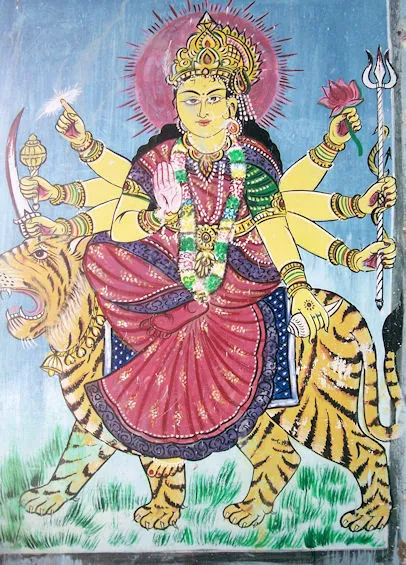
Fig.: Durgā = दुर्गा, Orissa
(Image source: Details)
sādhvī f. = साध्वी : fem. from sādhu.
gurvī f. = गुर्वी : fem. from guru.
asmitā f. = अस्मिता : "I-am-ness", i.e., the (false) belief: I am the one who sees, etc.
ānvīkṣikī f. = आन्वीक्षिकी : Philosophy (the science that arrives at its conclusions through logically correct reasoning).
upekṣā f. = उपेक्षा : Non-regard, equanimity.
karuṇā f. = करुणा : Compassion, pity.
muditā f. = मुदिता : Joy, specifically sympathetic joy (opposite of envy).
3.7. Exercise
A) Put the following sentences into the plural:
- dvijo brāhmaṇaḥ = द्विजो ब्राह्मणः
- dvijaḥ kṣatriyaḥ = द्विजः क्षत्रियः
- dvijo vaiśyaḥ = द्विजो वैश्यः
- gurur brāhmaṇaḥ = गुरुर्ब्राह्मणः
- sādhur guruḥ = साधुर्गुरुः
- guruḥ kaviḥ = गुरुः कविः
- sādhvī brāhmaṇī = साध्वी ब्राह्मणी
- devatā guruḥ = देवता गुरुः
- paśur dhenuḥ = पशुर्धेनुः
- gurvī sādhvī = गुर्वी साध्वी
B) Form nominal sentences by inserting:
- śrutis ... (veda) = श्रुतिस् ... वेद
- paśus ... (dhenu) = पशुस् ... धेनु
- devī ... (durgā, umā, indrāṇī) = देवी ... दुर्गा, उमा, इन्द्राणी
- devatā ... (mīnākṣī, annapūrṇā) = देवता ... मीनाक्षी, अन्नपूर्णा
- śūdrā ... (itarā) = शूद्रा ... इतरा
C) Translate into the feminine:
- gurur brāhmaṇaḥ = गुरुर्ब्राह्मणः
- sādhur guruḥ = साधुर्गुरुः
- kṣatriyaḥ sādhuḥ = क्षत्रियः साधुः
D) Translate into Sanskrit:
- Umā is a goddess.
- The Veda is śruti.
- The teachers are goddesses.
- Milk cows are domesticated animals.
- Poets are teachers.
- Kṣatriyas are twice-born.
- The holy men are Śūdras.