
Lesson 4
In this lesson, you will learn:
- Interrogative and demonstrative pronouns in the nominative
- Sandhi of final -m
- Sandhi of final -e
- Sandhi of final -d
- Simple question formulas
4.1. Simple Supplementary Questions (Word Questions) and Answers
4.1.1. Interrogative and Demonstrative Pronouns
4.1.1.1. Interrogative Pronoun (praśnārthakasarvanāma n. = प्रश्नार्थकसर्वनामन्)
| Nominative singular | Nominative plural | |
|---|---|---|
| Neuter | kim = किम् | kāni = कानि |
| Masculine | kas = कस् | ke = के |
| Feminine | kā = का | kās = कास् |
4.1.1.2. Demonstrative Pronouns (nidarśakasarvanāmāni n. = निदर्शकसर्वनामानि)
| Stems | |||
|---|---|---|---|
| tad = तद् "er, sie, es; der, die, das" (Erwähnte) | etad = एतद् "dieser, diese, dieses" (dem Sprechenden sehr Nahe) | idam = इदम् "dieser, diese, dieses" (Nahe) | |
| Nominative singular | |||
| Neuter | tad = तद् | etad = एतद् | idam = इदम् |
| Masculine | sa, so saḥ = स सो सः | eṣa, eṣo, eṣaḥ = एष एषो एषः | ayam = अयम् |
| Feminine | sā = सा | eṣā = एषा | iyam = इयम् |
| Nominative plural | |||
| Neuter | tāni = तानि | etāni = एतानि | imāni = इमानि |
| Masculine | te = ते | ete = एते | ime = इमे |
| Feminine | tās = तास् | etās = एतास् | imās इमास् |
For Nom. sg. masc.:
- sa, eṣa (स एष) stands before all sounds except short -a
- so, eṣo (सो एषो) stands before -a, which is elided with Avagraha (omitted)
- saḥ, eṣaḥ (सः एषः) stands only in pause (end of sentence, end of verse)
In order to form sentences with these pronouns (sarvanāman n.), knowledge of the following Sandhi rules is still necessary:
4.1.2. Sandhi of final -m
Final -m is replaced by Anusvāra (-ṃ) before consonants. At the end of a sentence or verse, and before vowels, -m remains.
4.1.3. Sandhi of final -e
before a- -e remains unchanged: the initial a- is elided with Avagraha:
e.g. ete + agnayas » ete 'gnayaḥ = एते ऽग्नयः "These fires"Before vowels other than short a- -e is usually replaced by -a with hiatus. Replacement by -ay also occurs:
e.g. ime + īśvarās » ima īśvarāḥ = इम ईश्वराः (rare: imay īśvarāh = इमयीश्वराः) "These LORDS"
4.1.4. Sandhi of final -d
Final -d is replaced by -t in pause, as well as before voiceless gutturals (k, kh) and labials (p, ph).
The replacement before other consonants will be discussed later. Avoid such sound collisions for now!
4.1.5. Question Formulas
Using these pronouns, one forms, for example, the following question formulas:
| Singular | Neuter | tat kim? /kiṃ tat? तत्किम्, किं तत् etat kim? /kim etat? एतत्किम्, किमेतत् idaṃ kim? / kim idam इदं किम्, किमिदम् | "What is that?" |
| Masculine | sa kaḥ? / kaḥ saḥ? स कः, कः सः eṣa kaḥ? / ka eṣaḥ एष कः, क एषः ayaṃ kaḥ? / ko 'yam? अयं कः, को ऽयम् | "Who is that?" "What is he?" | |
| Feminine | sā kā? / kā sā? सा का, का सा eṣā kā? / kaiṣā? (= kā + eṣā) एषा का, कैषा iyaṃ kā? / keyam? (= kā + iyam) इयं का, केयम् | "Who is that?" "Who is she?" | |
| Plural | Neuter | tāni kāni? / kāni tāni? तानि कानि, कानि तानि etāni kāni? / kāny etāni? एतानि कानि, कान्येतानि imāni kāni? / kānīmāni? (= kāni + imāni) इमानि कानि, कानीमानि | |
| Masculine | te ke? / ke te? ते के, के ते ete ke? / ka ete? एते के, क एते ime ke? / ka ime? इमे के, क इमे | ||
| Feminine | tāḥ kāḥ? / kās tāḥ? ताः काः, कास्ताः etāḥ kāḥ? / kā etāḥ? एताः काः, का एताः imāḥ kāḥ? / kā imāḥ? इमाः काः, का इमाः |
An example of other questions:
viṣṇuḥ kaḥ? = विष्णुः कः Answer: viṣṇur īśvaraḥ = विष्णुरीश्वरः. (Here, one can place the subject, for example, at the beginning of the nominal sentence to emphasize the connection to the question.)
NOTE: The answers you can give to such questions with your current Sanskrit knowledge do not, of course, yet correspond in every respect to idiomatic good Sanskrit.
4.2. Exercise
A) Form questions orally using the following words according to the pattern viṣṇuḥ kaḥ (विष्णुः कः) and answer the questions in Sanskrit:
śruti, śiva, brāhmaṇa, dvija (plural), indrāṇī, dhenu, tulādhara, kālidāsa
= श्रुति, शिव, ब्राह्मण, द्विज (बहुवचनम्), इन्द्राणी, धेनु, तुलाधर, कालिदास
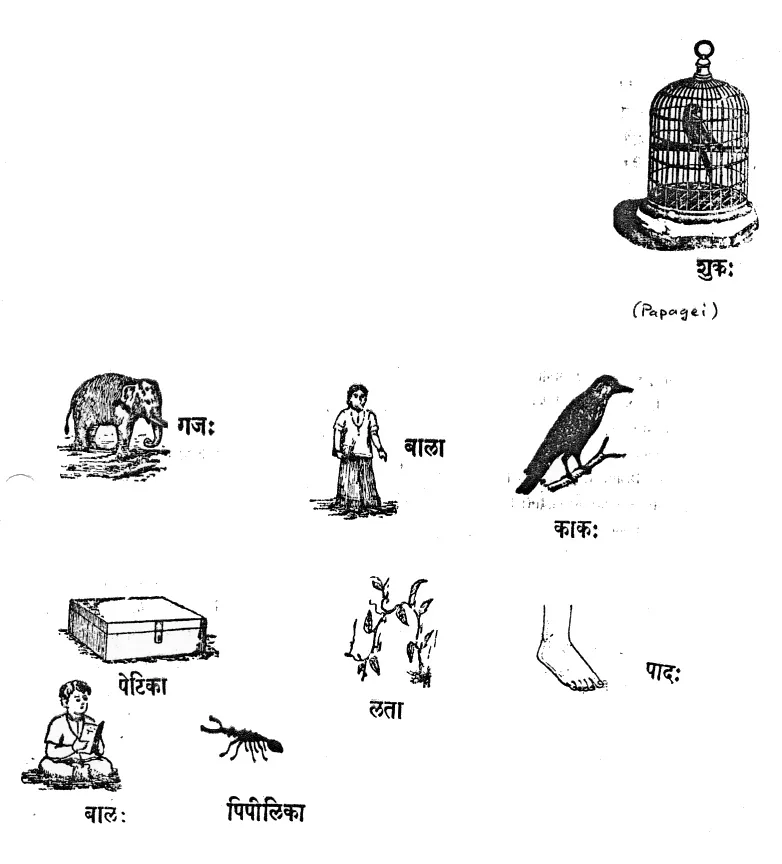
B) Form questions for the following reading exercise according to the pattern etat kim (एतत्किम्) and answer the questions with the specified words and demonstrative pronouns, e.g. eṣa bālaḥ (एष बालः):
(Image source: Details)