
Lesson 6
In this lesson, you will learn:
- The structure of the verbal sentence (agent and verb form)
- The formation of verb forms (Parasmaipada, Ātmanepada, Passive)
- The moods and tenses of the verb
- Indicative Present (laṭ) and the primary endings of the 3rd person
- The formation of the present stem (Classes 1, 4, and 6)
- Sound gradation (Ablaut: Guṇa and Vṛddhi)
6.1. The Verbal Sentence
Schema I: Verb Form
- e.g., yajati = यजति = "He (she, it) worships with a sacrifice," "He (she, it) sacrifices"
Schema II: Agent (kartṛ m. = कर्तृ) – Verb Form
- e.g., rāmo yajati = रामो यजति = "Rāma worships with a sacrifice," "Rāma sacrifices"
When the agent (kartṛ m. = कर्तृ) is mentioned in a verbal sentence that is not in the passive voice, the agent appears in the Nominative (first case, prathamā = प्रथमा). In number (vacana n. = वचन), the agent and verb form then agree.
6.2. On the Formation of Verb Forms
A finite verb form, i.e., a verb form with personal endings, expresses in Sanskrit the following:
Meaning (artha m. अर्थ)
Person and Number (vacana n. = वचन) (I, you, he <she, it>, we two, you two, they two, we, you, they)
Mode of action (genus verbi):
- Parasmaipada (n. = परस्मैपद) ("word form with reference to another"): Active. e.g., yajati = यजति = "He worships with a sacrifice" (namely, the priest who performs the sacrifice for someone else)
- Ātmanepada (n. = आत्मनेपद) ("word form with reference to oneself"): Middle. e.g., yajate = यजते = "He worships with a sacrifice for his own interest" (namely, the sacrificer who sacrifices for himself and his family)
- Passive (karman n. = कर्मन्). e.g., ijyate = इज्यते = "It is worshipped with a sacrifice"
In many cases, the semantic nuance of the Ātmanepada can no longer be discerned; furthermore, even skilled poets often use the Ātmanepada without any semantic difference from the Parasmaipada. Nevertheless, when translating, one must always pay close attention to whether such a semantic nuance is present.
Verbs that are used in both the Parasmaipada and Ātmanepada (in the specific Ātmanepada sense) are called Ubhayapada verbs (ubhayapada n. = उभयपद = "both word forms").
Some verbs are used either only in the Parasmaipada or only in the Ātmanepada. In these verbs, the Ātmanepada or Parasmaipada has no specific meaning. e.g., manyate = मन्यते = "he (she, it) thinks" (without specific Ātmanepada meaning).
Mode of statement (Mood):
- Indicative: Statement form
- Optative: Wish form and possibility form
- Imperative: Command form
Time (Tense):
- Present: Present time
- Imperfect
- Perfect
- Aorist
- Future: Future time
- Conditional
The tenses are formed by tense stems: present stem, aorist stem, perfect stem, future stem.
6.3. Indicative Present (laṭ = लट्)
The present is the tense of the present, particularly also of duration.
The indicative (declarative form) present is formed by adding the so-called primary endings to the present stem.
Examples:
| Root (dhātu) | Present Stem | 3. Person Singular Indikativ Present Parasmaipada |
|---|---|---|
| viś = विश् | viśa = विश | viśati = विशति = "he (she, it) enters" |
| bhū = भू | bhava = भव | bhavati = भवति = "he (she, it) arises" |
| nṛt = नृत् | nṛtya = नृत्य | nṛtyati = नृत्यति = "he (she, it) dances" |
6.4. Primary endings of the third person (prathama m. = प्रथम = "first (!) person")
| Singular (Einzahl) ekavacana n. एकवचन | Plural (Mehrzahl) bahuvacana n. बहुवचन | |
|---|---|---|
| Parasmaipada n. परस्मैपद | -ti -ति | -nti -न्ति |
| Ātmanepada n. आत्मनेपद | -te -ते | -nte -न्ते |
Example yaj = यज् = "to honor with a sacrifice", "to sacrifice":
- Present stem: yaja = यज
- 3rd sg. P. yajati = यजति
- 3rd pl. P. yajanti = यजन्ति
- 3rd sg. Ā. yajate = यजते
- 3rd pl. Ā. yajante = यजन्ते
6.5. Formation of the present stem
6.5.1. Verbs of the 6th present class (tudādi = तुदादि = "tud etc.")
Present stem = root in guṇa grade (as it is listed) + a-
| Root (dhātu m.) धातु | Present Stem |
|---|---|
| viś विश् | viśa- विश- |
| sṛj सृज् | sṛja- सृज- |
6.5.2. Verbs of the 1st present class (bhvādi / bhūvādi = भ्वादि / भूवादि = "bhū etc.")
| Present Stem = Root in Hochstufe (selten Dehnstufe) + a- | |||
|---|---|---|---|
| Root (dhātu m.) धातु | Strong grade | Strong grade before a- | Present Stem |
| bhū भू | bho भो | bhav भव् | bhava- भव- |
| nī नी | ne ने | nay नय् | naya- नय- |
| smṛ स्मृ | smar स्मर् | smar स्मर् | smara- स्मर- |
| yaj यज् | yaj यज् | yaj यज् | yaja- यज- |
| Steht der Vokal in langer geschlossener Silbe, d.h. Kurzvokal vor zwei oder mehr Konsonanten, unterbleibt die Formation der Hochstufe | |||
| nind निन्द् | nind निन्द् | nind निन्द् | ninda- निन्द- |
6.5.2.1. Word sandhi of e and o
Before vowels, within the word, e is replaced by ay, o by av.
6.5.2.2. Sound gradation (Ablaut)
| Weak grade zero grade | Hochstufe Vollstufe Guṇa m. गुण | Dehnstufe Vṛddhi f. वृद्धि |
|---|---|---|
| ø | a | ā |
| i / ī | e | ai |
| u / ū | o | au |
| ṛ / ṝ | ar | ār |
| ḷ | al | āl |
6.5.3. Verbs of the 4th Present Class (divādi = दिवादि = "div etc.")
Present stem = Root in guṇṣta (weak) form (as listed) + ya-
| Root (dhātu m.) धातु | Present Stem |
|---|---|
| nṛt नृत् | nṛtya- नृत्य- |
| muh मुह् | muhya- मुह्य- |
| yudh युध् | yudhya- युध्य- |
| man मन् | manya- मन्य- |
6.5.4. Thematic Vowel, Thematic Present Classes
The a in the present class stem-forming suffixes is called the thematic vowel. Present classes with a in the stem-forming suffix are therefore called "thematic present classes".
6.6. Spoken Sanskrit: Further Questions (praśna m. = प्रश्न)
- N. N. kiṃ karoti? = N.N. किं करोति = "What is N. N. doing?"
- N. N. (plural) kiṃ kurvanti? = N.N. किं कुर्वन्ति = "What are the N.N.s doing?"
- (karoti, kurvanti from kṛ = कृ 8 U: "to do, to make")
- kiṃ kuśalam? = किं कुशलम् = "Are you well?, How are you?"
- Answer: sarvathā kuśalam = सर्वथा कुशलम् = "(It is going) well in every respect."
6.7. Word List
In Sanskrit, verbs are listed in the root form. The number following the root indicates the conjugation class.
- P: Root is only Parasmaipada
- Ā: Root is only Ātmanepada
- U: Ubhayapada ("both word forms"): Root is used in both Parasmaipada and Ātmanepada.
- (): In parentheses is the 3rd person singular present indicative (laṭ).
Learn the following words:
- yaj 1 U (yajati) यज् यजति : to honor with a sacrifice, to sacrifice
- bhū 1 P (bhavati) भू भवति : to become, to arise, to be
- smṛ 1 P (smarati) स्मृ स्मरति : to make present, to remember
- nṛt 4 P (nṛtyati) नृत् नृत्यति : to dance
- nī 1 U (nayati) नी नयति : to lead
- man 4 Ā (manyate) मन् मन्यते : to think
- muh 4 P (muhyati) मुह् मुह्यति : to be confused
- yudh 4 Ā (yudhyate) युध् युध्यते : to fight
- viś 6 P (viśati) विश् विशति : to enter
- sṛj 6 P (sṛjati) सृज् सृजति : to release, to let out, to emanate
6.8. Exercise
A) Form verbal sentences with the roots specified in parentheses by inserting them:
- brāhmaṇas ... (yaj, nṛt, viś, man, yudh, nī, muh)
ब्राह्मणस् ... यज्, नृत्, विश्, मन्, युध्, नी, मुह् - devas ... (nṛt, yudh, smṛ, sṛj)
देवस् ... नृत्, युध्, स्मृ, सृज् - kavis ... (man, smṛ, viś)
कविस् ... मन्, स्मृ, विश् - dhenus ... (viś, bhū)
धेनुस् ... विश्, भू
B) Put the sentences formed in Exercise A into the plural.
C) Translate into Sanskrit:
- He sacrifices with a sacrifice. (The sacrificial priest for a sacrifice lord)
- Śiva dances.
- Rāma leads.
- Śūdras are confused.
- The Kṣatriya women enter.
- The LORD emanates.
- The Kṣatriya sacrifices with a sacrifice. (as a sacrifice lord)
- Śūdra women dance.
- Kṣatriyas fight.
- Holy men lead.
- They remember.
- Who (fem.) dances?
- The (mentioned) Brahmin woman dances.
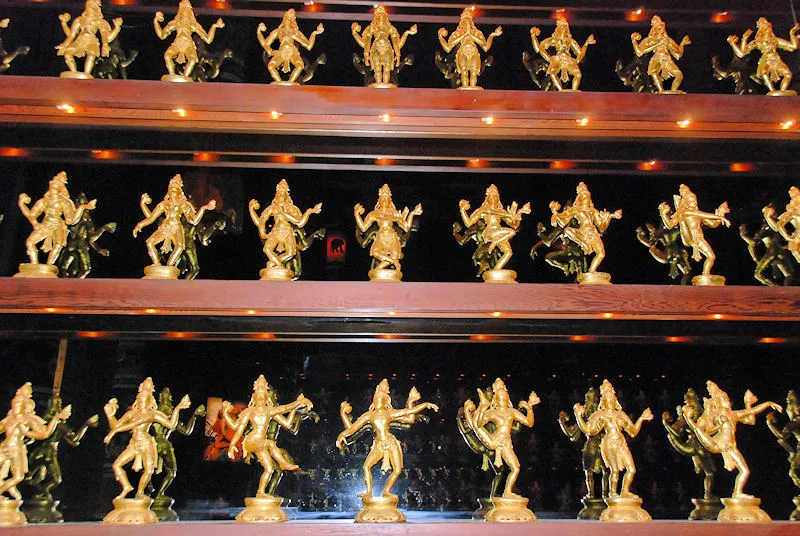
Śivo nṛtyati = शिवो नृत्यति
Śiva Naṭarāja (नटराज), Kadavul Hindu Temple, Kauai, Hawaii
(Image source: Wikipedia, CC-BY-SA 2.5)
6.9. Review Exercise
A) Insertion Exercise: Form questions to which the sentences you form after the following insertion exercises are answers:
- devas ... (īśvara, nṛt, sṛj, agni, indra)
देवस् ... ईश्वर, नृत्, सृज्, अग्नि, इन्द्र - (dvija, sādhu, kavi) ... brāhmaṇaḥ
द्विज, साधु, कवि ... ब्राह्मणः - (śruti) ... vedaḥ
श्रुति ... वेदः - (veda) ... śrutiḥ
वेद ... श्रुतिः - (brāhmaṇa, guru) ... yajanti
ब्राह्मण, गुरु ... यजन्ति - (devī) ... indrāṇī
देवी ... इन्द्राणी - (śūdra, śūdrā, devī) ... nṛtyanti
शूद्र, शूद्रा, देवी ... नृत्यन्ति - (kṣatriya) ... yudhyante
क्षत्रिय ... युध्यन्ते - (brāhmaṇa, brāhmaṇī) ... viśanti
ब्राह्मण, ब्राह्मणी ... विशन्ति - (guru) ... candrakīrtiḥ
गुरु ... चन्द्रकीर्तिः - (sādhu) ... rāmaḥ
साधु ... रामः
B) Put into the plural:
- brāhmaṇo yajati. = ब्राह्मणो यजति
- kaiṣā. = कैषा
- kṣatriyo yajate. = क्षत्रियो यजते
- sādhvī smarati. = साध्वी स्मरति
- vaiśyā muhyati. = वैश्या मुह्यति
- sṛjati. = सृजति
- devī manyate. = देवी मन्यते
- gururviśati. = गुरुर्विशति
- ko 'yam. = को ऽयम्
- iyaṃ devī nṛtyati. = इयं देवी नृत्यति
- eṣa devo yudhyate. = एष देवो युध्यते
- sa sṛjati. = स सृजति
- paśurdhenuḥ. = पशुर्धेनुः
- keyam. = केयम्
C) Form the Ātmanepada for:
- rāmo yajati. = रामो यजति
- kṣatriyā nayanti. = क्षत्रिया नयन्ति
D) Form the Feminine for:
- śūdro nayati. = शूद्रो नयति
- sādhurviśati. = साधुर्विशति
- brāhmaṇaḥ smarati. = ब्राह्मणः स्मरति
- kṣatriyo yudhyate. = क्षत्रियो युध्यते
- devo guruḥ. = देवो गुरुः
E) Translate:
- devatānnapūrṇā. = देवतान्नपूर्णा
- śūdretarā. = शूद्रेतरा
- vaiśyastulādhāraḥ. = वैश्यस्तुलाधारः
- kavirmāghaḥ. = कविर्माघः
- devyumā. = देव्युमा
- śrutirvedaḥ. = श्रुतिर्वेदः
- dhenurviśati. = धेनुर्विशति
- guruścaitanyaḥ. = गुरुश्चैतन्यः
- devīndrāṇī. = देवीन्द्राणी
- sādhurguruḥ. = साधुर्गुरुः
- gururyajate. = गुरुर्यजते
F) Translate into Sanskrit:
- Rāma sacrifices (as the sacrificer).
- Durgā is a goddess.
- Mīnākṣī is a goddess.
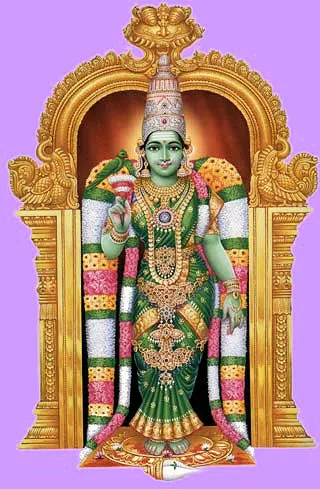
Mīnākṣī (मीनाक्षी), Mīnākṣī Temple, Madurai, Tamil Nadu
(Image source: Wikipedia, Public domain)
- They are confused.
- Rāma is a holy man.
- Who is the LORD?
- Indra is the LORD.
- The livestock enter.
- Viṣṇu causes to emanate = Viṣṇu creates.
- Twice-born are good.
- The triple (knowledge) is the Sāmaveda, the Ṛgveda and the Yajurveda. (2 possibilities)
- This goddess is good.
- The five "torments" are: ignorance, ego-illusion, passion (love), hatred, attachment to the body. (2 possibilities)
- "Abidance states of Brahman" are: friendly benevolence, compassion, sympathetic joy, equanimity. (2 possibilities)
- These Brahmins sacrifice on behalf of others.
- Brahmins, Kṣatriyas and Vaśyas are twice-born. (2 possibilities)
- The sciences (for a prince) are: philosophy, the triple (Vedic knowledge), economics and politics. (2 possibilities)
- Are you well?
- (It goes for me) in every respect well.