
Lesson 7
In this lesson you will learn:
- The verbal sentence with direct object
- The accusative of nouns and pronouns
- The sandhi of final -n
- The neuter of a-stems
- The athematic present classes (using the 5th class as an example)
Weekly Verse
धर्मो जयति नधर्मः
सत्यं जयति नानृतम् ।
क्षमा जयति न क्रोधो
देवो जयति नासुरः ॥
dharmo jayati nādharmaḥ
satyaṃ jayati nānṛtam |
kṣamā jayati na krodho
devo jayati nāsuraḥ ||
Right conquers, not unright,
Truth conquers, not untruth,
Forbearance conquers, not anger,
God conquers, not the anti-god.
7.1. The verbal sentence with direct object
Schema:
(Agent = kartṛ m. = कर्तृ) – direct object (karman n. = कर्मन्) – verb
e.g.
- rāmaḥ phalaṃ khādati = रामः फलं खादति : "Rāma eats (consumes) a fruit."
- brāhmaṇo devaṃ yajati = ब्राह्मणो देवं यजति : "The Brahman worships a god with a sacrifice (for someone else)."
If the verb is in the Parasmaipada or Ātmanepada, then the direct object (karman n. = कर्मन्) is generally in the accusative (accusative case, dvitīyā f. = द्वितीया).
7.2. The accusative (accusative case, dvitīyā f. = द्वितीया = "second case ending")
Ending of the accusative singular masculine and feminine after a vowel: -m
| Masculines ending in | Accusative Singular |
|---|---|
| -a: deva | devam देवम् |
| -i: kavi | kavim कविम् |
| -u: guru | gurum गुरुम् |
| Feminines ending in | Accusative Singular |
| -ā: devatā | devatām देवताम् |
| -i: śruti | śrutim श्रुतिम् |
| -ī: devī | devīm देवीम् |
| -u: dhenu | dhenum धेनुम् |
Accusative plural masculine of stems ending in a vowel (exception: monosyllabic root stems with long vowel): lengthening of the final vowel + -n
| Masculines ending in | Accusative Plural |
|---|---|
| -a: deva | devān देवान् |
| -i: kavi | kavīn कवीन् |
| -u: guru | gurūn गुरून् |
Accusative plural feminine of stems ending in a vowel (exception: monosyllabic root stems with long vowel): lengthening of the final vowel + -s
| Feminines ending in | Accusative Plural |
|---|---|
| -ā: devatā | devatās देवतास् |
| -i: śruti | śrutīs श्रुतीस् |
| -ī: devī | devīs देवीस् |
| -u: dhenu | dhenūs धेनूस् |
7.2.1. किं-शब्दस्य तद्-शब्दस्य च द्वितीयाविभक्तिः एकवचनं बहुवचनं च
| Masculine | Feminine | Neuter | ||
|---|---|---|---|---|
| kim who/what | sg. | kam कम् | kām काम् | kim किम् |
| pl. | kān कान् | kās कास् | kāni कानि | |
| tad er/es/jenes | sg. | tam तम् | tām ताम् | tad तद् |
| pl. | tān तान् | tās तास् | tāni तानि | |
| etad dieses hier | sg. | etam / enam एतम् / एनम् | etām / enām एताम् / एनाम् | etad / enad एतद् / एनद् |
| pl. | etān / enān एतान् / एनान् | etās / enās एतास् / एनास् | etāni / enāni एतानि / एनानि | |
| idam dieses | sg. | imam / enam इमम् / एनम् | imām / enām इमाम् / एनाम् | idam / enad इदम् / एनद् |
| pl. | imān / enān इमान् / एनान् | imās / enās इमास् / एनास् | imāni / enāni इमानि / एनानि | |
The forms enam (एनम्) etc. belong to the stem enad (एनद्), which forms cases only in some inflections. These are used instead of the forms of etad and idam when the thing referred to has already been mentioned in the preceding context.
e.g. ayaṃ devaḥ, enaṃ yajante. = अयं देवः । एनं यजन्ते ॥ : "He is a god. They sacrifice to him."
7.2.2. Usage of the Accusative (Second Case, dvitīyā f. = द्वितीया = "second case ending")
The accusative (dvitīyā f. = द्वितीया) denotes:
- In non-passive verbal sentences: the direct object (karman n. = कर्मन्) of the action expressed by the verb:
e.g.- devaṃ yajati = देवं यजति : "He venerates a god with a sacrifice."
- phalam āpnoti = फलमाप्नोति : "He obtains the fruit (e.g. of his action)."
- With verbs expressing going, movement, leading, or similar, the accusative denotes the goal of the movement:
e.g.- narakaṃ gacchati = नरकं गच्छति : "He goes to hell."
Further uses of the accusative will be treated later.
7.3. Sandhi of final -n
Final -n:
Before voiced palatal and retroflex sparśa and before ś-, it is replaced by the nasal corresponding to these sounds:
- -n before j-, jh-, ñ-, ś- » -ñ
- -n before ḍ-, ḍh-, ṇ-, ṣ- » -ṇ
e.g. kṣatriyān + jayati » kṣatriyāñ jayati = क्षत्रियांञ्जयति : "He defeats the Kṣatriyas."
Initial ś- is then usually replaced by ch-:
gurūn + śṛṇoti » gurūñ chṛṇoti (alternatively gurūñ śṛṇoti) = गुरूञ्छृणोति (गुरूञ्शृणोति) : "He hears the teachers." "He listens to the teachers."
Before initial l-, it is replaced by -l with Anunāsika (nasalized l, in writing ल् with Anunāsika ँ):
e.g. paśūn + labhate » पशूंल्लभते : "He obtains livestock."Before initial voiceless palatal, retroflex, or dental, it is replaced by Anusvāra + the sibilant corresponding to these sounds:
- -n before c-, ch- » -ṃś
- -n before ṭ-, ṭh- » -ṃṣ
- -n before t-, th- » -ṃs
e.g. devān + ca » devāṃś ca = देवांश्च : "and the gods (acc.)"
devān + tu » devāṃs tu = देवांस्तु : "but the gods (acc.)"
Except after a short vowel (see later), final -n remains unchanged in all other cases.
7.4. The Neuter (napuṃsaka n. = नपुंसक)
In the neuter, the forms for Nominative (prathamā) and Accusative (dvitīyā) are identical.
7.4.1. Neuter of stems ending in -a
- Ending Nominative / Accusative Singular: -m
e.g. phala n. = फल = "fruit": Nom. / Acc. sg. phalam = फलम् - Ending Nominative / Accusative Plural: -āni
e.g. phala n. = फल: Nom. / Acc. pl. phalāni = फलानि
7.5. Athematic Present Classes
The 5th present class forms a so-called athematic present stem, i.e., the present stem does not end in the "thematic vowel" -a as in the thematic present classes (1st, 4th, 6th, 10th class).
The athematic present classes have stem gradation, i.e., there are two forms of the present stem:
- strong stem: guṇa grade (rarely vṛddhi grade)
- weak stem: zero grade
The strong stem occurs:
- in the Indicative Singular Parasmaipada Present (laṭ) and Imperfect (laṅ)
- in all first persons of the Imperative (loṭ) Parasmaipada and Ātmanepada
- in the third person Singular Imperative (loṭ) Parasmaipada
All other forms have the weak present stem.
7.5.1. अदन्तधातूनां तृतीयपुरुषबहुवचनस्य सार्वधातुकप्रत्ययाः
In athematic present stems, the primary endings of the 3rd person Plural are:
- Parasmaipada: -anti
- Ātmanepada: -ate
7.5.2. The 5th Present Class (svādi = स्वादि = "su etc.")
- Strong stem: (usually) zero-grade root (as stated) + -no-
- Weak stem: (usually) zero-grade root (as stated) + -nu-
Before vocalic endings, in roots ending in a vowel, -nu- is replaced by -nv-, and in roots ending in a consonant, -nu- is replaced by -nuv- before vocalic endings.
Examples:
| Root धातु | Starker Stem | Schwacher Stem | Before Vowel (weak) |
|---|---|---|---|
| āp 5 P आप् "erreichen" | āp-no (3.sg. āpnoti = आप्नोति) | āp-nu | āp-nuv (3.pl. āpnuvanti = आप्नुवन्ति) |
| aś 5 Ā अश् "erreichen" | — | aś-nu (3.sg. aśnute = अश्नुते) | aś-nuv (3.pl. aśnuvate = अश्नुवते) |
| su 5 U सु "auspressen" | su-no (3.sg. sunoti = सुनोति) | su-nu (3.sg. sunute = सुनुते) | su-nv (3.pl. sunvanti = सुन्वन्ति, 3.pl. sunvate = सुन्वते) |
| śru 5 P श्रु "hören" | śṛ-ṇo (3.sg. śṛṇoti = शृणोति) | śṛ-ṇu | śṛ-ṇv (3.pl. śṛṇvanti = शृण्वन्ति) |
7.6. Vocabulary
Learn the following words:
- aś 5 Ā (aśnute) अश् अश्नुते : to reach, to attain, to obtain
- āp 5 P (āpnoti) आप् आप्नोति : to reach, to obtain
- kup 4 P (kupyati) कुप् कुप्यति : to be angry
- krudh 4 P (krudhyati) क्रुध् क्रुध्यति : to be angry
- khād 1 P (khādati) खाद् खादति : to chew, to eat
- śru 5 P (śṛṇoti !) श्रु शृणोति : to hear (something: Accusative, someone: Genitive or Accusative; about: Accusative; from someone: Genitive, Ablative, Instrumental)
- su 5 U (sunoti) सु सुनोति : to press
- soma m. सोम : pressed drink, Soma; Moon (From which plant Soma was pressed is still disputed to this day).
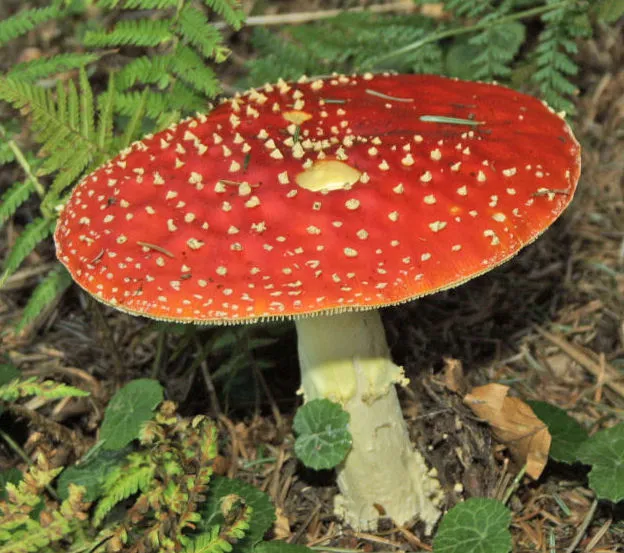
Fig.: Was war das die vedische Somapflanze?: Fliegenpilz: Amanita muscaria (L.) Lam.
(Image source: Details)
- phala n. फल : fruit (also in the figurative sense: (karmic) fruit of an action)
- nṛtya n. नृत्य : dance
- svarga m. स्वर्ग : heaven
- naraka m. नरक : hell (according to a Hindu conception, the universe has the form of an egg (Brahmāṇḍa m.n. = ब्रह्माण्ड = "Egg of Brahmā"): above the earth are six heavens with increasing bliss, below the earth are seven so-called pātāla n. = पाताल, dwellings of the nāga m. = नाग (snakes) and other mythical beings, among them come 7 hells with increasing torments)
- aṅga n. अङ्ग : limb of the body, component; also = vedāṅga = वेदाङ्ग
- gam 1 P (gacchati) गम् गच्छति : to go (According to the indigenous verb classification, it belongs to Present class 1, but is in reality a formation with a present stem formation suffix -ccha-: gam » Middle grade (gm ») ga-ccha-ti)
7.7. Exercise
A) Insert the direct object or directional accusative in both singular and plural:
- brāhmaṇas ... yajati (deva, devī, viṣṇu, agni, devatā)
ब्राह्मणस् ... यजति (देव, देवी, विष्णु, अग्नि, देवता)
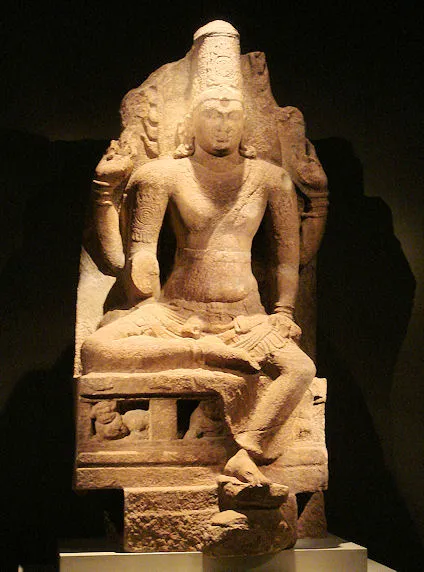
Fig.: Viṣṇu = विष्णु, 8th/9th century.
(Image source: Details)
- gurus ... khādati (phala)
गुरुस् ... खादति (फल) - sādhus ... gacchati (svarga)
साधुस् ... गच्छति (स्वर्ग) - śūdrā ... gacchati (naraka)
शूद्रा ... गच्छति (नरक) - ... jayati (śūdra)
... जयति (शूद्र) - ... labhate (dhenu, paśu, phala)
... लभते (धेनु, पशु, फल)
B) Insert the corresponding verb forms:
- sādhuḥ svargaṃ ... (āp, gam, aś)
साधुः स्वर्गम् ... (आप्, गम्, अश्) - brāhmaṇaḥ somam ... (su) (2 forms)
ब्राह्मणः सोमम् ... (सु) - sādhur gurum ... (śru)
साधुर्गुरुम् ... (श्रु) - devī ... (kup, krudh)
देवी ... (कुप्, क्रुध्)
C) Insert agent, object, and verb in the plural in exercise sentences B).
D) Insert into Ātmanepada:
- sunvanti.
सुन्वन्ति । - nayanti.
नयन्ति । - sunoti.
सुनोति । - yajati.
यजति ।
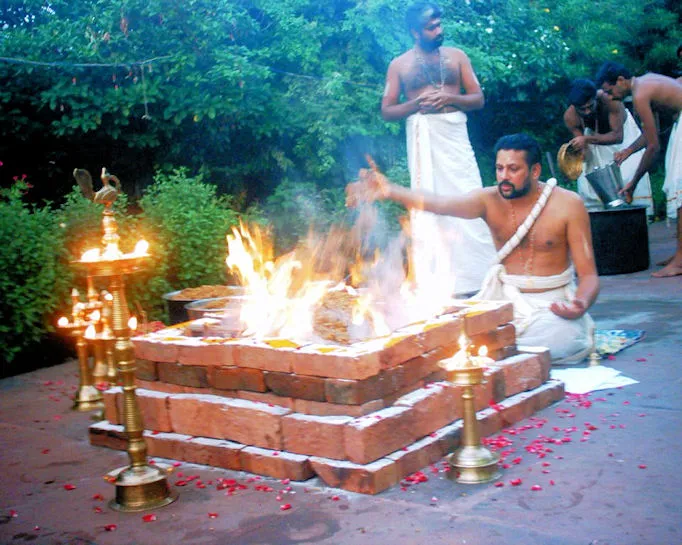
Fig.: yajati = यजति — Vedic sacrifice = yajña m. = यज्ञ
(Image source: Details)
E) Form the accusative (dvitīyā) sg. and pl. for all nouns learned so far.
F) Translate:
- narakāṃś ca svargāṃś ca gacchanti.
नरकांश्च स्वर्गांश्च गच्छन्ति । - gurūṃs tu śṛṇvanti.
गुरूूंस्तु शृण्वन्ति । - Śūdras attain a heaven.
- The Kṣatriyas, as sacrifice lords, worship the goddesses with sacrifices.
- Vaiśya women worship deities with sacrifices.
- The LORD is angry.
- śikṣā kalpo vyākaraṇaṃ niruktaṃ chando jyotiṣam aṅgāni.
शिक्षा कल्पो व्याकरणं निरुक्तं छन्दो ज्योतिषमङ्गानि । - To which god does this Brahmin sacrifice?
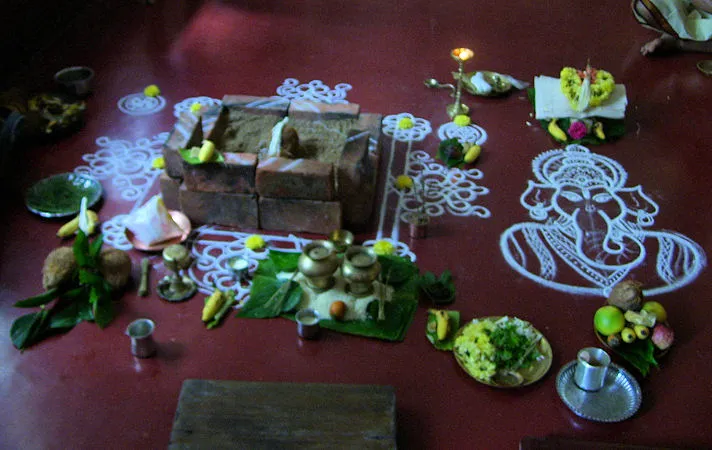
Fig.: To which god is one sacrificing here? Answer: Gaṇeśa (Gaṇapati) = गणेश (गणपति). Gaṇapatihoma (yajña).
(Image source: Details)
- What is this holy man chewing?
- What are these (here) pressing out?
- He is the teacher. One listens to him (= they listen to him).