
Lesson 28
28.1. The Causative (णि, णिच्, कारित)
If one wishes to express that someone or something causes or brings about that someone else or something else does or suffers something expressed by a root (with or without a prefix), the causative (णि, णिच्, कारित) is used.
Example:
गम् "to go" » Causative: गमयति "he causes someone to go; he sends"
दृश् "to see" » Causative: दर्शयति "he causes to see = he shows"
28.2. Sentence Construction with the Causative (णि, णिच्, कारित)
Scheme 1:
If the root underlying the causative (with or without a prefix) is INTRANSITIVE (i.e., cannot take an accusative object) or expresses movement, knowledge, information, or eating:
Agent (कर्ता) of the causative in the Nominative (प्रथमा) — Agent of the caused action in the Accusative (द्वितीया) — (Target of movement, object of knowledge, etc. in the Accusative = द्वितीया) — Verb in the Causative
Examples:
दुर्जनो रामं मोहयति = "an evil person causes Rāma to be confused = confuses Rāma = causes Rāma to err"
Result: रामो मुह्यति = "Rāma is confused / deluded / errs."
रामः शत्रून्स्वर्गं गमयति = "Rāma causes the enemies to go to heaven = sends the enemies to heaven"
Result: शत्रवः स्वर्गं गच्छन्ति = "the enemies go to heaven / come to heaven"
गुरू रामं वेदार्थं वेदयति = "The teacher causes Rāma to know the meaning of the Veda = explains / teaches Rāma the meaning of the Veda"
Result: रामो वेदार्थं वेत्ति = "Rāma knows / understands the meaning of the Veda"
स रामं वेदमध्यापयति = "he teaches Rāma the Veda"
Result: रामो वेदमधीते "Rāma studies the Veda"
रामो देवानामृतमाशयति = "Rāma causes the gods to eat nectar = gives the gods nectar to eat" (अश् 9 "to eat")
Result: देवा अमृतमश्नन्ति "The gods eat nectar"
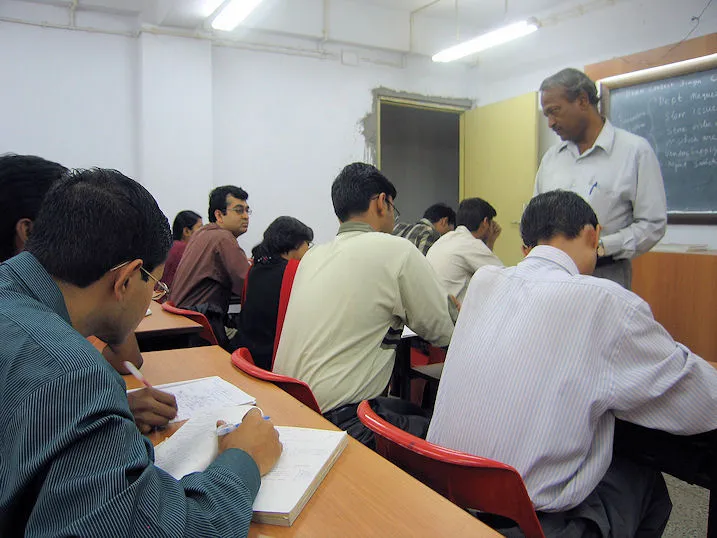
Fig.: स नरान्प्रबन्धविज्ञानमध्यापयति
ISKCON Temple Bangalore.
(Image source: Details)
Also constructed according to Scheme 1 is the root दृश्:
Exceptions to Scheme 1 see under Scheme 2
Example:
(स) रामं पुत्रं दर्शयति = "he shows the son to Rāma"
The following verse summarizes examples of causative formation according to Scheme 1 (the verbal forms are each the 3rd Person Imperfect Parasmaipada):
शत्रूनगमयत्स्वर्गं
वेदार्थं स्वानवेदयत् ।
आशयच्चामृतं देवान्
वेदमध्यापयद्विधिम् ।
आसयत्सलिलै पृथ्वीं
यः स मे श्रीहरिगतिः ॥
My refuge and my goal is Hari,
Who sent the enemies to heaven,
Who taught his followers the meaning of the Veda,
Who fed the gods with nectar,
Who taught the Creator the Veda,
Who set the earth in the water.
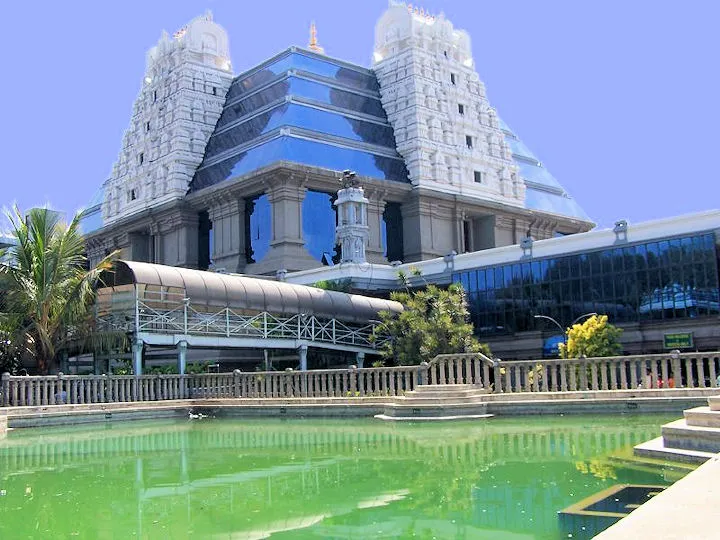
Fig.: स मे श्रीहरिगतिः
Jadavpur University Management building.
(Image source: Details)
Schema 2:
With transitive verbs (except those mentioned under Schema 1). Also with all verbs, when the action designated by the causative is caused (i.e., when the causative is a causative of a causative):
Agent (कर्ता) of the causative in the Nominative (प्रथमा) — Agent of the caused action in the Instrumental (तृतीया) — Object of the caused action in the case it would have according to the simple verb (i.e., usually in the Accusative) — Verb in the causative
Examples:
(स) रामेण भार्यां त्याजयति = "He causes Rāma to leave his wife"
Result: रामो भार्यां त्यजति = "Rāma leaves his wife"
विष्णुमित्रो रामेण गोविन्दं गमयति = "Viṣṇumitra causes Rāma to cause Govinda to go = Viṣṇumitra has Rāma send Govinda away"
Result: रामो गोविन्दं गमयति = "Rāma sends Govinda away"
Result of this result: गोविन्दो गच्छति = "Govinda goes"
Exceptions to Schema 1:
The following verbs also construct according to Schema 2:
Causative of:
- नी "to lead"
- वह् "to travel" (only when the agent of the caused action is not the driver)
- स्मृ "to recall" (there are exceptions to this)
- अद् "to eat"
- खाद् "to chew"
Examples:
रामो भृत्येन भारं नाययति वाहयति वा = "Rāma has the servant lead or travel with the burden"
Result: भृत्यो भारं नयति वहति वा = "The servant leads or travels with the burden"
रामो बालेनान्नमादयति खादयति वा = "Rāma has the boy eat or chew food"
Result: बालो ऽन्नमत्ति खादति वा = "the boy eats or chews food"
(स) रामेण स्मारयति = "He causes Rāma to remember"
Result: रामः स्मरति = "Rāma remembers"
The following causatives can construct both according to Schema 1 and according to Schema 2:
- हृ "to hold, to fetch"
- कृ "to do, to make"
- Ātmanepadakausative of दृश्
Examples:
रामो भृत्यं कटं कारयति हारयति वा = "Rāma has the servant make or fetch a mat (कट f.)"
or:
रामो भृत्येन कटं कारयति हारयति वा
Result: भृत्यः कटं करोति हरति वा = "The servant makes or fetches a mat"
रामो बालं प्रतिमां दर्शयते = "Rāma has the boy see the image = shows the boy the image (for his own interest)"
or:
रामो बालेन प्रतिमां दर्शयते
Result: बालः प्रतिमां पश्यति = "the boy sees the image"
When the causative is used in a passive construction, the following schema is almost always applied:
Schema A (Passive construction):
Agent of the causative in the Instrumental (तृतीया) — Agent of the caused action in the Nominative (प्रथमा) — Object of the caused action in the case it would have according to the simple verb (i.e., usually in the Accusative) — Verb in the causative
Examples:
गुरुणा रामो ग्रामं गम्यते = "The master sends Rāma to the village"
Result: रामो ग्रामं गच्छति = "Rāma goes to the village"
रामेण भृत्यः कटं कार्यते = "Rāma has the servant make a mat"
Result: भृत्यः कटं करोति = "The servant makes a mat"
रामेण भृत्यो भारं हार्यते = "Rāma has the servant fetch the load"
Result: भृत्यो भारं हरति = "The servant fetches the load"
28.3. Formation of the present stem from the causative (णि, णिच्, कारित)
The thematic endings of the present stem are added to the causative stem
There are various formation types:
Formation type 1: (usually) guṇa-grade root + -aya-
Examples:
| Root | Kausativ 3. sg. Indikativ Present | Meaning |
|---|---|---|
| विश् | वेशयति | he/she/it causes to enter, leads in |
| लुभ् | लोभयति | cause to desire, make desirous, entice |
| दृश् | दर्शयति | cause to see = show |
| वृत् | वर्तयति | cause to turn, turn (transitive), roll (transitive), set in motion |
Formation type 2: dīrgha-grade root + -aya-
Often with roots ending in a vowel, and with roots where a single final consonant follows -a-.
Examples:
| Root | Kausativ 3. sg. Indikativ Present | Meaning |
|---|---|---|
| भू | भावयति (aus: bhau-aya-ti) | cause someone or something to become, produce |
| इ | आययति (aus: ai-aya-ti) | cause someone to go |
| नी | नाययति (aus: nai-aya-ti) | cause to lead |
| कृ | कारयति (kār-aya-ti) | cause to do |
| वच् | वाचयति (vāc-aya-ti) | cause to speak, make speak, (to make speak a text =) read aloud |
Formation type 3: zero-grade root + -aya-
Occurs.
Example:
| Root | Kausativ 3. sg. Indikativ Present | Meaning |
|---|---|---|
| दुष् | दूषयति (dūṣ-aya-ti) | (to) corrupt |
Formation type 4: root + -paya-
With roots ending in -ā and some other roots.
Examples:
| Root | Kausativ 3. sg. Indikativ Present | Meaning |
|---|---|---|
| स्था | स्थापयति (sthā-paya-ti) | cause to stand, set up |
| इ + अधि "studieren" | अध्यापयति (aus: adhi+ā-paya-ti) (zur Explanation siehe Thumb-Hauschildt Bd. I,2 S. 341) | cause to study, instruct |
Irregular formations:
Native grammarians consider the following forms as causatives:
- han : Caus. ghātayati¹ "cause to strike, cause to kill"
- pā 2 "to protect": pālayati² "to bring across, save, protect"
Notes:
- ghātayati is in reality a verb derived from the noun ghāta m. "blow" (denominative) and is used instead of the causative of han.
- pālayati is a genuine causative, but from the root pṛ 3 "to bring across, save, protect": pārayati (pār-aya-ti) » pālayati (in some parts of India r corresponds to l, in others conversely l corresponds to r).
28.4. Formation of the Passive (यक्) from the Causative
The passive of the causative is formed as follows:
Causative stem WITHOUT -aya- + passive suffix -ya-
Examples:
bhāvyate (bhāv-ya-te) "he/she/it is brought forth"
sthāpyate (sthāp-ya-te) "he/she/it is placed"
While the passive of the original root is usually formed from the guṇa-grade root, the passive of the causative can usually be recognized by the fact that it is formed from the strong or lengthened-grade root.
28.5. Formation of the Future (ऌट्, भविष्यन्ती f.) from the Causative
The future of the causative is formed from the causative stem, whereby the final -a- of the causative suffix is dropped:
-ay-iṣya-
Example:
budh Future-Causative: bodhayiṣyati (bodh-ay-i-ṣya-ti): "he/she/it will awaken"
28.6. Formation of the PPP (क्त) from the Causative
Causative stem on -ay- (without final a) + -i- + -ta
Examples:
gam — gamayati — gamita (gam-i-ta) "sent" (PPP of the simple root: gata)
sthā — sthāpayati — sthāpita (sthāp-i-ta) "placed"
28.7. Formation of the Absolutives (क्त्वा . ल्यप्) from the Causative
The -tvā absolute is formed from the causative stem on -ay- (without final a):
Causative stem on -ay- + -i- + -tvā
Example:
sthāpayitvā (sthā-pay-i-tvā) "after having placed"
The -ya absolute occurs with causatives having a prefix usually on the causative stem WITHOUT -aya-
Examples:
prabudh — prabodhayati — prabodhya (pra-bodh-ya) "after having awakened"
ānī — ānayati — ānāyya (ā-nāy-ya) "after having caused to bring near, after having caused to bring"
However, if the root syllable of the causative contains a short -a- before a single consonant, the -ya of the absolute attaches to the causative stem on -ay- (without final a)
Example:
āgam — āgamayati — āgamayya (ā-gamay-ya) "after having caused to come"
28.8. Formation of the Infinitive (तुमुन्) from the Causative
The infinitive of the causative is formed from the causative stem on -ay- (without final a):
Causative stem on -ay- + -i- + -tum
Example:
jan — janayati — janayitum (janay-i-tum) "in order to produce"
28.9. The 10th Present Class (चुरादि = चुर् etc.)
In the same way as causatives, some roots of the 10th present class form the present (and the other tenses) without being causatives.
Examples:
- Lengthened-grade root + -aya- : कम् 10Ā कामयते "to love"
- Strong-grade root + -aya- : cur 10U corayati "to steal"; Future: corayiṣyate; Passive: coryate
The forms of the causative of verbs of the 10th present class are identical with the forms of the simple verb. The decision as to whether a causative is present is possible only from the meaning or sometimes from the construction.
28.10. Word List
विद् 2P वेत्ति, विदन्ति: to know, to recognize
Fut. vediṣyati
Pass. vidyate
Caus. vedayati
PPP vidita
Inf. vediṣyum
from this: vidyā f., veda m.
विद् 6U विन्दति (!): to find
Fut. vediṣyati / vetsyat
Pass. vidyate: there is, it exists
Caus. vedayati
PPP vinna / vitta
Inf. vediṣtum / vettum
i + adhi 2Ā adhīte, adhīyate: to study, to memorize
Caus. adhyāpayati: to cause to study, to teach
from this: adhyayana n.: study (esp. of the Veda); adhyāya m.: lesson, chapter (section for memorization)
कम् 10Ā कामयते: to love
Fut. kāmayiṣyate / kamiṣyate
Pass. kāmyate
Caus. kāmayati
PPP kānta (!)
Inf. kāmayitum / kamitum

Fig.: कृष्णो राधां कामयति
Painting by राजा रवि वर्मा (1848 - 1906)
(Image source: Details)
चुर् 10 चोरयति: to steal
Fut. corayiṣyati
Pass. coryate
Caus. corayati
PPP corita
Inf. coritum
Pay special attention to the meaning of the causatives of the following verbs:
dṛś — darśayati: to show
man — mānayati: to esteem, to honor (but is probably a denominative from māna "honor")
vac — vācayati: also: to read aloud (to cause a text to be spoken)
vad — vādayati: also: to cause a musical instrument to speak = to play a musical instrument
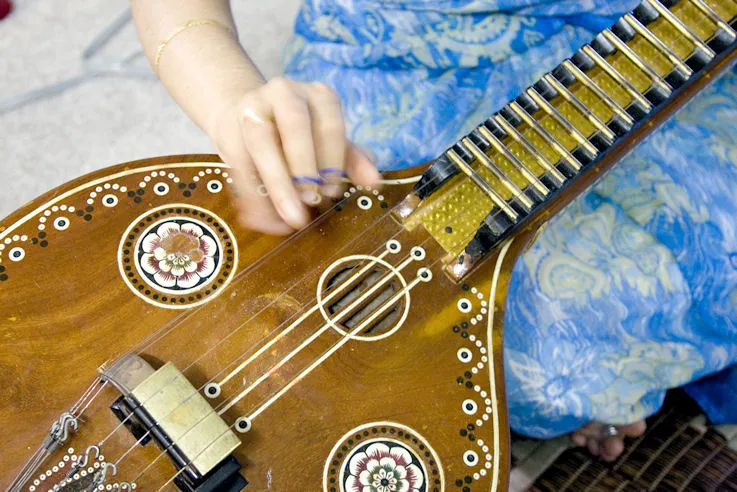
Fig.: वीणां वादयति
Vīṇā-Spielerin.
(Image source: Details)
भार m.: burden
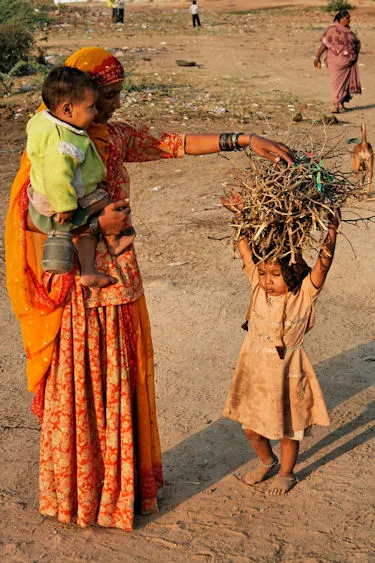
Fig.: बाला भारं हरति
Girl carrying a burden. Near Ahmedabad.
(Image source: Details)
भृत्य m.: subordinate, servant
28.11. Exercise
A) Form the causative of the following verb forms and participial forms and give the meaning:
1. With guṇa-grade root:
- अर्हन्ति
- प्राप्य
- एषिष्यन्ति
- कुप्यति
- कर्क्ष्यति
- क्रुध्यन्ती
- चोर्यते
- गन्तुम्
- जातः
- देक्ष्यन्ति
- दोग्धि
- माद्यन्
- द्रक्ष्यति
- द्वेष्टि
- नर्तितुम्
- भोत्स्यन्ते
- मुञ्चन्ति
- पृच्छन्ति
- मुह्यति
- योत्स्यन्
- रक्ष्यते
- रोदिति
- लुब्धा
- प्रविश्य
- वर्तते
- सिक्त्वा
- स्रक्ष्यति
- लिम्पन्ति
- वृद्धाः
2. With vṛddhi-grade root:
- अत्ति
- अस्यन्ति
- एष्यति
- संस्कृतम्
- चरति
- तनोति
- खाद्यते
- धक्ष्यति
- उपानैष्यति
- पच्यते
- पतन्ति
- पत्स्यते
- भक्तः
- भवति
- मंस्यन्ते
- म्रियते
- इज्यते
- वक्ति
- प्रोद्य
- शृणोति
- सुन्वन्ति
- स्तौति
- विस्मृत्य
- उषितः
- वसिता
- अश्नुते
- आस्ते
- त्यक्ष्यता
- धृतेन
- म्रियन्ते
- यजतः
- उक्ते
- उद्यन्ते
- शक्नुवन्ति
- श्रोष्यन्तः
- सीदति
- सोढायाः
- हरन्ती
- ऊढया
3. Causative in -पय
- स्थित्वा
4. Pay special attention to and learn the following causative forms
- दुष् — दूषयति
- पा 1 ("to drink") — पाययति
- पा 2 ("to protect") — पालयति
- लभ् — लम्भयति
- हन् — घातयति
- जि — जापयति
- जीव् — जीवयति
B. Translate the following sentences, resolve the compounds into Sanskrit, and form sentences using the simple verbs that express what happens when that which is expressed by the causative is effected:
Example: रामो दासं भारं हारयति » दासो भारं हरति
शत्रुजयाय क्षत्रियो ब्राह्मणेन हरिहरं याजयित्वारीन्योत्स्यते ॥१॥
गुरुर्बालान्वेदमध्याप्य गृहं गतः ॥२॥
गर्भगृहे देवीप्रतिमा दृश्यते ॥३॥
यजन्नग्निनान्नमादयति पानं च पाययति ॥४॥
पुत्रे जाते ब्राह्मणी दासं ब्राह्मणं गमयति । ब्राह्मणस्तं दासं गृहं प्रवेश्य पुत्रं पृच्छति । सुभगः पुत्र इति दासो वक्ति । तच्छ्रुत्वा ब्राह्मणो सुखतां गच्छति ॥५॥
स्तुवता नरेण देवा महाकवेः स्तोत्राणि श्राविताः ॥६॥
आर्ययोधैर्महायुद्धे ऽरयो मार्यन्ते ॥७॥
सत्क्षत्रिया ब्राह्मणेनेष्टदेवतापूजां कारयति । स ब्राह्मणः पूजां कृत्वा क्षत्रियाया धनमेषिष्यति ॥८॥
धनं जेतुं महाक्षत्रियो योधव्याघ्रैर्व्रतानि चारयिष्यति ॥९॥
पापान्मोक्षार्थेन सुगत आर्यजनानार्यसत्यानि बोधयति ॥१०॥
lekt2801: Jadavpur University Management building. [Image source: noii's Flickr, 2008-12-19, CC BY-SA]
lekt2802: ISKCON Temple Bangalore. [Image source: Ramki's reflections Flickr, 2008-12-19, CC BY-NC-ND]
lekt2803: Vīṇā player. [Image source: Kelvin Kay / Wikipedia. GNU FDLicense]
lekt2804: Kṛṣṇa and Rādhā. Painting by Rāja Ravi Varmā. [Image source: Wikipedia. Public domain]
lekt2805: Girl carrying a load. Near Ahmedabad. [Image source: m-bot. Flickr, 2008-12-20. CC BY-SA]