
Lesson 9
In this lesson you will learn:
- The Samāhāradvandva ("collective dvandva")
- The formation of nominal stems with the suffixes -ka (taddhita) and -aka (kṛt)
- Vocabulary related to professions and social roles
- Quotes from classical legal texts (Dharmaśāstras)
9.1. Samāhāradvandva (समाहारद्वन्द्व = "collective dvandva")
When a dvandva is intended to express that a series of things, etc., form a unity, it generally stands in the singular neuter:
e.g. āhāra-nidrā-maithuna-bhayam = आहारनिद्रामैथुनभयम् does not simply mean "food intake (āhāra m.), sleep (nidrā f.), mating (maithuna n.) and fear (bhaya n.)", but these four as a unity that characterizes animal life.
In addition to this basic rule for the formation of Samāhāradvandvas, there are a number of other rules that can be found in Pāṇini 2,4,2-17 or e.g. Mr. R. Kale, A higher Sanskrit grammar, reprint 1969, § 189 - 192 a. In the various stages of language development, the same rules were not always observed!
9.2. On the Formation of Nominal Stems
9.2.1. -ka (taddhita)
The taddhita suffix -ka forms among others:
1. Diminutives (diminutive forms like German -chen, -lein, -li, -le):
putra m. "son" » putraka m. पुत्रक "little son"
2. Nouns that denote an approximate similarity:
aśva m. "horse" » aśvaka m. अश्वक "little horse, a thing resembling a horse"
3. Nouns without semantic difference from the underlying noun:
putraka m. पुत्रक = putra m. पुत्र
4. Nouns that express "related to the concept of the base word":
kāśi f. "Benares" » kāśika 3 काशिक "native of Benares, originating from Benares"
rūpa n. "form" » rūpaka 3 रूपक "possessing the form of something"
9.2.2. -aka (kṛt), fem. often -ikā
The kṛt suffix -aka, feminine often -ikā, forms agent nouns (nouns expressing the agent) from any root.
A final vowel of the root and -a- at the penultimate position of the root are replaced by their lengthened grade (vṛddhi) (there are some exceptions), the other vowels are replaced by their strengthened grade (guṇa).
Examples:
| Root धातु | + -aka / -ikā (kṛt) | Meaning |
|---|---|---|
| kṛ 8 U कृ "machen" | kāraka (कारक) | "doer, making" |
| śru 5 P श्रु "hören" | śrāvaka m. (श्रावक) | "hearer, student, buddh.: follower of the Buddha" |
| nī 1 U नी "führen" | nāyaka m. (नायक) / nāyikā f. (नायिका) | "leader, master, husband, lover / beloved, lady" |
| yaj 1 U यज् "opfern" | yājaka m. (याजक) | "sacrificer, sacrificial priest" |
| nṛt 4 P नृत् "tanzen" | nartaka m. (नर्तक) / nartakī f. (नर्तकी) | "dancer / danceress" |
| ji 1 P जि "siegen" | jayaka 3 (जयक) | "victorious" |
Some of these formations have the narrower meaning: "that which habitually or as an obligation or well performs that expressed by the root".
see above e.g. śrāvaka, yājaka, jayaka
Examples:
| Root धातु | + -aka (kṛt) | Meaning |
|---|---|---|
| kṛṣ 6 U कृष् "pflügen" | kṛṣaka m. (कृषक) | "farmer" (weak grade!) |
| kliś 9 P क्लिशु "quälen" | kleśaka m. (क्लेशक) | "tormentor" |
| khād 1 P खाद् "kauen, essen" | khādaka m. (खादक) | "eater, glutton" |
In addition, there are some less important uses of the suffix -aka. Cf. Wackernagel, Altindische Grammatik, II, §45ff.
9.3. Word List
Learn the following words:
- adhyayana n. (अध्ययन) : learning, esp. Vedic study

Fig.: adhyayana = अध्ययन, Sri Skandaguru Vidyalayam, Tiruparankundram near Madurai.
(Image source: Details)
- kāru m. / kāruka m. (कारु / कारुक) : craftsman
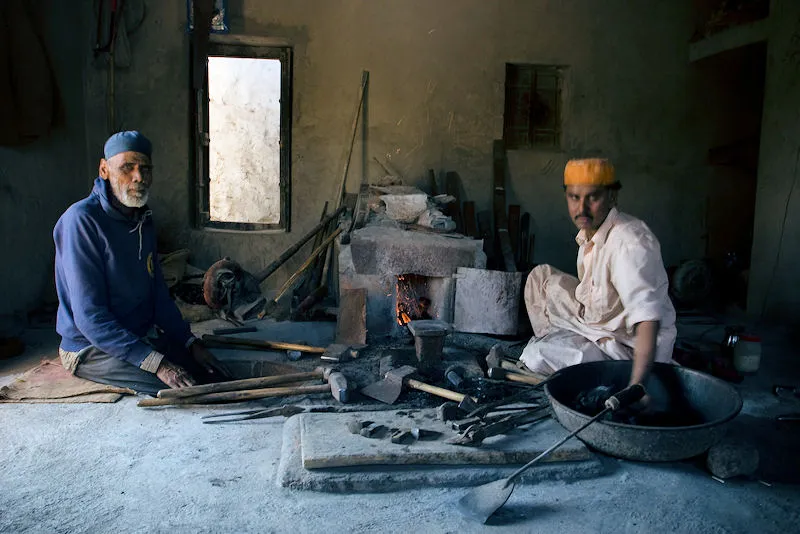
Fig.: kāru = कारु, Gujarat.
(Image source: Details)
- kuśīlava m. (कुशीलव) : (wandering) showman, actor, singer
- kusīda n. (कुसीद) : usury
- kṛṣ 1 P (karṣati) कृष् कर्षति : to pull
- kṛṣ 6 U (kṛṣati) कृष् कृषति : to plow
- from this: kṛṣi f. / kṛṣikā f. (कृषि / कृषिका) : agriculture
- dāna n. (दान) : giving, gift, generosity
- pratigraha m. (प्रतिग्रह) : receiving, gift
- pravacana n. (प्रवचन) : speech, (oral) instruction
- pāśupālya n. (पाशुपाल्य) : cattle keeping, cattle breeding
- to yaj 1 U:
- ijyā f. (इज्या) : sacrifice (from *yj » ij + suffix yā)
- yajana n. (यजन) : sacrifice on behalf of someone else
- rūpa n. (रूप) : appearance, form, beautiful form, nature, essence
- vāṇijya n. / vāṇijyā f. / vaṇijyā f. (वाणिज्य / वाणिज्या / वणिज्या) : trade
- śuśrūṣā f. (शुश्रूषा) : obedience, obedient service
9.4. Exercise
A) Try to determine the possible meanings of the following words:
1. brāhmāṇaka ब्राह्मणक
2. mati मति
3. śravaṇa श्रवण
4. dhenuka m. धेनुका
5. jayaka जयक
6. rakṣikā रक्षिका
7. karṣaka कर्षक

Fig.: karṣaka = कर्षक.
(Image source: Details)
8. kleśa (क्लेश)
9. nāyikātva (नायिकात्व)
10. tantraka (तन्त्रक)
11. nartaka (f. nartakī) (नर्तक / नर्तकी)
12. naraka (नरक)
13. lābhaka (लाभक)
14. īśvaratā (ईश्वरता)
15. dhenukā f. (धेनुका)
16. yodhaka (योधक)
17. kopa (कोप)
18. veśaka (वेशक)
19. darśaka (दर्शक)
20. kopaka (कोपक)
B) Translate:
Duties of all twice-born:
ijyādhyayanadānāni
इज्याध्ययनदानानि
(Yājñavalkyadharmaśāstra I, 118)Specific duties of a Brāhmaṇa:
pravacanayājanapratigrahāḥ
प्रवचनयाजनप्रतिग्रहाः
(Gautamadharmasūtra X, 2)Specific duties of a Kṣatriya:
rakṣaṇaṃ sarvabhūtānām
रक्षणं सर्वभूतानाम्
(sarvabhūtānām = Genitive (oblique case): "of all beings"; Gautamadharmasūtra X, 7)Specific duties of a Vaiśya:
kṛṣivāṇijyapāśupālyakusīdam
कृषिवाणिज्यपाशुपाल्यकुसीदम्
(according to Gautamadharmasūtra X, 49)Duties of a Śūdra:
dvijātīnāṃ śuśrūṣā vārttā kārukuśīlavakarma ca.
द्विजातीनां शुश्रूषा वार्त्ता कारुकुशीलवकर्म च
(according to Kauṭilīya-Arthaśāstra 1.3.8.)
Explanation: dvijātīnām = Genitive (oblique case) plural of dvijāti (translate here: "towards the twice-born"); kārukuśīlavakarma is a Tatpuruṣa compound with a Dvandva (kārukuśīlava) in the prior member. karma = Nom. sg. of karman n. "deed, activity, karma" from the root kṛ 8 U). Translate "deed / activity of the ... (Genitive)" (designated by the Dvandva).kṛṣiḥ pāśupālyaṃ vāṇijyā ca vārttā.
कृषिः पाशुपाल्यं वाणिज्या च वार्त्ता ।
(according to Kauṭilīya-Arthaśāstra 1.4.1.)