
Lesson 5
In this lesson, you will learn:
- Fundamentals of nominal compounds (samāsa)
- Technical terminology for compounds
- Copulative compounds (Dvandva)
- The order of members in Dvandvas
5.1. Nominal Compounds (samāsa m. = समास)
The formation of word compounds on a very large scale is a characteristic feature of Sanskrit.
The most important forms of compound formation are:
- copulative compounds (dvandva n. = द्वन्द्व)
- determinative compounds (tatpuruṣa m. = तत्पुरुष)
- possessive compounds (bahuvrīhi m. = बहुव्रीहि)
(See later for the latter two!)
5.2. On Sanskrit Terminology for Compounds
- ghaṭakapadāni n. pl. = घटकपदानि : members of a compound
- vigrahavākyam n. = विग्रहवाक्यम् : resolution of a compound
- nityasamāsaḥ m. = नित्यसमासः : compound for which there is no vigrahavākya or whose vigrahavākya is not possible with the words of the compound.
- aluksamāsaḥ m. = अलुक्समासः : compound in which the first member retains a case ending
- luksamāsaḥ m. = लुक्समासः : compound whose first members are without case endings (the normal case)
- madhyamapadalopī m. = मध्यमपदलोपी : compound in which one or more middle members are omitted
5.3. Copulative Compounds (Dvandva n. = द्वन्द्व)
Copulative compounds serve to link grammatically similar, coordinated members (nouns or adjectives).
A Dvandva denotes:
either the summative connection of the persons, things, or properties designated by its individual members:
Itaretaradvandva = इतरेतरद्वन्द्वor it combines these persons, things, or properties into a single unit:
Samāhāradvandva ("summary dvandva") = समाहारद्वन्द्व
In the first case (Itaretaradvandva):
The Dvandva receives the grammatical gender of its last member and the endings of the dual (for two things) or the plural (for more than two things). Singular endings are also permissible.
In the second case (Samāhāradvandva):
The Dvandva is generally neuter (independent of the gender of the last member) and stands in the singular.
The resolution:
Occurs with "and" (ca = च), occasionally with "or" (vā = वा) or "each".
See later for dual Dvandvas!
5.3.1. First Members of Compounds
The first members of compounds (not only Dvandvas) generally have the form of the unchanged nominal stem. The individual members of compounds are connected according to the rules of sentence sandhi (i.e., the sandhi we have learned so far, in contrast to word sandhi, which applies within the word before formative elements).
5.3.2. इतरेतरद्वन्द्वसमासस्य बहुवचनम्
Examples of plural Dvandva:
brāhmaṇa-kṣatriya-vaiśya-śūdrāḥ = ब्राह्मणक्षत्रियवैश्यशूद्राः
= brāhmaṇāḥ kṣatriyā vaiśyāḥ śūdrāś ca = ब्राह्मणाः क्षत्रिया वैश्याः शूद्राश्च
(Brahmans, Kṣatriyas, Vaiśyas, and Śūdras)or = brāhmaṇaḥ kṣatriyo vaiśyaḥ śūdraś ca = ब्राह्मणः क्षत्रियो वैश्यः शूद्रश्च
((a/the) Brahman, Kṣatriya, Vaiśya, and Śūdra)
kavi-guravaḥ = कविगुरवः
= kavayo guravaś ca = कवयो गुरवश्च
(poets and teachers [Plur.])
(Note: "A poet and a teacher" would have to be in the dual!)
For the order of members in a Dvandva, the following rules apply among others:
- The designation of the various castes (varṇa) should be ordered according to their hierarchy (highest first).
- The name of the older brother should precede the name of the younger brother.
- In general, the more important word should be placed at the beginning.
- Words ending in -i or -u should precede.
- Words ending in -a and beginning with a vowel should precede.
- Words containing fewer syllables should precede.
If two of the three last-mentioned regulations can apply simultaneously, the rule given later should always be followed. (Examples of dual Dvandvas for these rules in Kielhorn, Grammar § 570).
5.4. Word List
Learn the following words:
abhiniveṣa m. = अभिनिवेष : inclination, tenacity, insistence; specifically: attachment to the body as if it were something one's own.
kāma m. = काम : wish, desire, desired gift, sensual pleasure, love; the god of love Kāma.
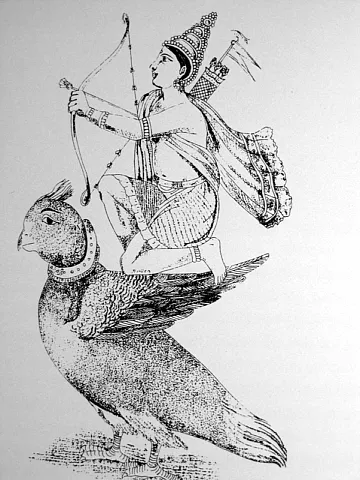
Fig.: God Kāma = kāmadeva = कामदेव, 18th century
(Image source: Wikipedia, Public domain)
krodha m. = क्रोध : anger.
kleśa m. = क्लेश : torment, plague.
trayī f. = त्रयी : triad; in particular, the three Vedas (Ṛgveda, Sāmaveda, Yajurveda).
daṇḍanīti f. = दण्डनीति : politics (a Tatpuruṣa compound from daṇḍa m. = "staff, power, rule, punishment" and nīti f. = "right guidance").
dvijāti 3 / dvija 3 = द्विजाति / द्विज : twice-born.
dveṣa m. = द्वेष : hatred.
maitrī f. = मैत्री : friendship, friendliness, friendly goodwill.
rāga m. = राग : (red) color, passion, love.
lobha m. = लोभ : greed, avarice.
varṇa m. = वर्ण : color, genus, caste.
vārttā f. = वार्त्ता : livelihood, economics (economy).
vidyā f. = विद्या : knowledge, science.
avidyā f. = अविद्या : ignorance, non-knowledge.
ca = च : and.
(It is placed after the word it connects. If several words are connected, it ideally stands behind the first word of the last connecting member: brāhmaṇāḥ kṣatriyā vaiśyāḥ śūdrāś ca = ब्राह्मणाः क्षत्रिया वैश्याः शूद्राश्च).
ca ... ca = च ... च : both ... and.
5.5. Exercise
A) Translate the following sentences and compounds and resolve the Dvandvas occurring therein into Sanskrit:
catvāro varṇā brāhmaṇakṣatriyavaiśyaśūdrāḥ.
(Āpastambīyadharmasūtra I,1,1,4 = Vāsiṣṭhadharmaśāstra II,1)
चत्वारो वर्णा ब्राह्मणक्षत्रियवैश्यशूद्राः ॥
(Explanation: catvāras = चत्वारस् = "four")The three varṇas, the twice-born: brāhmaṇa, kṣatriya, and vaiśya.
(Vāsiṣṭhadharmaśāstra II,1)
त्रयो वर्णा द्विजातयो ब्राह्मणक्षत्रियवैश्याः ॥
(Explanation: trayas = त्रयस् = "three")The sāmaveda, the ṛgveda, and the yajurveda: the Trayī.
(Kauṭilīya-arthaśāstra 1.3.1. / in good Sanskrit: sāmārgyajurvedās trayī)
सामवेदर्ग्वेदयजुर्वेदास्त्रयी ॥
(in good Sanskrit: सामार्यजुर्वेदास्त्रयी)The three enemies of man, which form the gate to hell (Viṣṇusmṛti 33,1+6):
kāmakrodhalobhāḥ
कामक्रोधलोभाः ॥maitrī, karuṇā, muditā, and upekṣā: the four brahmavihārās.
मैत्रीकरुणामुदितोपेक्षाश्चत्वारो ब्रह्मविहाराः ॥
(Explanation: brahmavihāra: "states of abiding in Brahman", also called "the Immeasurables". They are Buddhist meditation practices.)avidyā, asmitā, rāga, dveṣa, and abhiniveśa: the five kleśās.
(Yogasūtra 2,3)
अविद्यास्मितारागद्वेषाभिनिवेषाः पञ्च क्लेशाः ॥
(Explanation: pañca = "five")ānvīkṣikī, Trayī, and vārttā; daṇḍanitaya: the three vidyās.
(According to Kauṭilīya-arthaśāstra 1.2.1.)
आन्वीक्षिकीत्रयीवार्त्तादण्डनितयो विद्याः ॥
5.6. Review Exercise
A) Translate:
vidyā vārttā.
विद्या वार्त्ता ।brāhmaṇaḥ kṣatriyo vaiśyaś ca trayo varṇā dvijātayaḥ.
ब्राह्मणः क्षत्रियो वैश्यश्च त्रयो वर्णा द्विजातयः ।dvijā vaiśyāḥ. (2 possibilities)
द्विजा वैश्याः ।
B) Insert the corresponding form:
(dvija, sādhu, kavi) ... rāmaḥ
(द्विज, साधु, कवि) ... रामः ।(devī) ... indrāṇī
(देवी) ... इन्द्राणी ।dvijātayas ... (vaiśyā, kṣatriya)
द्विजातयस् ... (वैश्या, क्षत्रिय) |
C) Resolve the compound in the following sentence into Sanskrit and form the same sentence with this resolved form:
sāmargyajurvedās trayī.
सामर्ग्यजुर्वेदास्त्रयी ।
D) Translate into Sanskrit in two ways (once with a compound, once without):
"States of abiding in Brahman" are: friendly goodwill, compassion, sympathetic joy, and equanimity.