
Lesson 1 [Test]
गणेशपूजनम्
gaṇeśapūjanam
Veneration of Gaṇeśa
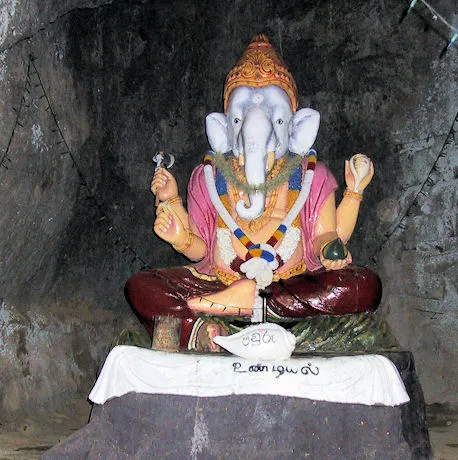
Fig.: Gaṇeśa, Adamspeak, Sri Lanka
(Image source: Details)
sig[लम्बोदर नमस् तुभ्यं]
sig[सततं मोदकप्रिय |]
sig[निर्विघ्नं कुरु मे देव]
sig[सर्वकार्येषु सर्वदा |]
lambodara namas tubhyaṃ
satataṃ modakapriya |
nirvighnaṃ kuru me deva
sarvakāryeṣu sarvadā |
You with the hanging belly, you sweet-toothed one,
May you always be honored!
God, make all my undertakings
Free from obstacles!
मङ्गलचरणम्
maṅgalacaraṇam
"Auspicious Beginning"
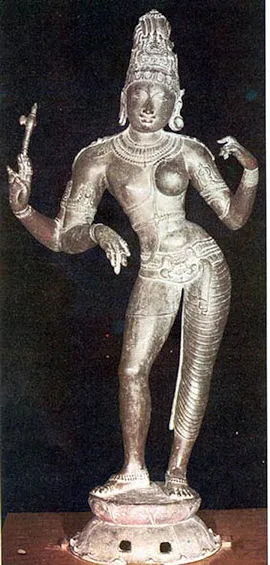
Fig.: Ardhanarīśvara
(Image source: Details)
sig[वागर्थाविव संपृक्तौ]
sig[वागर्थप्रतिपत्तये |]
sig[जगतः पितरौ वन्दे]
sig[पार्वतीपरमेश्वरौ |]
vāgarthāviva saṃpṛktau
vāgarthapratipattaye |
jagataḥ pitarau vande
pārvatīparameśvarau |
(Kālidāsa: Raghuvaṃśa 1.1)
I salute the parents of the world,
Pārvatī and Śiva,
Who are so firmly united
As word and meaning for the understanding
Of the meaning of the word.
At the beginning, a curiosity:
"When William Jones [1746–1794] and Henry Thomas Colebrooke (1765—1857) first thoroughly studied, partially translated, and found that Sanskrit possessed a rich literature and considerable affinity with the classical languages, they encountered considerable resistance. Since this intimate relationship of Sanskrit to the geographically so distant European languages could not be reconciled with the old views, which either derived all languages from Hebrew or largely isolated them from one another, the famous philologist Dugald Steward (1753—1828) took the simplest way out by declaring the entire history with the Sanskrit language to be a lie. He wrote an essay in which he attempted to prove that it had been forged by the rascally Brahmins according to the model of Greek and Latin, and that both the language and the literature were forgeries. This view was further developed in 1840 by the professor in Dublin, Charles William Wall, at length (Göttingische gelehrte Anzeigen 1842 p. 1888)."
[Source: Kemmerich, Max <1876-1932>: Kultur-Kuriosa. -- Munich : Langen. -- Vol. 2. -- 1923. -- p. 74. -- Online: http://www.archive.org/details/kulturkuriosa02kemmuoft. -- Accessed on 2010-01-10]
1.1. Literature for Beginners in Indology
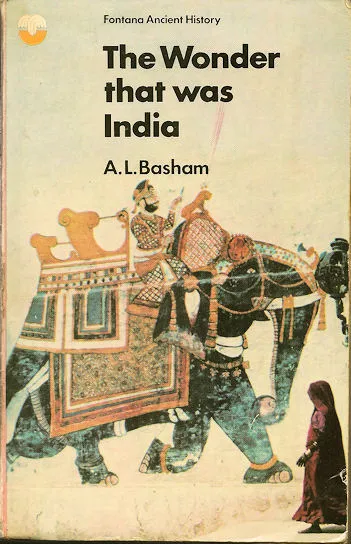
Fig.: Cover title of a paperback edition
(Image source: Details)
Basham, A. L. (Arthur Llewellyn) <1914-1986> The wonder that was India Part: A survey of the culture of the Indian sub-continent before the coming of the Muslims. -- London : Sidgwick & Jackson, 1954. -- Since then many editions, including paperback editions. -- Mandatory reading. A good overview of life, history, and culture in pre-Muslim India. Comprehensive overview of the various fields of classical Indology.
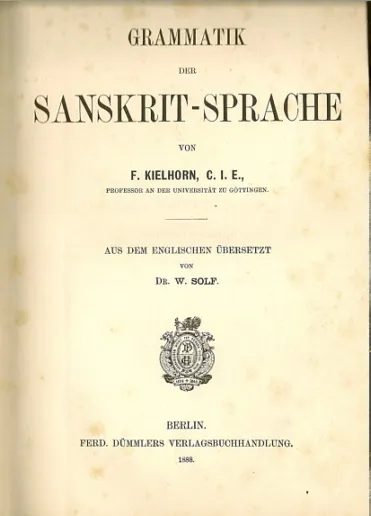
Fig.: Title page
(Image source: Details)
Best systematic grammar:
Kielhorn, Franz <1840-1908>: Grammar of the Sanskrit Language / Translated from English by W. Solf [1862 - 1936]. -- Berlin : Dümmler, 1888. -- XIII, 238 p. -- Original title: A grammar of the Sanscrit language
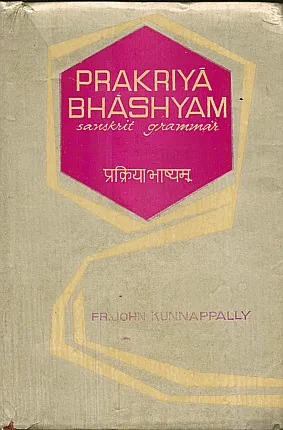
Fig.: Cover title
(Image source: Details)
Good systematic grammar based on indigenous grammarians and at the same time an introduction to Pāṇini:
Kunnappally, John: Prakriyā bhāshyam : Sanskrit grammar / Originally written in Malayalam. Translated into English by K.V.R. Pai. -- Parathode : Self-published, 1983. -- 818 p. ; 23 cm.
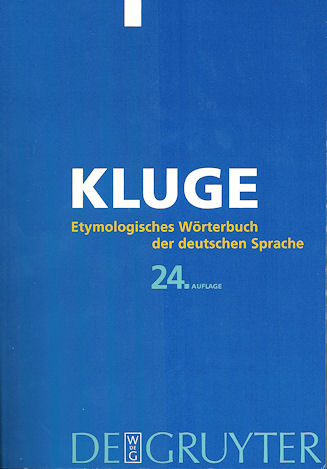
Fig.: Binding title
(Image source: Details)
A good, concise presentation of European linguistic terminology can be found in:
Etymological Dictionary of the German Language / [Friedrich] Kluge <1856 - 1926>. Edited by Elmar Seebold. -- 24th, revised and expanded ed. -- Berlin [et al.] : de Gruyter, 2002. - LXXXIX, 1023 p. : 24 cm. -- ISBN 3-11-017473-1 Paperback. -- pp. XIII - XLVII.

Fig.: Cover title
(Image source: Details)
For the curious to look up:
Lexicon of Linguistics / edited by Hadumod Bußmann. -- 4th, revised and bibliographically supplemented ed. / with the collaboration of Hartmut Lauffer. -- Stuttgart : Kröner, 2008. -- 816 p. ; 22 cm. -- ISBN 978-3-520-45204-7
1.2. The Sounds of Sanskrit
The sounds of Sanskrit according to the traditional Indian classification and their scientific transcription.
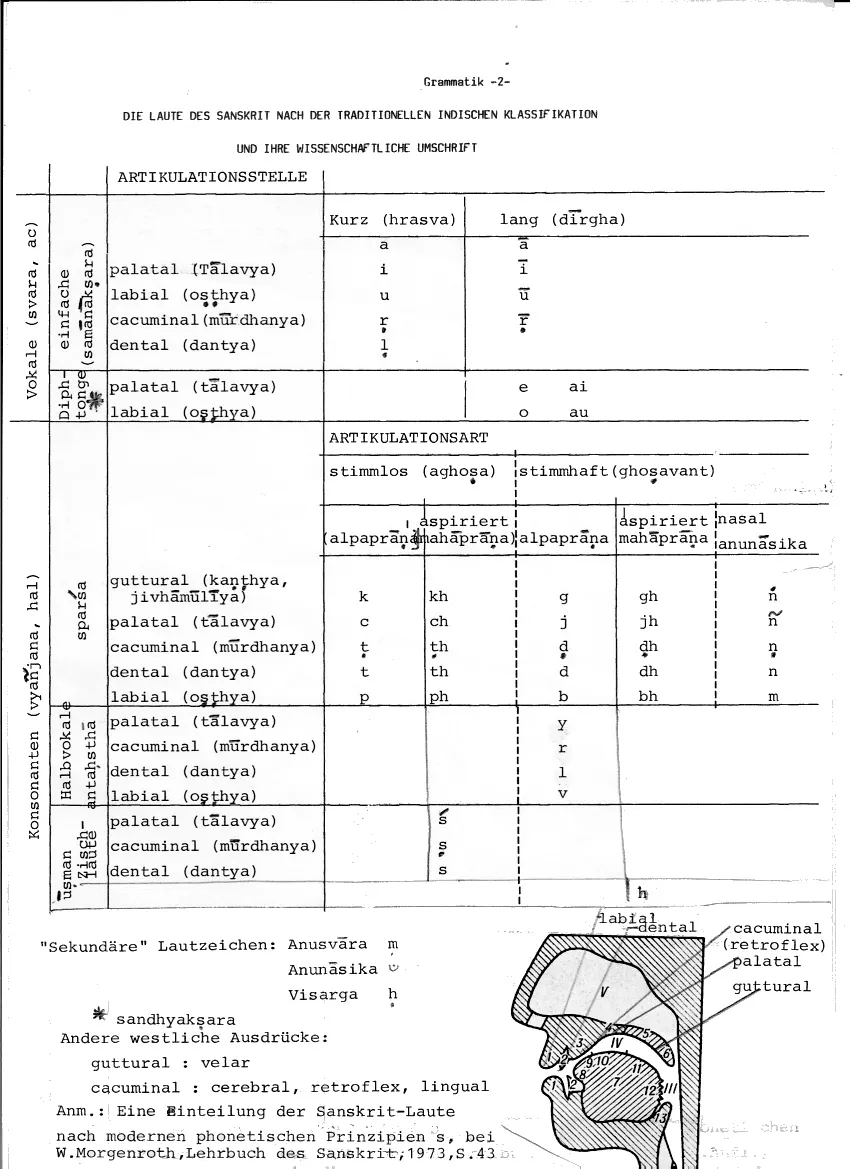
(Image source: Details)
Modern dictionaries of Sanskrit are arranged in the order of this classification. This classification and the order of the sounds are essential for understanding Sanskrit grammar and therefore must be memorized:
Classification
- simple vowels (samānākṣara -- समानाक्षर):
अ a, आ ā, इ i, ई ī, उ u, ऊ ū, ऋ ṛ, ॠ ṝ, ऌ ḷ - Diphthongs (sandhyakṣara -- सन्ध्यक्षर):
ए e, ऐ ai, ओ o, औ au - Consonants (vyañjana / hal -- व्यञ्जन / हल्):
क ka, ख kha, ग ga, घ gha, ङ ṅa
च ca, छ cha, ज ja, झ jha, ञ ña
ट ṭa, ठ ṭha, ड ḍa, ढ ḍha, ण ṇa
त ta, थ tha, द da, ध dha, न na
प pa, फ pha, ब ba, भ bha, म ma
य ya, र ra, ल la, व va
श śa, ष ṣa, स sa
ह ha
1.2.1. On the pronunciation of individual sounds
| Sound | Description |
|---|---|
| a - अ | "short a" is often pronounced by Indians -- since ancient times -- as ə. In Europe it is pronounced as short a, in Bengal as short dark o. |
| ṛ - ऋ | like Czech vocalized r. Light echo of i. |
| ṝ - ॠ | like Bohemian vocalized r. Lighter resonance of u. |
| jñ - ज्ञ् | also like dny (Marāṭhī) or gy (North Indian). |
| ś - श् | sch-sound with tongue tip bent downward. Similar to sch in "mischen". |
| ṣ - ष् | ach-sound with tongue tip curled back. Often articulated so far back in the throat that it sounds almost like kh. |
| h - ह् | Aspiration sound, never a lengthening mark. |
| ḥ - : | Visarga (Visarjanīya) -- विसर्ग / विसर्जनीय. Voiceless aspiration with resonance of the preceding vowel or the second part of the preceding diphthong: agniḥ -- अग्निः = agnihi, devaiḥ -- देवैः = devaihi, gauḥ -- गौः = gauhu |
| ṃ | Anusvara -- अनुस्वर. Before sibilants, h, l: nasalization of the vowel. Word-finally = m. Word-internally before consonants: the nasal corresponding to the following consonant: saṃdhi -- संधि = sandhi -- सन्धि |
The best pronunciation is achieved by reading the sentences, verses, or words quite slowly and monotonously, with exact consideration of the length of the vowels.
1.3. Exercise
A) Read the following words:
- varṇa brāhmaṇaḥ kṣatriya vaiśya śūdra — वर्ण ब्राह्मणः क्षत्रिय वैश्य शूद्र
- brahmā viṣṇu śiva — ब्रह्मा विष्णु शिव
- āśrama brāhmacārin gṛhastha vānaprastha saṃnyāsin — आश्रम ब्राह्मचारिन् गृहस्थ वानप्रस्थ संन्यासिन्
- ṛgveda sāmaveda yajurveda atharvaveda — ऋग्वेद सामवेद यजुर्वेद अथर्ववेद
- upaniṣad — उपनिषद्
- jaina bauddha — जैन बौद्ध
- prajñāpāramitā — प्रज्ञापारमिता
- cakra vajra — चक्र वज्र
- pitṝn — पितॄन्
- saṃskṛta — संस्कृत
B) Read the Sanskrit expressions in the sound classification above.