
Lesson 60
60.1. लिट्लकारस्य द्विवचनप्रत्ययाः
| परस्मैपदम् | आत्मनेपदम् | |
|---|---|---|
| 1. तृतीयः | -va | -vahe |
| 2. मध्यमः | -athur | -āthe |
| 3. प्रथमः | -atur | -āte |
60.2. द्वित्वलिट्लकारस्य द्विवचनम्
60.2.1. Type 1: no stem gradation
बन्ध् 9P "to bind"
| परस्मैपदम् | |
|---|---|
| 1. तृतीयः | बबन्धिव |
| 2. मध्यमः | बबन्धथुर् |
| 3. प्रथमः | बबन्धतुर् |
भाष् 1Ā "to speak"
| आत्मनेपदम् | |
|---|---|
| 1. तृतीयः | बभाषिवहे |
| 2. मध्यमः | बभाषाथे |
| 3. प्रथमः | बभाषाते |
60.2.2. Type 2: strong stem strong grade, weak stem low grade
भिद् 7U "to split"
| परस्मैपदम् | आत्मनेपदम् | |
|---|---|---|
| 1. तृतीयः | बिभिदिव | बिभिदिवहे |
| 2. मध्यमः | बिभिदथुर् | बिभिदाथे |
| 3. प्रथमः | बिभिदतुर् | बिभिदाते |
60.2.3. Type 3: Strong stem strong grade/lengthened grade
60.2.3.1. Type 3a: Strong stem strong grade/lengthened grade, weak stem low grade
नी 1U "to lead"
| परस्मैपदम् | आत्मनेपदम् | |
|---|---|---|
| 1. तृतीयः | निन्यिव | निन्यिवहे |
| 2. मध्यमः | निन्यथुर् | निन्याथे |
| 3. प्रथमः | निन्यतुर् | निन्याते |
स्तु 2U (अनिट्) "to praise"
| परस्मैपदम् | आत्मनेपदम् | |
|---|---|---|
| 1. तृतीयः | तुष्टुव | तुष्तुवहे |
| 2. मध्यमः | तुष्टुवथुर् | तुष्टुवाथे |
| 3. प्रथमः | तुष्टुवतुर् | तुष्टुवाते |
कृ 8U (अनिट्) "to do, to make"
| परस्मैपदम् | आत्मनेपदम् | |
|---|---|---|
| 1. तृतीयः | चकृव | चकृवहे |
| 2. मध्यमः | चक्रथुर् | चक्राथे |
| 3. प्रथमः | चक्रतुर् | चक्राते |
60.2.3.2. Type 3b: Strong stem strong grade/lengthened grade, weak stem strong grade
स्मृ 1P "to present, to make present"
| परस्मैपदम् | |
|---|---|
| 1. तृतीयः | सस्मरिव |
| 2. मध्यमः | सस्मरथुर् |
| 3. प्रथमः | सस्मरतुर् |
60.2.4. Type 4: Roots ending in -ā / -ai
दा 3U "to give"
| परस्मैपदम् | आत्मनेपदम् | |
|---|---|---|
| 1. तृतीयः | ददिव | ददिवहे |
| 2. मध्यमः | ददथुर् | ददाथे * |
| 3. प्रथमः | ददतुर् | ददाते * |
* identical to the corresponding forms of the indicative present!
60.2.5. Type 5: Consonant-a-Consonant
60.2.5.1. Type 5a: Consonant-a-Consonant, weak stem low grade
गम् 1U "to go"
| परस्मैपदम् | आत्मनेपदम् | |
|---|---|---|
| 1. तृतीयः | जग्मिव | जग्मिवहे |
| 2. मध्यमः | जग्मथुर् | जग्माथे |
| 3. प्रथमः | जग्मतुर् | जग्माते |
60.2.5.2. Type 5b: Consonant-a-Consonant, initial consonant not a guttural, aspirate, h, Weak stem without reduplication, with -e-
पच् 1U "to want"
| परस्मैपदम् | आत्मनेपदम् | |
|---|---|---|
| 1. तृतीयः | पेचिव | पेचिवहे |
| 2. मध्यमः | पेचथुर् | पेचाथे |
| 3. प्रथमः | पेचतुर् | पेचाते |
60.2.5.3. Type 5c: Consonant-a-Consonant, weak stem strong grade
क्रम् 1U "to stride"
| परस्मैपदम् | आत्मनेपदम् | |
|---|---|---|
| 1. तृतीयः | चक्रमिव | चक्रमिवहे |
| 2. मध्यमः | चक्रमथुर् | चक्रमाथे |
| 3. प्रथमः | चक्रमतुर् | चक्रमाते |
60.3. अनुप्रयोगलिट्लकारस्य द्विवचनम्
गण् 10P "to count"
| परस्मैपदम् | |
|---|---|
| 1. तृतीयः | गणयां चकृव गणयामासिव गणयां बभूविव |
| 2. मध्यमः | गणयां चक्रथुर् गणयामासथुर् गणयां बभूवथुर् |
| 3. प्रथमः | गणयां चक्रतुर् गणयामासतुर् गणयां बभूवतुर् |
आस् 2Ā "to sit"
| आत्मनेपदम् | |
|---|---|
| 1. तृतीयः | आसां चकृवहे आसामासिव आसां बभूविवव् |
| 2. मध्यमः | आसांव् चक्राथे आसामासथुर् आसां बभूवथुर् |
| 3. प्रथमः | आसां चक्राते आसामासतुर् आसां बभूवतुर्व् |
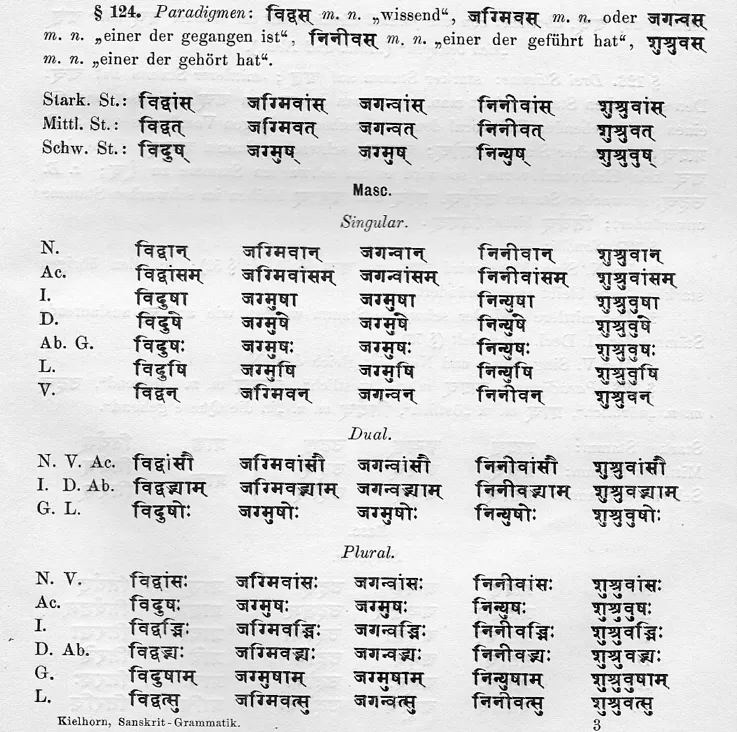
60.4. The participle परस्मैपद of the reduplicated perfect (द्वित्वलिट्)
Formation:
weak perfect stem + vāṃs
If the weak perfect stem consists of only one syllable, the connecting vowel -i- is added. In some perfects, the connecting vowel is optional.
Examples:
| भिद् 7U | बिभिद्वांस् "one who has split" |
|---|---|
| अस् 2P; 4P | आसिवांस् "one who has been" ; "one who has thrown" |
| दा 3U | ददिवांस् (da-d-i-vāṃs) "jemand, der gegeben hat" |
| पच् 1U | पेचिवांस् "one who has cooked" |
| गम् 1U | जग्मिवांस् / जगन्वांस् "one who has gone" |
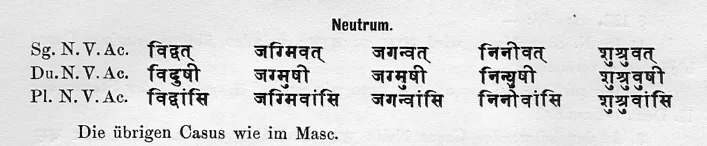
Declension:
- strong stem: -vāṃs
- weak stem:
- before consonant: -vat (!)
- before vowel: -uṣ
Before uṣ, the connecting vowel -i- is dropped.
Feminine:
weak stem before vowel + -ī (declined like देवी)
Example: विदुषी "a knowing one"
See Kielhorn, Grammar § 124 for paradigms:
(Image source: Details)
(Image source: Details)
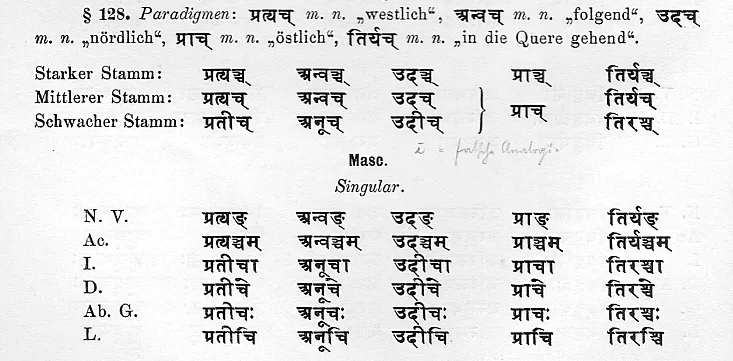
60.5. Declension of stems in -añc (-ac)
The stems in -añc/-ac are combinations of prefixes, etc., with the root noun of the root अञ्च् / अच् 1U "to move".
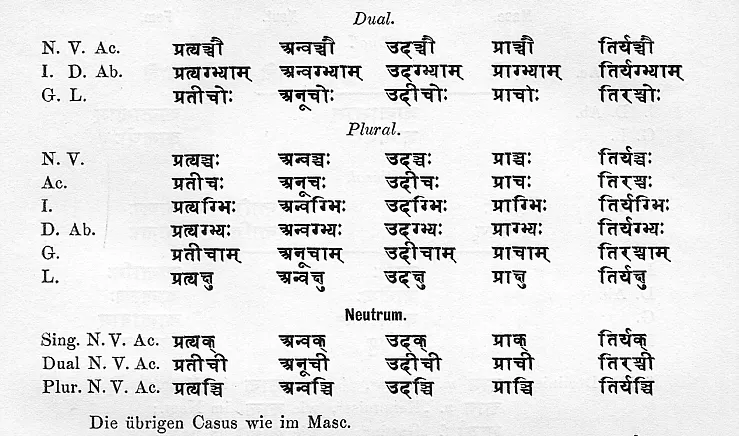
60.5.1. Three-stemmed stems in -añc
Formation:
- strong stem: -añc
- weak stem:
- before consonant: -ac
- before vowel:
- the -a- of the weak stem -ac is dropped and a preceding semivowel is replaced by the corresponding long vowel:
प्रत्यच् » प्रतीच्
अन्वच् » अनूच् - If no semivowel precedes -ac, -ac is replaced by -īc:
उदच् » उदीच् - तिर्यञ्च् » तिरश्
- the -a- of the weak stem -ac is dropped and a preceding semivowel is replaced by the corresponding long vowel:
Feminine:
weak stem before vowel + -ī (declined like देवी)
Example: प्रतीची
Paradigms see Kielhorn, Grammar § 128:
(Image source: Details)
(Image source: Details)
These include:
प्रत्यञ्च् 3 "backward, western"
अन्वञ्च् 3 "following"
उदञ्च् 3 "directed upward, northern"
तिर्यञ्च् 3 "going horizontally (of animals"
सम्यञ्च् 3 "correct"
न्यञ्च् 3 "low"
विष्वञ्च् 3 "going in all directions"
60.5.2. Two-stem stems in -añc
Formation:
- strong stem: -añc
- weak stem before consonant or vowel: -ac
These include:
- प्राञ्च् 3 "directed forward, eastern"
- अवाञ्च् 3 "directed downward"
Paradigm प्राञ्च् see above!
The main cardinal directions
| उदञ्च् 3 "nach oben gerichtet, nördlich" | ||
|---|---|---|
| प्रत्यञ्च् 3 "rückwärts, westlich" | 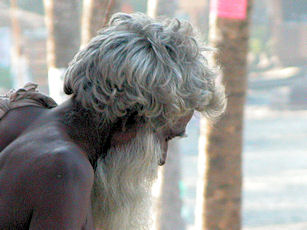 | प्राञ्च् 3 "vorwärts gerichtet, östlich" |
| दक्षिण 3 rechts, südlich |
(Image source: Details)
60.6. The Desiderative (सन्)
A desiderative (सन्) can be formed from every root as well as from the causative. The desiderative can be conjugated in all tenses and moods of the P, Ā, and passive. Desiderative forms outside the present stem, however, are very rare.
Meaning:
- a person or thing wishes to do or to undergo what is expressed by the root or the causative
- rarely: someone or something is about to do what is expressed by the root or the causative
Examples:
| कृ 8U | चिकीर्षति "he wishes to do" |
|---|---|
| पत् 1P | पिपतिषति "he is about to fall" |
| चुर् 10U | चुचोरयिषति "he wishes to steal" |
| बुध् Caus. | बुबोधयिषति "he wishes to instruct (to awaken to knowledge)" |
60.6.1. Formation of the desiderative stem
Roots of present classes 1 - 9:
reduplicated root + sa
or:
reduplicated root + i + ṣa
The rules for the use of the connecting vowel -i- see in Kielhorn, Grammar § 443 - 445.
Roots of the 10th present class and causatives:
reduplicated present stem + i + ṣa
Form of the root:
The root is mostly in the guṇa grade: जीव् » जिजीविष-
final -i, -u is replaced by -ī or -ū if no connecting vowel follows:
जि » जिगीष- "to wish to conquer"
द्रु » दुद्रूष- "to wish to run"final -ṛ, -ṝ is replaced by -īr, after labials by -ūr, if no connecting vowel follows:
कृ » चिकीर्ष- "to wish to do"
मृ » मुमूर्ष- "to be about to die"
पॄ » पुपूर्ष- "to wish to fill"दा, धा, मा and some other roots ending in -ā, -e, -o have the zero-grade:
दा » दित्स- (di-d + sa)
धा » धित्स-
मा » मित्स-
Roots with the strong grade form the desiderative:
most roots ending in -ā (-e, -ai, etc.):
गै » जिगास- "to wish to sing"
पा » पिपास- "to wish to drink, to thirst"most roots of the form (consonant -) a / ā - consonant:
दह् » दिधक्ष- "to wish to burn"
खाद् » चिखादिष- "to wish to chew"upon the addition of the connecting vowel -i-:
obligatory: roots of the form i/u - consonant and (consonant -) ṛ/ḷ - consonant:
इष् » एषिषिष- "to wish to desire"
कॢप् » चिकल्पिष- "to wish to be fitting"
स्मि » सिस्मयिष- "to wish to smile"optional: roots of the form consonant - (consonant -) i/u - consonant except -v_
द्युत् » दिद्योतिष- / दिद्युतिष- "to wish to flash"
Regarding reduplication:
Consonant-initial roots: Reduplication occurs on the roots modified according to the above rules, following the usual rules. Instead of a, the reduplication vowel i appears:
पा » पिपास-
त्यज् » तित्यज-
चुर् » चुचोरयिष-
The cerebralization after i/u of final -s of the root is omitted if the s of the desiderative suffix is cerebralized:
स्मि » सिस्मयिष-Vowel-initial roots are reduplicated according to the corresponding rules for the reduplicated aorist (Lesson 56):
इष् » एषिषिष- (eṣ-i-ṣ-i-ṣa)
ईक्ष » ईचिक्षिष- (ī-c-i-kṣ-i-ṣa)
ऋ » अरिरिष-For the special desiderative formation of certain roots, see Kielhorn, Grammar § 451.
Desideratives are formed for certain roots without desiderative meaning. Desideratives with desiderative meaning can be formed from these desideratives.
List in Kielhorn, Grammar § 452:
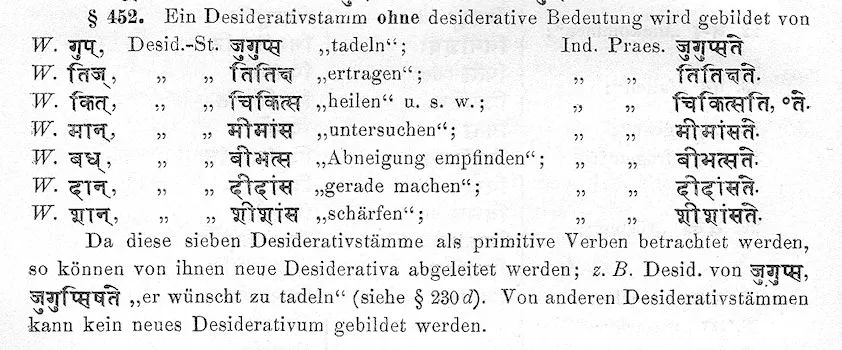
(Image source: Details)
60.6.2. Conjugation of the Desiderative (सन्)
The desiderative is, with few exceptions, P, Ā, or U, depending on whether the underlying root (or the underlying verbal stem) is P, Ā, or U.
Present stem: Conjugated like a thematic stem:
यज् 1U:
P: यियक्षति "he wishes to sacrifice for someone else"
Ā: यियक्षते "he wishes to sacrifice for himself (as the sacrificer)"
Passive: यियक्ष्यते "it is wished to sacrifice"
Perfect: periphrastic:
आप् » ईप्स- » ईप्सां चकार "he wished to attain"
Aorist: iṣ-Aorist:
आप् » ऐप्सिषम् (a + īps-i-ṣ-am)
Future: सेट्
आप् » ईप्सिष्यामि
For the formation of agent nouns ending in -u from the desiderative stem, see Lesson 54.
60.7. Exercise
A) Study in Kielhorn, Grammar § 451 the irregular desiderative forms of verbs learned so far:
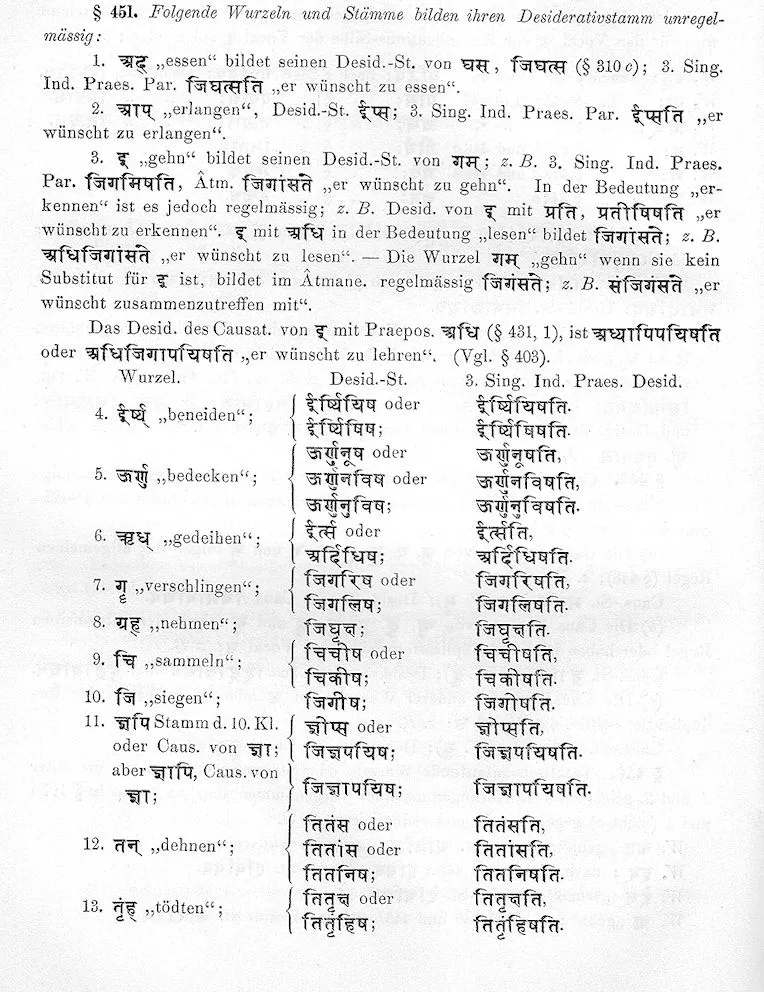
(Image source: Details)
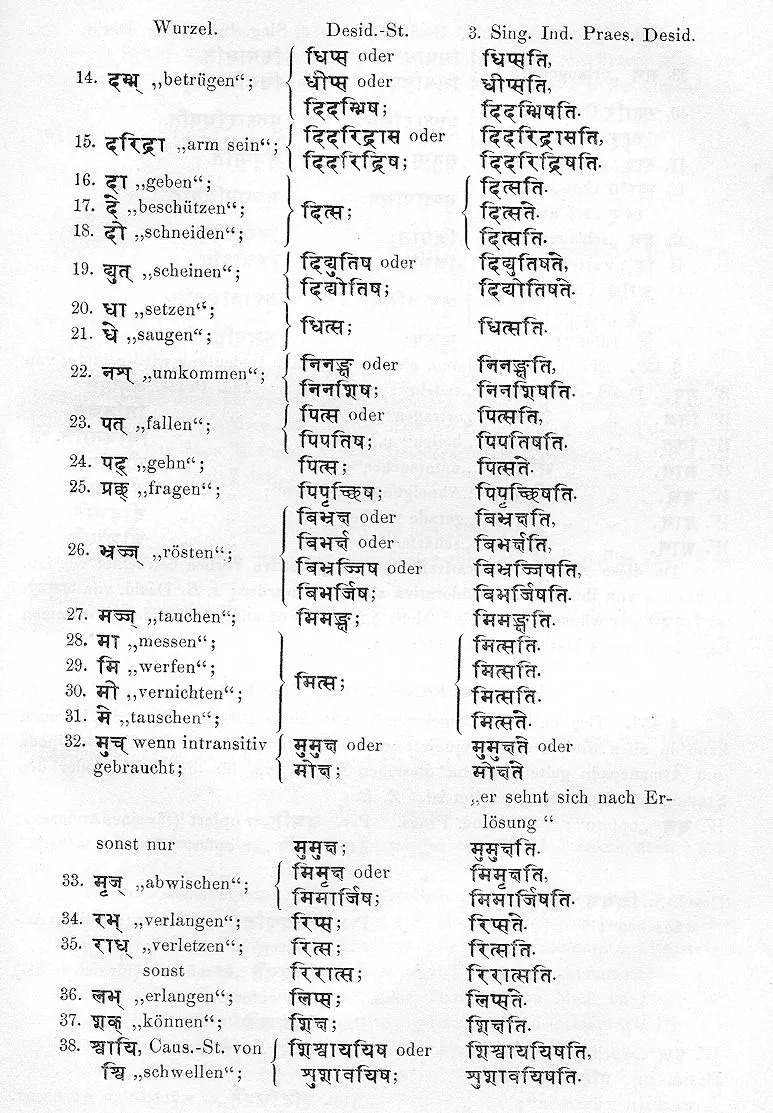
(Image source: Details)
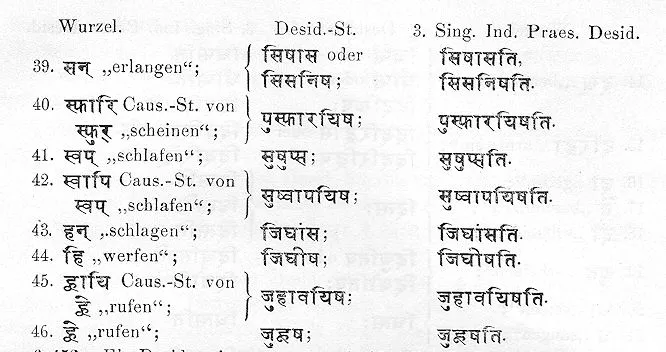
(Image source: Details)
B) Determine and translate the following forms without aids:
ददुषोः
अहिंसीः
देमथुः
वक्त्वा
अक्षथाः
मुमुषिषिष्यतः
अचिक्षंसेथाम्
अस्नाः
जिहिंसुषि
जिहिंसिषुणा
द्युभिः
जग्लिव
अतिस्तीर्षम्
अस्मेष्ठाः
ईशिष्व
रुरुषतुः
रुरुषुः
रुरुषिषुः
अपिप्रीणताम्
अपिप्रीषतम्
पिप्रियतुः
तिस्रः
अदांक्ष्टाम्
असिसीर्ष्यत
बभासाते
बिभासिषेथे
अबीभणत
चकर्त
चकर्थ
दिद्युते
दिद्युतिषे
चुच्यूषवे
दित्सामि
अचीकृतम्
विजिगीषौ
पित्सेथे
उदीचि
संगणय्य
अतिस्तराव
त्रिलोक्याः
अहः
जग्मुषः
अताप्स्व
ईशिशिषाञ्चक्रे
ईशाञ्चक्रे
ईशयाञ्चक्रे
षण्णाम्
अघुक्षम्
अष्टौ
प्साथः
अवाचः
ईयुषे