
Lesson 8
In this lesson you will learn:
- The formation of nouns (kṛt- and taddhita suffixes)
- Important nominal suffixes (-a, -ana, -tra, -ti, -tva, -tā)
- The 8th present class (tanādi)
- The conjugation of kṛ (tun, to make)
8.1. On the Formation of Nouns
In traditional Indian grammar, a distinction is made among the suffixes used to form nominal stems:
- kṛt suffixes (कृत्) (primary suffixes): form nominal stems, absolutes, and infinitives from verbal roots (dhātu m. = धातु) and verbal stems.
- taddhita suffixes (तद्धित) (secondary suffixes): attach to nominal stems and indeclinables to form new nominal stems or indeclinables.
Schema:
Root + kṛt suffix » nominal stem etc. + taddhita suffix » new nominal stem etc.
Nominal stem + case ending » syntactically functional noun
8.2. Classification of Nominal Suffixes
kṛt (kṛdanta) = कृत् (कृदन्त)
- kārakakṛt (कारककृत्) » nomina agentis (denote someone who performs the action indicated by the root)
- kṛtikṛt (कृतिकृत्) » nomina actionis (denote the action expressed by the root) or abstracts
taddhita
- viśeṣyataddhita (विशेष्यतद्धित) » adjectives
- bhāvārthakataddhita (tanmātrataddhita) (भावार्थकतद्धित / तन्मात्रतद्धित) » abstracts
- tadvattaddhita (तद्वत्तद्धित) » possessive (e.g., -mant -मन्त्, -vant -वन्त्)
- tolanataddhita (atiśāyanataddhita) (तोलनतद्धित / अतिशायनतद्धित) » comparison (comparative, superlative), comparison
- pūraṇataddhita (पूरणतद्धित) » ordinal numbers (first, etc.)
- vibhaktitaddhita (विभक्तितद्धित) » in place of case endings (e.g., -tas -तस्, -tra -त्र)
- abhūtatadbhāva (cvitaddhita) (अभूततद्भाव / च्वितद्धित) » (cvi formations च्वि, -sāt -सात्)
Classification based on ablaut:
- guṇya (गुण्य): strong-grade formation
- na guṇya (न गुण्य): weak-grade formation
- vṛddhyarha (वृद्ध्यर्ह): lengthened-grade formation
8.3. Some Important Nominal Suffixes
8.3.1. -a m. (kṛt)
The kṛt suffix -a forms masculine (rarely neuter) nouns that denote an action or state indicated by the root; sometimes also adjectives or nouns that express the agent (kartṛ) of the action denoted by the verbal root. For short penults (= vowel before the consonant at which the root ends) or final root vowels, strong grade (guṇa) or lengthened grade (vṛddhi) is usually substituted.
Examples:
| Root धातु | + -a (kṛt) | Meaning |
|---|---|---|
| ji 1 P आप् "siegen" | jaya m. जय | "conquering, victory" |
| muh 4 P मुह् "verwirrt sein" | moha m. मोह | "confusion, delusion, error" |
| krudh 4 P क्रुध् "zürnen" | krodha m. क्रोध | "anger" |
| kup 4 P कुप् "zürnen" | kopa m. कोप | "anger" |
| lubh 4 P लुभ् "begehren" | lobha m. लोभ | "desire" |
| labh 1 Ā लभ् "bekommen" | lābha m. लाभ | "obtaining, gain" |
| sṛj 6 P सृज् "loslassen, emanieren lassen" | sarga m. सर्ग | "letting go, emanation, creation" (for word-sandhi j » g see later) |
| śru 5 P श्रु "hören" | śrava m. श्रव | "hearing" |
| bhū 1 P भू "werden, sein" | bhāva m. भाव | "becoming, (something) being, nature, character" |
| yudh 4 Ā युध् "kämpfen" | yodha m. योध | "fighter, warrior, soldier" |
8.3.2. -ana n. (kṛt)
The kṛt suffix -ana usually forms neuter nouns that denote an action, a state, or the means or instrument by which the action designated by the root or verbal stem is accomplished. For a short penultimate or an ending vowel of the root, usually the strong grade (guṇa) is substituted.
Examples:
| Root धातु | + -ana (kṛt) | Meaning |
|---|---|---|
| gam 1 P गम् "gehen" | gamana n. गमन | "going" |
| nī 1 U नी "führen" | nayana n. नयन | "(the instrument of leading, i.e.) eye" |
| śru 5 P श्रु "hören" | śravaṇa n. श्रवण | "(hearing instrument =) ear" |
| kṛ 8 U कृ "tun" | kāraṇa n. कारण | "(that by which something is done, i.e.) cause, reason" |
| bhū 1 P भू "werden" | bhavana n. भवन | "becoming, arising" |
| dṛś 4 P दृश् "sehen" | darśana n. दर्शन | "seeing, viewpoint, philosophical system, appearance, specifically: Darśan" |
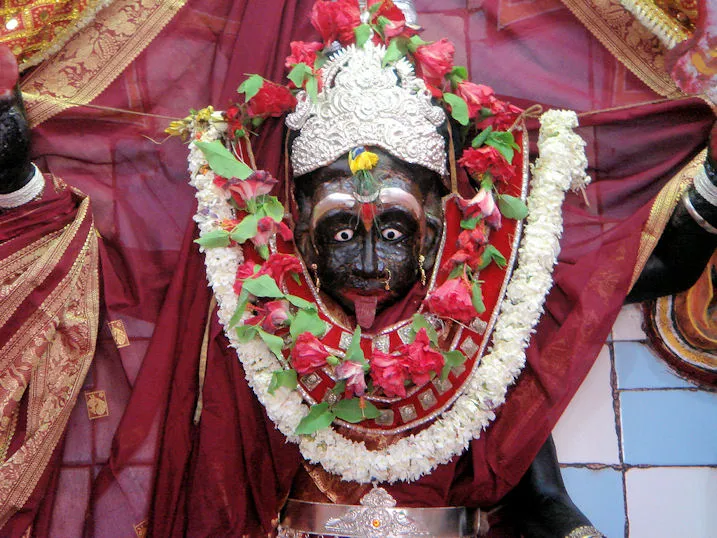
Fig.: Maa Batakali Darshan, Puri, Orissa
(Image source: Details)
"Darshan" or "Darshana" is a term from Hinduism for the sight and vision of the sacred and divine. Under Darshana is understood, for example, the official meeting of student and teacher, in which the student was invited by the teacher. However, it can also mean immersing oneself while contemplating an image of a deity. The latter meaning is the one that is most common in modern Hindi usage. In connection with Mata Amritanandamayi, Darshan means the embrace by the Guru.
Devout Hindus go to the temple to obtain the sight of God through a symbol or statue, in which the spiritual presence of the deity is assumed. In this sense, also a blessing by the deity. However, Darshan can also be received through a vision of the deity during prayer or meditation. Also, a living person who is regarded as an incarnation of the deity, such as an Avatara, can give Darshan.
(Source: Wikipedia)
8.3.3. -tra n. (kṛt)
The kṛt suffix -tra forms (mostly) neuter nouns that denote the means or instrument by which the action designated by the root comes about. A short penultimate and final vowel of the root is replaced by strong grade (guṇa).
Examples:
| Root धातु | + -tra (kṛt) | Meaning |
|---|---|---|
| nī 1 U नी "führen" | netra n. नेत्र | "(Means of leading =) eye" |
| śru 5 P श्रु "hören" | śrotra श्रोत्र | "(Instrument of hearing =) ear" |
| man 4 Ā मन् "denken" | mantra m. (!) मन्त्र | "(Instrument of thinking:) verse, 'magical' formula (mantra)" |
| tan 8 U तन् "aufspannen" | tantra n. तन्त्र | "warp" |
The primordial mantra Oṃ (ॐ) in various Indian scriptures
 |  |
|---|---|
| In Devanāgarī | In Bengali Schrift |
 |  |
| In Kannada script | In Tamil-Schrift |
 |  |
| In Malayalam-Schrift | Jaina-Oṃ |
(Image sources: Details)
8.3.4. -ti f. (kṛt)
The kṛt suffix -ti forms feminine nouns that generally express the action designated by the root or the state designated by the root. The form of the root is in the weak grade.
Examples:
| Root धातु | + -ti (kṛt) | Meaning |
|---|---|---|
| śru 5 P श्रु "hören" | śruti f. श्रुति | "hearing, the Veda" |
| smṛ 1 P स्मृ "vergegenwärtigen" | smṛti f. स्मृति | "recalling, memory, tradition, mindfulness" |
| nī 1 U नी "führen" | nīti f. नीति | "leading, guidance, conduct" |
| sṛj 6 P सृज् "emanieren lassen" | sṛṣṭi f. सृष्टि | "emanation, creation" |
| dṛś 4 P दृश् "sehen" | dṛṣṭi f. दृष्टि | "sight, face, viewpoint" |
| gam 1 P गम् "gehen" | gati f. गति | "going, course, goal of going" (from *gm » ga + -ti) |
| man 4 Ā मन् "denken" | mati f. मति | "thinking, thought, opinion" (from *mn » ma + -ti) |
*Note: * before a form means that this form does not occur in Sanskrit, but is theoretically reconstructed as a prerequisite for a specific formation. The weak grade of gam is gṃ = *gm, the m is replaced by a as a so-called sonant nasal » ga. The same applies to man » ma.
8.3.5. -tva n., -tā f. (taddhita)
The taddhita suffixes -tva n. and -tā f. form abstract nouns from nouns. The form of the underlying nominal stem remains unchanged.
Examples:
| Nominalstamm नामप्रातिपदिक | + -tva n. (taddhita) | + -tā f. (taddhita) | Meaning |
|---|---|---|---|
| guru गुरु 3 "schwer, würdig, m. Meister" | gurutva n. गुरुत्व | gurutā f. गुरुता | "heaviness, reverence, teacherhood (essence or nature of a teacher)" |
| brāhmaṇa ब्राह्मण m. "Brahmane" | brāhmaṇatva n. ब्राह्मणत्व | brāhmaṇatā f. ब्राह्मणता | "das Brahmane-sein, was einen Brahmanen zum Brahmanen macht, Wesen / Natur eines Brahmanen" |
| deva देव m. "Himmlischer, Gott" | — | devatā f. देवता | "deity" |
These formations can be practically created for any noun and are very common in scientific Sanskrit works.
8.4. The 8th Present Class (tanādi = तनादि = "tan etc.")
Stem Formation:
- Strong Stem: Root + -o-
- Weak Stem: Root + -u- (before vowel: -v-)
Example tan 8 U (तन्) "to stretch":
- 3. sg. P. tanoti :brतनोति
- 3. pl. P. tanvanti :brतन्वन्ति
- 3. sg. Ā. tanute :brतनुते
- 3. pl. Ā. tanvate :brतन्वते
Note: Regarding the debate on whether tan is actually a root of the 5th class (*tn » ta + no-), see Thumb-Hauschild, Handbuch des Sanskrit II, 265.
The most important root of the 8th class is kṛ 8 U (कृ) "to do, to make". Its conjugation is irregular:
kṛ 8 U (कृ) "to make, to do"
- 3. sg. P. karoti :brकरोति
- 3. pl. P. kurvanti :brकुर्वन्ति
- 3. sg. Ā. kurute :brकुरुते
- 3. pl. Ā. kurvate :brकुर्वते
8.5. Vocabulary List
Learn the following words:
- ji 1 P (jayati) जि जयति : to conquer, to defeat, to win
- labh 1 Ā (labhate) लभ् लभते : to grasp, to obtain, to seize
- tu तु : but (appears after the first word of the opposing sentence or clause)
- paś 4 P (paśyati) पश् पश्यति : to see, to behold (used as the present stem instead of the root dṛś 0 "to see, to behold")
- kṛ 8 U (karoti) कृ करोति : to make, to do
- tan 8 U (tanoti) तन् तनोति : to stretch
- rakṣ 1 P (rakṣati) रक्ष् रक्षति : to protect
- sārathi m. सारथि : charioteer, coachman
- kapi m. कपि : ape
- kumārī f. कुमारी : the girl, the maiden
- nāga m. नाग : the naked one, the elephant, the snake (elephants and snakes have no fur, just as the "naked ape" human)
- gaja m. गज : elephant
- śuc 1 P (śocati) शुच् शोचति : to mourn
- śuka m. शुक : parrot
- pat 1 P (patati) पत् पतति : to fall, to fly
- patrikā f. पत्रिका : letter
- likh 1 P (likhati) लिख् लिखति : to engrave, to write (originally with a stylus on a palm leaf, but later generally)

Fig.: likh (लिख्) : Indian steel writing stylus for engraving on palm leaves
(Image source: Details)

Fig.: likh (लिख्) : Writing stick of the Batak (Sumatra), as it was probably also used in India
(Image source: Details)
- sukha n. सुख : happiness, well-being
- duḥkha n. दुःख : misfortune, suffering
8.6. Exercise
A) Explain the following nouns by specifying the root from which they are derived, and the nominal suffix. Specify gender and meaning:
- lobha
- rakṣa
- śrotra
- mati
- savana
- yodha
- lābha
- kāraṇa
- gati
- khādana
- smara
- sṛṣṭi
- tantra
- bhāva
- darśana
- netra
- veśana
- kopa
- sarga
- yajana
- moha
- śrava
- bhavana
- nīti
- nartana
- jaya
- nayana
- śravaṇa
B) Form abstract nouns for all nouns learned so far and consider their meaning (orally).
C) Insert as direct object in singular and plural:
- kṣatriyas ... rakṣati (brāhmaṇa, vaiśya, śūdra, brāhmaṇī, kṣatriyā)
D) Translate:
- Kṣatriyas protect both Brāhmaṇas and Vaiśyas and Śūdras. (2 possibilities)
- A holy man sees both heaven and hells.
- He defeats Kṣatriyas.
- She sets up the warp.
- Soldiers fight.
- The Brāhmaṇa makes a fire.
- Brāhmaṇas make fires.
- What do these warriors do?
- Whom does the eye see?
- What do gods desire?
- What is the reason?
8.7. Reading and Translation Exercise
- शूद्रो बालं नयति ।
- कविर्देवं यजते ।
- साधुः फलानि खादति ।
- गुरुः क्रोधं जयति ।
- देवो नरकं सृजति ।
- धेनुर्ग्रामं विशति ।
- कामक्रोधलोभा नरकं नयन्ति ।
- देवतां यजति ।
- बाला भवति ।
- सारथी रथं नयति ।
- कपयः फलानि खादन्ति ।
- बाला लिखति ।
- कुमारी गृहं विशति ।
- देवो नागं सृजति ।
- बालो गजं नयति ।
- विमला शोचति । (विमला proper name Vimalā)
- शुकः पतति ।
- बालः पत्रिकां लिखति ।