
Lesson 16
16.1. On the Sandhi of Final Consonants
To form compounds whose first member consists of stems ending in a consonant, the following rules are required:
Final guttural, retroflex, dental, and labial stops (i.e., not nasals and not palatals).
| in pause and before voiceless sounds | Replacement by the corresponding voiceless non-aspirated sound: e.g. -g + p- » -kp- -d + ph- » -tph- -dh + p- » -tp- |
| before voiced non-nasal sounds | Replacement by the corresponding voiced non-aspirated sound: e.g. -t + g- » -dg- -k + b- » -gb- -dh + d- » -dd- -k + a- » -ga- |
| before nasals | Replacement by the corresponding nasal sound: e.g. -t + n- » -nn- -p + n- » -mn- |
Exception to the above rule:
Final dental stop (not nasal):
| before palatals | Replacement by the relevant unaspirated palatal: i.e. -t + c- » -cc- -d + c- » -cc- -th + c- » -cc- -dh + c- » -cc- -t/-th/-d/-dh + ch- » -cch- -t/-th/-d/-dh + j- » -jj- -t/-th/-d/-dh + jh- » -jjh- |
| + ś | » -cś- or -cch- |
| before retroflexes | Replacement by the relevant unaspirated retroflex: i.e. -t/-th/-d/-dh + ṭ(h)- » -ṭṭ(h)- -t/-th/-d/-dh + ḍ(h)- » -ḍḍ(h)- |
| before l- | Replacement by -l: i.e. -t/-th/-d/-dh + l- » -ll- |
Examples:
तद् + फल = तत्फल
पुण्यवत् + ब्राह्मण = पुण्यवद्ब्राह्मण
पुण्यवत् + नर = पुण्यवन्नर
पुण्यवत् + पुरुष = पुण्यवत्पुरुष
सत्यवत् + चैतन्य =सत्यवच्चैतन्य
सुखवत् + लोक = सुखवल्लोक
पुत्रवत् + जन = पुत्रवज्जन
बलवत् + शत्रु = बलवच्छत्रु
16.2. Vocabulary
अध्यापन n.: Teaching, instruction
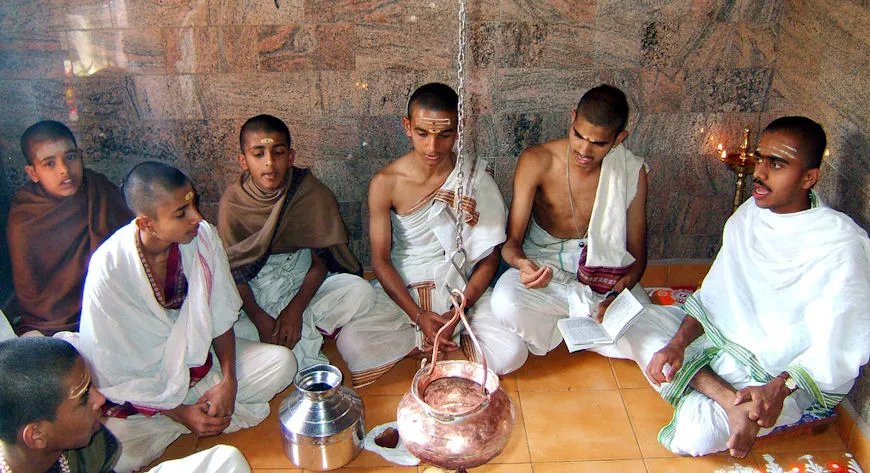
Fig.: अध्यापनम्
"This is a special ceremony in a small temple in Satara (सातारा). It is performed by the students of the Swami Muktananda Vedashala on the celebration of Mahāśivarātri. This is a vedic school, where children by heart the sacred texts called the Vedas. This school teaches the Krishna Yajurveda and some portions of the Samaveda. I'm doing my master's thesis on this school."
(Image source: Details)
अनसूया f.: Non-murmuring, envylessness
नृशंस्य n.: Malice, baseness
therefrom:
अनृशंस्य n.: Non-maliciousness
जीव् 1 P जीवति ; Pass. जीव्यते ; PPP जीवित : to live
therefrom:
आजीव m.: livelihood
क्षमा f.: Patience, forbearance, leniency
क्षेम n.: Calm, peace, well-being, secure possession
चित्त n.: Consciousness, thinking, mind
निरोध m.: Stopping, bringing to a standstill
- bhūta n. (भूत) (PPP from bhū): Being, ghost
योग m.: Harnessing, connection, union, acquisition; Yoga
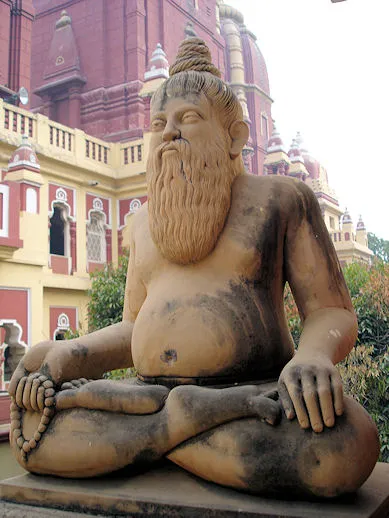
Fig.: योगी
Birla Mandir, Delhi
(Image source: Details)
वृत् 1 Ā वर्तते ; Pass. वृत्यते ; PPP वृत्त : to turn, to turn around, to be (somewhere), to dwell
शस्त्र (śastra) n.: Cutting tool, cutting weapon, sword, weapon
शौच n.: Purification, purity
साधन m.,n. साधनी साधना f.: leading to the goal, effective
अहिंसा f.: not causing harm to anyone, non-injury, non-violence

Fig.: अहिंसा
"The hand with a wheel on the palm symbolizes the Jain Vow of Ahimsa. The word in the middle is "ahimsa". The wheel represents the dharmacakra which stands for the resolve to halt the cycle of reincarnation through relentless pursuit of truth and non-violence."
(Image source: Details)
16.3. Exercise
A) Convert the following expressions into Tatpuruṣa compounds and translate them:
१. देवस्य पुरुषः ।
२. गुणवती ब्राह्मणी ।
३. सत्यवान्ब्राह्मणः ।
४. पशुमन्तो जनाः ।
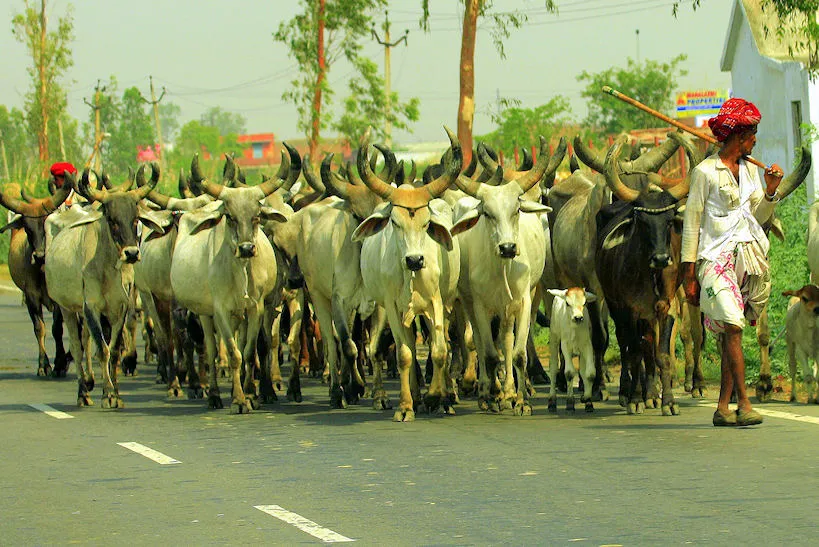
Fig.: पशुमन्तो जनाः
हरियाणा / Haryāṇā
(Image source: Details)
५. सुखवान्वैश्यायाः पुत्रः ।
६. सुखवत्या वैश्यायाः पुत्रः ।
७. कवेरुक्त्याः सत्यम् ।
८. शिवेन रक्षिता बाला ।
९. रामेण पीतं जलम् ।
१०. फलवांल्लाभः ।
११. इष्टाया देवतायाः पूजा ।
१२. देवानां स्तुतिः ।
B) Resolve the following compounds in Sanskrit, form sentences with inflected nouns, and translate:
१. पुण्यवद्वैश्यपुत्रो देवेन्द्रलोकं गच्छति ।
२. पुण्यकरणं स्वर्गमार्गः ।
३. न साधुः पशुवन्नरधेनुलोभः ।
४. न पशुयज्ञैर्नराः स्वर्गं गच्छन्ति । धर्मयज्ञैस्तु स्वर्गसुखमाप्नुवन्ति ।
५. द्विजदासा इति शूद्रा उच्यन्ते ।
६. बालब्राह्मणपुत्राः सत्यवन्नरं शृण्वन्ति ।
७. बलवत्क्षत्रिया धनवच्छत्रुनगरं जयन्ति ।
८. ऋष्युक्त्या सत्यमुच्यते ।
९. बलवद्योधा ब्राह्मणग्रामं गताः ।
१०. पुण्यवद्वैश्येष्टदेवतापूजां करोति ।
16.4. Review Exercise
A) Form all cases learned so far for the following words as examples of the declension classes learned so far.
Use the following schema, which corresponds to the order of cases among Indian grammarians and which was also adopted by Western grammarians due to its - later to be discussed - advantages:
| Singular एकवचनम् | Plural बहुवचनम् |
|---|---|
| १. प्रथमा Nominative | १. प्रथमा |
| २. द्वितीया Accusative | २. द्वितीया |
| ३. तृतीया Instrumental | ३. तृतीया |
| ६. षष्ठी Genitive | ६. षष्ठी |
Memorize the declension patterns based on these examples!!!
१. नर m.
२. फल n.
३. क्षत्रिया f.
४. अरि m.
५. मति f.
६. गुरु m.
७. धेनु f.
८. देवी f.
९. गुणवन्त् m., n., f.
१०. किम् m., n., f.
११. तद् m., n., f.
१२. एतद् m., n., f.
१३. इदम् m., n., f.
B) Translate and resolve all compounds into Sanskrit:
१. योगश्चित्तवृत्तिनिरोधः ॥योगसूत्र १.२॥
२. स्वधर्मो ब्राह्मणस्याध्ययनमध्यापनं यजनं याजनं दानं प्रतिग्रहश्च ॥५॥
क्षत्रियस्याध्ययनं यजनं दानं शस्त्राजीवो भूतरक्षणं च ॥६॥
वैश्यस्याध्ययनं यजनं दानं कृषिपाशुपाल्ये वणिज्या च ॥७॥
शूद्रस्य द्विजातिशुश्रूषा वार्त्ता कारुकुशीलवकर्म च ॥८॥
सर्वेषामहिंसा सत्यं शौचमनसूयानृशंस्यं क्षमा च ॥१३॥
(कौटिलीयार्थशास्त्र १.३.५-८, १३)
Explanations;
Sentence 7: कृषिपाशुपाल्ये Dual, Nom. Acc.: Dvandva, denoting the two "things"
Sentence 8: कर्म Nom., Acc. sg. Neuter to कर्मन् "deed"
Sentence 13: सर्वेषाम् Gen. pl. masc. to सर्व "each, all" (pronoun, not declined like deva)
३. आन्वीक्षिकीत्रयीवार्त्तानां योगक्षेमसाधनो दण्डः, तस्य नीतिर्दण्डनीतिः ॥कौटिलीयार्थशास्त्र १.४.३॥
lekt1601: Birla Mandir, Delhi [Image source: Deepak / Wikipedia ; Creative Commons License (Attribution, share alike)]
lekt1602: "This is a special ceremony in a small temple in Satara (सातारा). It is performed by the students of the Swami Muktananda Vedashala on the celebration of Mahāśivarātri. This is a vedic school, where children by heart the sacred texts called the Vedas. This school teaches the Krishna Yajurveda and some portions of the Samaveda. I'm doing my master's thesis on this school." [Image source: Shrimaitreya. -- http://www.flickr.com/photos/shrimaitreya/339418301/. -- Accessed on 2008-12-07. -- Creative Commons License (Attribution, non-commercial use, no derivatives)]
lekt1603: "The hand with a wheel on the palm symbolizes the Jain Vow of Ahimsa. The word in the middle is "ahimsa". The wheel represents the dharmacakra which stands for the resolve to halt the cycle of reincarnation through relentless pursuit of truth and non-violence." [Image source: Wikipedia, Public domain]
lekt1604: हरियाणा / ਹਰਿਆਣਾ [Image source: mksfoto. -- http://www.flickr.com/photos/mksfoto/583024679/. -- Accessed on 2008-12-07. -- Creative Commons License (Attribution, non-commercial use, no derivatives)]