
Lesson 18
18.1. सुभाषितम्
नास्ति कामसमो व्याधिर्
नास्ति मोहसमो रिपुः ।
नास्ति क्रोधसमो वह्निर्
नास्ति ज्ञानसमं सुखम् ॥
18.2. Determinative compounds (तत्पुरुष) with adverbial first member
As an adverbial (indeclinable) first member, the following can be used:
- adverbs
- prepositions
- particles
- other indeclinables
can be used. Such Tatpuruṣa compounds mostly belong to the class of Nityasamāsa = नित्यसमास (m. "permanent compound"), i.e., compounds that cannot be resolved at all or not merely by means of the words occurring in the compound itself.
Examples:
अति "beyond that":
अतिगुरु 3: extremely heavy, extremely weighty
अतिपुरुष m.: outstanding man, Superman, hero
अतिस्तुति f.: excessive praise
अत्युक्ति f.: excessive speech, exaggeration
The most important adverbial first members are a-/an-, su-, dus-.
अ (before consonant), अन् (before vowel): un-: stands in the compound instead of न "not".
Examples:
अनृत n. = नर्तम् (= न + ऋतम्): untruth, lie
अकृत 3 = न कृत 3: not done, undone
अब्राह्मणी f. = न ब्राह्मणी : a non-Brahmin woman, un-Brahmin
अदेव m. = न देवः : a non-god, un-god
सु "well, good"; when resolving the compound, commentators replace it with an adjective meaning "good" (e.g., सुष्टु 3, शोभन 3).
Examples:
सुकवि m.: a good poet
सुकृत n.: good deed
सुखादित 3: well chewed
सुदुःख n.: great suffering
दुस् "bad, evil" (observe Sandhi!).
Examples:
दुर्नय m.: bad guidance, bad behavior
दुष्करण n.: bad deed, difficult deed
The following rule applies here:
Sound change of -s in compounds
Contrary to sentence Sandhi, in the final position of the first member of compounds:
-s after -i- or -u- before voiceless guttural or labial » -ṣ
Therefore: दुष्करण
18.2.1. Compounds of the type सुकर / दुष्कर
Compounds of the type सुकर / दुष्कर mainly have the meaning of passive possibility:
Examples:
सुकर 3: easy to do
सुगम 3: easy to go
दुर्गम 3: difficult to go
सुदुर्गम 3: very difficult to go
18.2.2. Meanings of nañ-Tatpuruṣa (a- / an-)
Tatpuruṣa with a- / an- can have the following meanings:
- Similarity (तत्सादृश्यम्):
अब्राह्मणः = a Kṣatriya or Vaiśya who wears the sacred thread (यज्ञोपवीत n.) and thus resembles a Brahmin, without being one - Absence, non-existence (तदभावः):
अज्ञानम् = ignorance (absence of knowledge) - Otherness (तदन्यत्वम्):
अपटम् = something that is not fabric / garment (पट m: fabric, garment) - Smallness (तदल्पता):
अनुदरम् = a small belly (a non-belly) - Disapproval (अप्राशास्त्यम्):
अकालः = unseasonal time - Hostility (निरोधः):
असुरः = counter-god (according to the false etymology a-sura)
The following verse summarizes these meanings:
तत्सादृश्यमभावश्च
तदन्यत्वं तदल्पता ।
अप्राशास्त्यं निरोधश्च
नजर्थाः षट्प्रकीर्तिताः ॥
Six meanings of nañ (= a-/an-) are named ....
18.3. Verbal Compounds
उपसर्गेण धात्वर्थो
बलादन्यत्र नीयते ।
गङ्गासलिलमाधुर्यं
सागरेण यथाम्भसा ॥
चन्द्रकीर्ति : प्रसन्नपदा p. 2 line 14f.
A prefix forcibly changes the meaning of a root, just as the sweetness of the Ganges water is changed by seawater.
Verbs in Sanskrit can be combined with prefixes (उपसर्ग m.). In most cases, sentence sandhi applies. Prefixes can, under certain circumstances, significantly modify the meaning of the root, so that in many cases the meaning of a root with a prefix must be learned separately. Verbs with a prefix may have a different mood (P, Ā) than the simple root. Multiple prefixes can be placed before a root simultaneously.
Some important prefixes are:
उप "to, towards, against"
Examples:
उपगम् 1 उपगच्छति : to go towards, to approach
उपदिश् 6 उपदिशति : to point out, to instruct, to advise
उपपद् 4 Ā उपपद्यते : to reach, to arrive
- PPP उपपन्न 3: equipped with (Instrumental)
उपलभ् 1 Ā उपलभते : to grasp, to attain
प्र "forward, forth"
Examples:
प्राप् (pra-āp) 5 प्राप्नोति : to attain
प्रदिश् 6 प्रदिशति : to show
प्रबुध् 4 Ā प्रबुध्यते : to wake up, to recognize
प्रभू 1 प्रभवति : to emerge, to stand out, to have power over (Gen., Loc. Dat.)
प्रवच् 2 प्रवक्ति PPP प्रोक्त (« pra + ukta) : to explain, to communicate, to utter
प्रवद् 1 प्रवदति : to utter, to designate as, to declare to be
प्रस्तु 2 प्रस्तौति : to praise before, to praise loudly, to mention something, to begin
वि "apart, away, apart, dis-, vi-"
Examples:
विगम् 1 विगच्छति : to go apart, to pass away, to disappear
विजि 1 Ā (!) विजयते : to conquer
विमुच् 6 विमुञ्चति : to detach, to liberate
विवद् 1 विवदति : to dispute, to discuss, to tell
विस्मृ 1 विस्मरति : to forget
विहन् 2 विहन्ति : to shatter, to destroy, to annihilate
सम् "together, with"
Examples:
समास् 2 Ā समास्ते : to sit together, to stay, to dwell
समि 2 समेति : to come together, to unite
संगम् 1 Ā (!) संगच्छते : to come together, to meet (friendly or hostile), to have sexual intercourse with (Acc.)
संजन् 4 Ā संजायते : to arise
- PPP संजात 3: born, arisen, become
सम्बुध् 4 Ā सम्बुध्यते : to awaken completely (to the truth)
सम्पद् 4 Ā सम्पद्यते : to be granted to someone, to succeed
- PPP सम्पन्न 3: provided with (Instr.)
The root कृ "to do" shows, in combination with the prefixes सम् । उप । अप । परि also the form स्कृ
Example:
sam-kṛ 8 संस्करोति : to prepare, to prepare for sacrifice, to consecrate
- PPP संस्कृत 3: prepared for the sacrifice ; संस्कृत n.: Sanskrit: the language suitable for the sacrifice ; counterpart प्राकृत 3: ordinary, common ; प्राकृत n.: ordinary language, Prakrit (designation for the vernacular and trade languages related to Sanskrit)
18.3.1. Nominal formations from verbal compounds
From roots with prefixes, nouns can be formed using kṛt suffixes.
Examples:
sam-kṛ + -a = संस्कार m.: consecration, preparation ; transition rituals = designation for the ceremonies that accompany the various stages of life from conception to death (see the excellent summary in Basham, Wonder pp. 160 - 170!)
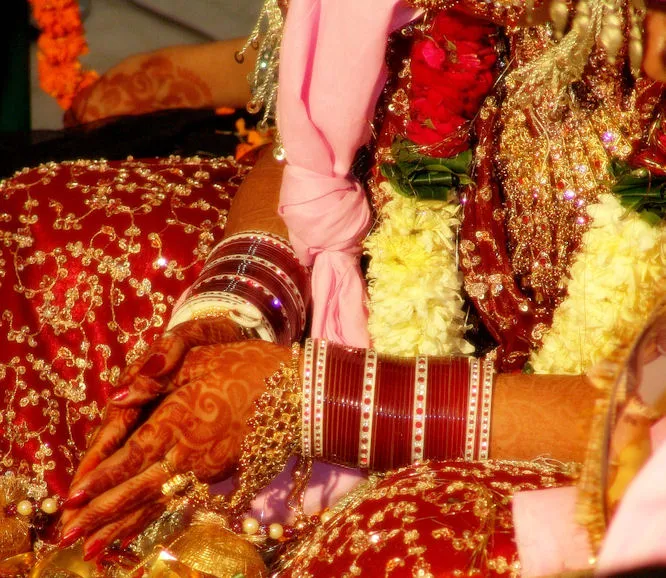
Fig.: विवाहः
Wedding = विवाह m., an important संस्कारः
(Image source: Details)
upa-nī + -ana = उपनयन n.: the bringing near (to the sacrificial fire) = ceremony in which the sacred thread (यज्ञोपवीत n.) is placed on the male members of the three upper castes and the sacred verse सावित्री is whispered into their ear, which they are to recite daily at sunrise and sunset. For the Brahmins, the Ṛgveda III.62.10:
"May we receive the excellent brilliance of the god 'Driver,' who may set our thoughts in motion."
Through the Upanayana, the second birth occurs, therefore: द्विज । द्विजाति
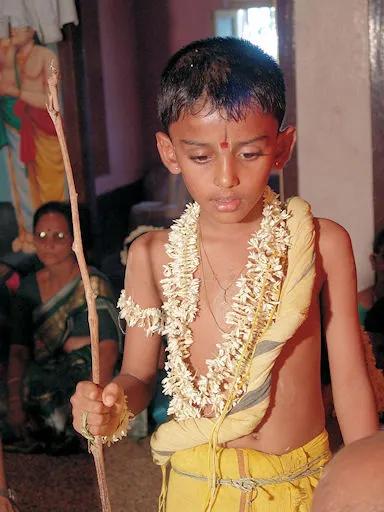
Fig.: उपनयनम्
"A young boy is seen during upanayana ritual. The yellowed, thin, thread running from left shoulder to the waist is Yagnopaivta. Also note the girdle of munja grass around the waist. The twig in the right hand (usually from peepa treel) siginifies his entry in to Brahmacharya."
(Image source: Details)
18.4. Vocabulary list
सुष्टु 3: highly praised, excellent, good
शोभन 3: brilliant, splendid, majestic, beautiful, good
सम 3: equal, even, similar (with instrumental)
व्याधि m.: illness
रिपु m. = शत्रु , fraudster
वह्नि m. = अग्नि
ज्ञान n.: knowledge
शूर 3: brave, heroic ; m.: hero
शब्द m.: sound, tone, signal sound: word
उदक n.: water
अन्त m.: end, limit
आदि m.: beginning
दण्ड m.: stick, rod, punishment
मात्रा f. मात्र n.: measure, limitation
सहित 3: united, provided with
हस्त m.: hand
प्रभृति f.: beginning
18.5. Exercise
A) Translate the सुभाषित at the beginning of the lesson.
B) Translate the following Tatpuruṣa:
१. सुकर ३
२. सुकुल n.
३. सुकृती f.
४. अकरण n.
५. दुरिष्ट n.
६. दुरिष्टि f.
७. सुखादित 3
८. दुष्कर 3
९. दुर्जय 3
१०. सुगत m.
११. सुजन m.
१२. दुरुक्ति f.
१३. दुरुपदेश m.
१४. सुजात 3
१५. सुगुरु 3
१६. अनाप्त 3
१७. अनीति f.
१८. अनीश्वरत्व n.
१९. सुदुःख n.
२०. दुर्जन m.
२१. दुर्दग्ध 3
२२. अतिकृत 3
२३. सुपुत्र m.
२४. सुबुद्धि f.
२५. दुष्पुत्र m.
२६. दुष्प्रणीत 3
२७. सुमति f.
२८. दुर्लभ 3
२९. दुर्वच 3
३०. दुर्वचन n.
३१. अमृत n.
18.6. Review Exercise
Please do not use any aids!
A) Resolve the following Sanskrit compounds and provide translation suggestions:
१. अन्तगत 3
२. क्षमाकर 3
३. क्षेमेन्द्र m.
४. शस्त्रकोपनिरोध m.
५. सिंहसंहनन n.
६. अरिसिंह m.
७. आहारनिद्राभय n.
८. मृतिसाधनी f.
९. कुलोपदेश m.
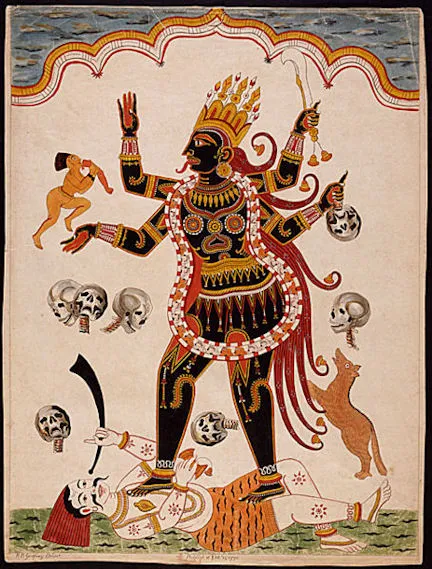
Fig.: मृतिसाधनी काली
1770 Print
(Image source: Details)
B) Translate using verbs of the 2nd present class:
1. The Brahmin praises the goddesses.
2. The heroes proceed along the difficult-to-traverse path into the village of the Āryas.
3. The housemaid milks the cows.
4. The enemies of the Aryans slay the mighty Kṣatriyas.
5. A ghost eats no fruit.
6. Thus speaks he who has [well traversed the path through rebirths] to the disciple.
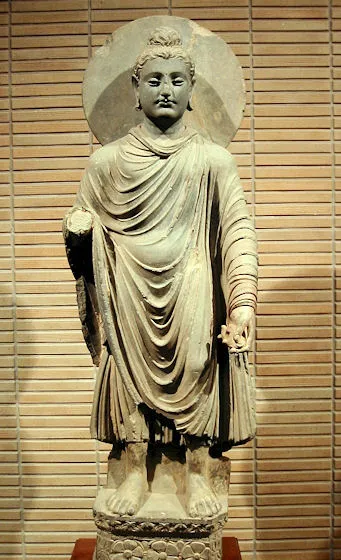
Fig.: सुगतः
गन्धार 1st/2nd cent. CE
(Image source: Details)
C) Provide the definition of Yoga in Sanskrit in two ways: once using a compound, once by resolving the compound.
D) Translate:
(धर्मः) सर्वेषामाहिंसा सत्यं शौचमनसूयानृशंस्यं क्षमा च ॥
lekt1801: "A young boy is seen during upanayana ritual. The yellowed, thin, thread running from left shoulder to the waist is Yagnopaivta. Also note the girdle of munja grass around the waist. The twig in the right hand (usually from peepa treel) siginifies his entry in to Brahmacharya." [Image source: Nagesh Rao / Wikipedia, GNU FDLicense]
lekt1802: 1770 Print [Image source: Wikipedia, Public domain]
lekt1803: गन्धार 1st/2nd cent. CE [Image source: Wikipedia, Public domain]
lekt1804: Wedding = विवाह m., an important संस्कारः [Image source: Saad.Akhtar. -- http://www.flickr.com/photos/saad/64770385/. -- Accessed on 2008-12-08. -- Creative Commons License (Attribution, non-commercial use, no derivatives)]