
Lesson 57
57.1. लुङ् ४: स-लुङ्
The s-Aorist is formed for most अनिट् roots, provided they do not exclusively have another aorist form. Optional अनिट् roots can generally optionally form either this or the iṣ-Aorist. Also, अनिट् roots that form the परस्मैपद after the 1st, 2nd, or 6th form of the aorist form the आत्मनेपद according to the s-Aorist.
Formation: Augment + Root + s + athematic secondary endings
Table of endings with stem-forming suffix
| परस्मैपदम् | आत्मनेपदम् | |||
|---|---|---|---|---|
| एकवचनम् | बहुवचनम् | एकवचनम् | बहुवचनम् | |
| 1. तृतीयः | -sam | -sma | -si | -smahi |
| 2. द्वितीयः | -sīs | -sta | -sthās | -dhvam |
| 3. प्रथमः | -sīt | -sur | -sta | -sata |
The general sound law is applied that a sibilant between two plosives drops out (cf. उद् + स्थित » उत्थित), i.e., the stem-forming suffix -s- before endings that begin with -t- or -th- drops out (but not after nasals or r-).
Examples:
3.sg.Ā a-kṣip + s + ta » अक्षिप्त
2.sg.Ā a-kṣip + s + thās » अक्षिप्थास्
Such forms could also belong to the root aorist and probably partly do belong there.
Such forms could also belong to the root aorist and probably partly do belong there.
The Indian grammarians also counted forms like अकृत (3.sg.Ā) as s-Aorist, which clearly belong to the root aorist. For this purpose, the Indian grammarians invented the following ad-hoc sound rule for the s-Aorist:
"After a short vowel, the 'endings' that begin with -st- or -sth- lose the -s-."
Otherwise, the sound rules for the connection of final consonants with s- must be observed.
For -dhvam applies:
The -dh- of -dhvam is replaced by -ḍh- after all non-a/ā vowels as well as after -r.
e.g. चि 5U: 2.pl.Ā अचेढ्वम्
Form of the root:
- परस्मैपद : Guṇa stage
- आत्मनेपद :
- Roots with final i/ī/u/ū: Strong stage
- final -ṝ is replaced by -īr or -ūr
- ablaut-capable roots on ā/e/o: Weak stage
- other root vowels: unchanged (i.e. usually weak stage)
Examples:
| 3.sg.P | |
|---|---|
| चि 5U | अचैषीत् |
| श्रु 5P | अश्रौषीत् |
| कृ 8U | अकार्षीत् |
| भज् 1U | अभाक्षीत् |
| भञ्ज् 7P | अभाङ्क्षीत् |
| भुज् 7U | अभौक्षीत् |
| 3.sg.Ā | |
| --- | --- |
| चि 5U | अचेष्ट |
| नी 1U | अनेष्ट |
| सू 2/4 | असोष्ट |
| sg.Ā | |
| दा 3U | अदिषि अदिथास् अदित |
| 1.sg.Ā | |
| कृ 8U | अकृषि |
| पच् 1U | अपक्षि |
दृश् and सृज् have in the परस्मैपद Guṇa stage with rising diphthong -rā-:
दृश् 3.sg.P अद्राक्षीत्
Auch der Aorist andere Wurzeln mit -ṛ- an vorletzter Stelle kann so gebildet werden:
कृष् 1P/6U 3.sg.P अकार्क्षीत् / अक्राक्षीत्
Paradigms:
नी 1U "to lead"
| परस्मैपदम् | आत्मनेपदम् | |||
|---|---|---|---|---|
| एकवचनम् | बहुवचनम् | एकवचनम् | बहुवचनम् | |
| 1. तृतीयः | अनैषम् | अनैष्म | अनेषि | अनेष्महि |
| 2. द्वितीयः | अनैषीस् | अनैष्ट | अनेष्ठास् | अनेढ्वम् |
| 3. प्रथमः | अनैषीत् | अनैषुर् | नेष्ट | अनेषत |
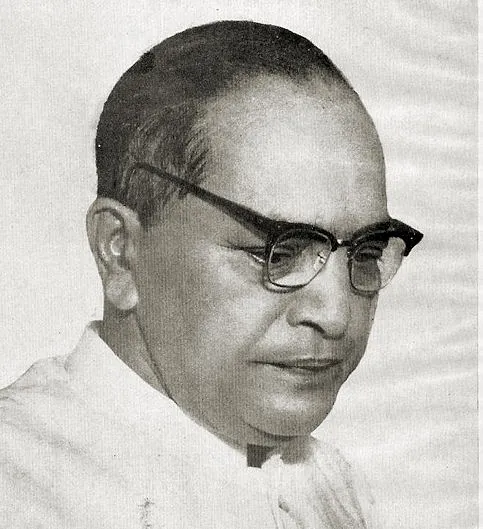
Fig.: भीमराव रामजी आंबेडकर (१८९१ १९५६) । सो ऽनैषीद्दलितान् ॥
(Image source: Details)
कृ 8U "to do"
| परस्मैपदम् | आत्मनेपदम् | |||
|---|---|---|---|---|
| एकवचनम् | बहुवचनम् | एकवचनम् | बहुवचनम् | |
| 1. तृतीयः | अकार्षम् | अकार्ष्म | अकृषि | अकृष्महि |
| 2. द्वितीयः | अकार्षीस् | अकार्ष्ट | अकृथास् | अकृढ्वम् |
| 3. प्रथमः | अकार्षीत् | अकार्षुर् | अकृत | अकृषत |
तुद् 6U "to strike"
| परस्मैपदम् | आत्मनेपदम् | |||
|---|---|---|---|---|
| एकवचनम् | बहुवचनम् | एकवचनम् | बहुवचनम् | |
| 1. तृतीयः | अतौत्सम् | अतौत्स्म | अतुत्सि | अतुत्स्महि |
| 2. द्वितीयः | अतौत्सीस् | अतौत्त aus: a-taut + s + ta | अतुत्थास् | अतुद्ध्वम् |
| 3. प्रथमः | अतौत्सीत् | अतौत्सुर् | अतुत्त | अतुत्सत |
Irregular forms:
1. Roots ending in a nasal (गम्, मन्, रम्) form the s-aorist with strong grade:
अगंसि । अमंसि । अरंस्त
In addition, for गम् there are the regular weak-grade forms:
अगसि (« *a-gm-si) । अगथास् । अगत (in the P, गम् has the thematic aorist)
पद् 4Ā is regular (e.g., अपत्सि), but in the 3.sg.Ā it has the form of the passive root aorist:
अपादि "he went"बुध् Ā can optionally take the form of the passive root aorist in the 3.sg.Ā:
अबोधि / अबुद्ध "he recognized"
57.2. Exercise
A) Translate and identify the following forms without aids, and form the corresponding aorist forms. Except for causatives and roots that form the s-aorist, the class of the corresponding aorist is given in parentheses:
- पेचिथ
- अवक् (३)
- सोष्यसि
- छिन्दे
- कुरुषे
- आधत्ते
- पद्यते
- जिगाय
- जिघ्रामः (१,६)
- शासति (२)
- स्तुवे
- दिग्धे
- प्लवध्वे
- तस्थिथ (१)
- बिभ्यति
- ततर्प
- जुहुथ
- ऊषुः
- ससर्जिथ
- लिल्यिरे
- अत्याजयम्
- सिध्यथ (२)
- निन्य
- कर्षन्ति
- अप्रच्छयन्
B) Translate and identify the following forms:
- चेलुः
- जन्तुः
- अश्वसीत्
- ज्येष्ठायाः
- संयक्
- असे
- असि
- अचैष्ट
- अचेष्ट
- अभग्नम्
- भस्म
- हवींषि
- अद्राक्षीः
- शनैः
- अपन्थाः
- शत्रुह
- उदासीने
- कनीयान्
- कन्याम्
- आरम्
- रिपू
- अदात्
- आदत्
- अवोढ
- अवोचम्
- दिक्
- शुनोः
- यते
- येते
- याते
- चतस्रः
- परंपरायै
- विमलाभ्याम्
- ते
- रजसि
- रजसी
- विक्रेढ्वम्
- युष्मत्
- अघम्
- अभुक्थाः
- उत्थानाय
- अलुम्पत
- अलुपत
- अलुप्त
- अलुप्तम्
- वसिष्ठे
- वर्षिष्ठे
- अक्षैष्म
- अहृत
- कामधुग्भिः
- अमुत्र
- पत्युः
- क्षेपीयन्
- आदि्षि
- पाणी
- अस्प्राक्षम्
Lesson 5701: [Image source: Wikipedia. Public Domain]