
Exercise 8
A) Explain the following nouns by specifying the root from which they are derived, and the nominal suffix. Specify gender and meaning:
1. lobha: lubh 4 P "to desire" + -a m.: "desire"
2. rakṣa: rakṣ 1 P "to protect" + -a 3: "protecting, protective" ; m.: "guardian"
3. śrotra: śru 5 P "to hear" + -tra n.: "ear"
4. mati: man 4 Ā "to think" + -ti f.: "thought, opinion"
5. savana: su 5 U "to press out" + -ana n.: "Soma pressing"
6. yodha: yudh 4 Ā "to fight" + -a m.: "fighter, soldier"
7. lābha: labh 1 Ā "to obtain" + -a m.: "getting, gain"
8. kāraṇa: kṛ 8 U "to make, to do" + -ana n.: "cause, reason"
9. gati: gam 1 P "to go" + -ti f.: "going, 'course', goal"
10. khādana: khād 1 P "to chew" + -ana n.: "chewing, consumption, fodder"
11. smara: smṛ 1 P "to recall" + -a m.: "memory, recollection, longing, love"
12. sṛṣṭi: sṛj 6 P / 4 A "to emanate, to create" + -ti: "emanation, creation"
13. tantra: tan 8 U "to stretch out" + -tra n.: "warp, fabric"
14. bhāva: bhū 1 P "to become, to be" + -a m.: "becoming, nature, character"
15. darśana: dṛś (4 P: paśyati) "to see" + -ana n-: "seeing, appearance, viewpoint, philosophical system"
16. netra: nī 1 U "to lead" + -tra n.: "eye"
17. veśana: viś 6 P "to enter" + -ana n.: "entry"
18. kopa: kup 4 P "to be angry" + -a m.: "anger"
19. sarga: ṛj 6 P / 4 A "to emanate, to create" + -a m.: "letting go, emanation, creation"
20. yajana: yaj 1 U "to sacrifice" + -ana n.: "sacrificing, sacrifice place"
21. moha: muḥ 4 P "to be confused" + -a m.: "confusion, delusion, error"
22. śrava: śru 5 P "to hear" + -a m.: "hearing"
23. bhavana: bhū 1 P "to become, to be" + -ana n.: "becoming, arising, origin"
24. nīti: nī 1 U "to lead" + -ti f.: "leadership"
25. nartana: nṛt 4 P "to dance" + -ana 3: "dancing, dancer" ; n.: "dance"
26. jaya: ji 1 P "to win" + -a m.: "winning, victory"
27. nayana: nī 1 U "to lead" + -ana n.: "eye"
28. śravaṇa: śru 5 P "to hear" + -ana n.: "ear"
B) Form abstract nouns for all nouns learned so far and consider their meaning (orally)
C) Insert as direct object in singular and plural:
kṣatriyas ... rakṣati (brāhmaṇa, vaiśya, śūdra, brāhmaṇī, kṣatriyā)
kṣatriyo brāhmaṇaṃ / brāhmaṇān / vaiśyaṃ / vaiśyān rakṣati. kṣatriyaḥ śūdraṃ / śūdrān. kṣatriyo brāhmaṇīṃ / brāhmaṇī rakṣati. kṣatriyaḥ kṣatriyāṃ / kṣatriyā rakṣati.
क्षत्रियो ब्राह्मणं रक्षति । क्षत्रियो ब्राह्मणान्रक्षति । क्त्रियो वैश्यं रक्षति । क्षत्रियो वैश्यान्रक्षति । क्षत्रियः शूद्रं रक्षति । क्षत्रियः शूद्रान्रक्षति । क्षत्रियो ब्राह्मणीं रक्षति । क्षत्रियो ब्राह्मणी रक्षति । क्षत्रियः क्षत्रियां रक्षति । क्षत्रियः क्षत्रिया रक्षति ॥
D) Translate
1. The Kṣatriyas protect both Brāhmaṇas and Vaiśyas and Śūdras. (2 possibilities)
kṣatriyā brāhmaṇāṃś ca vaiśyāṃś ca śūdrāṃś ca rakṣanti / kṣatriyā brāhmaṇavaiśyaśūdrān rakṣanti.
क्षत्रिया ब्राह्मणांश्च वैश्यांश्च शूद्रांश्च रक्षन्ति । क्षत्रिया ब्राह्मणवैश्यशूद्रान्रक्षन्ति ।
- A holy man sees both heavens and hells.
sādhuḥ svargāmś ca narakāmś ca paśyati.
साधुः स्वर्गांश्च नरकांश्च पश्यति ।
- He defeats Kṣatriyas.
kṣatriyāñ jayati.
क्षत्रियञ्जयति ।
- She sets up the warp threads.
tantraṃ tanoti.
तन्त्रं तनोति ।
- Soldiers fight.
yodhā yudhyante.
योधा युध्यन्ते ।
- The Brahman makes a fire.
brāhmaṇo 'gniṃ karoti.
ब्राह्मणो ऽग्निं करोति ।
- Brahmanen make fires.
brāhmaṇā agniṃ kurvanti.
ब्राह्मणा अग्निं कुर्वन्ति ।
- What are these warriors doing?
ime yodhāḥ kiṃ kurvanti?
इमे योधाः किं कुर्वन्ति ।
- Whom does the eye see?
netraṃ (nayanaṃ) kaṃ paśyati?
नेत्रं (नयनं) कं पश्यति ।
- What do gods desire?
devāḥ kiṃ lubhyanti?
देवाः किं लुभ्यन्ति ।
- What is the reason?
kiṃ kāraṇam?
किं कारणम् ॥
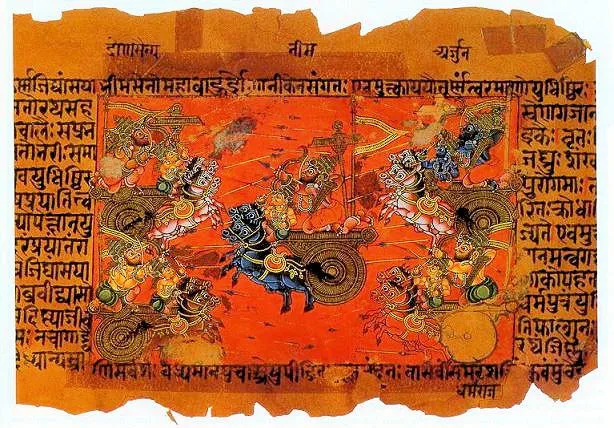
Fig.: इमे योधाः किं कुर्वन्ति ।
(Image source: Details)
Reading Exercise
शूद्रो बालं नयति ।
The Śūdra leads the boy.कविर्देवं यजते ।
The poet sacrifices to the god.साधुः फलानि खादति ।
The holy man eats fruits.गुरुः क्रोधं जयति ।
The master conquers his anger.देवो नरकं सृजति ।
The god creates the hell.धेनुर्ग्रामं विशति ।
The cow enters the village.कामक्रोधलोभा नरकं नयन्ति ।
Passion, anger, and greed lead to hell.देवतां यजति ।
He sacrifices for a lord of sacrifice of the deity.बाला भवति ।
A girl is born.सारथी रथं नयति ।
A charioteer drives the chariot.कपयः फलानि खादन्ति ।
The monkeys eat the fruits.बाला लिखति ।
The girl writes or draws.कुमारी गृहं विशति ।
The maiden enters the house.देवो नागं सृजति ।
Gott schafft den Elefanten bzw. die Schlange bzw. den Nāga.बालो गजं नयति ।
The boy leads the elephant.विमला शोचति । (⟪विमला Proper name Vimalā)
Vimalā ist traurig.शुकः पतति ।
The parrot flies.बालः पत्रिकां लिखति ।
The boy writes a letter.
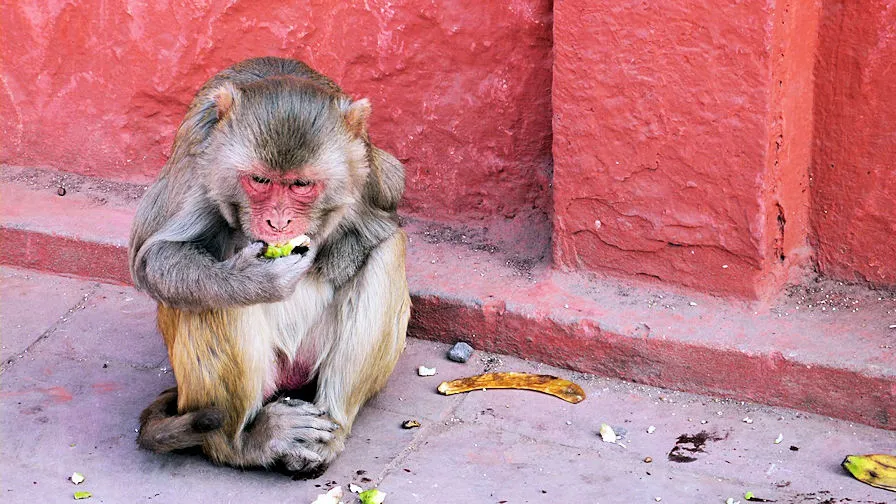
Fig.: कपिः फलं खदति
(Image source: Details)