
Lesson 2
2.1. The Nominal Sentence
Schema: Predicate Noun - Subject
e.g. devo viṣṇuḥ = देवो विष्णुः = "Viṣṇu is a god."
A verbal copula ("is", "are", "am", "art", "be") is not necessary, but may sometimes occur.
There are no articles: devaḥ -- देवः can mean "the god" or "a god".
Although in Sanskrit word order is quite free (especially in verses), when translating a nominal sentence one must always primarily consider a translation according to the above standard schema.
In the nominal sentence, the subject is in the nominative (first case = prathamā f. = प्रथमा). The predicate noun agrees with the subject in number and case; if the predicate noun is an adjective, also in gender.
2.2. On Declension (Inflection of Nouns)
In Sanskrit there are:
- three numbers (forms of counting) = vacana n. -- वचन
- Singular (singular number) = ekavacana n. -- एकवचन
- Dual (dual number) = dvivacana n. -- द्विवचन
- Plural (plural number) = bahuvacana n. -- बहुवचन
- three genders (grammatical genders) = liṅga n. / vyakti f. -- लिङ्ग / व्यक्ति
- Masculine (masculine) = puṃs m. -- पुंस्
- Feminine (feminine) = strī f. -- स्त्री
- Neuter (neuter) = napuṃsaka n. -- नपुंसक
- eight cases (cases) = sup -- सुप् (= case endings)
For declension, the case endings (sup = सुप्) attach to the so-called nominal stem (form of the noun without case endings).
Example: devas = देवस् (nominative singular masculine) "the/a god" = deva- -- देव- (nominal stem) + -s -- -स् (case ending).
In Sanskrit dictionaries, nouns are listed in the nominal stem:
- deva m. -- देव m. (masculine)
- vacana n. -- वचन n. (neuter)
- vyakti f. -- व्यक्ति f. (feminine)
2.3. प्रथमैकवचनम्
Nominative Singular = prathamā ekavacanam = प्रथमा एकवचनम्
The nominative singular ends in -s = -स् or is endingless.
2.3.1. स-कारान्तं प्रथमैकवचनम्
The following nominal stems, which end in a vowel, form the nominative singular in -s:
Masculines in -a: e.g. deva m. = देव "god" -- Nom. sg.: devas = देवस्
Masculines in -i: e.g. kavi m. = कवि "poet" -- Nom. sg.: kavis = कविस्
Masculines in -u: e.g. guru m. = गुरु "teacher" -- Nom. sg.: gurus = गुरुस्
2.4. Sandhi -- सन्धि
The final sound of a word in Sanskrit is also determined by the initial sound of the following word. This phenomenon is called Sandhi (m.) = सन्धि ("connection").
2.4.1. Sandhi of final -s
See also the overview:
Payer, Alois <1944 - >: Sandhi of final -s. -- (Materials on Sanskrit). -- URL: http://www.payer.de/sanskritmaterialien/ssandhi.htm
Final -s:
in absolute final position (end of sentence) it becomes Visarga (-ḥ):
- devas = देवस् » devaḥ = देवः
- kavis = कविस् » kaviḥ = कविः
- gurus = गुरुस् » guruḥ = गुरुः
before voiceless sounds:
- before k, kh, p, ph and ś, ṣ, s: it becomes Visarga (-ḥ)
- devas + śivaḥ » devaḥ śivaḥ = देवः शिवः ("Śiva is a god")
- before c, ch: it becomes -ś
- before ṭ, ṭh: it becomes -ṣ
- before t, th: it remains -s
- sādhus + caitanyas » sādhuś caitanyaḥ = साधुश्चैतन्यः ("Caitanya is a saint")
- before k, kh, p, ph and ś, ṣ, s: it becomes Visarga (-ḥ)
before voiced sounds:
- after non-a vowels: it becomes -r
- kavis + Māghas » kavir māghaḥ = कविर्माघः ("Māgha is a poet")
- after non-a vowels before r-: -s drops out, the vowel is lengthened.
- gurus + rāmas » gurū rāmaḥ = गुरू रामः ("Rāma is a teacher")
- after a-: -as
- before voiced consonants/a: it becomes -o (initial a drops out » ऽ)
- devas viṣṇus » devo viṣṇuḥ = देवो विष्णुः
- devas agnis » devo 'gniḥ = देवो ऽग्निः
- before other vowels: it becomes -a (hiatus)
- devas + indras » deva indraḥ = देव इन्द्रः
- before voiced consonants/a: it becomes -o (initial a drops out » ऽ)
- after non-a vowels: it becomes -r
2.5. Word List
deva m. -- देव : Celestial being, god; prince, king.
īśvara m. -- ईश्वर : Lord, ruler, god (monotheistic).
brāhmaṇa m. -- ब्राह्मण : Brahmin (priestly class).
kṣatriya m. -- क्षत्रिय : Kṣatriya (aristocratic and military class).
vaiśya m. -- वैश्य : Vaiśya (agricultural and merchant class).
śūdra m. -- शूद्र : Śūdra (service class).
According to classical theory (e.g., Manusmṛti I, 88-91), the duties are distributed:
- of the Brahmins
- study of the Vedas
- teaching
- sacrifice for oneself
- sacrifice for others
- giving
- receiving gifts
- of the Kṣatriyas
- protecting the people
- giving gifts (to Brahmins)
- sacrificing for oneself
- study of the Vedas
- of the Vaiśyas
- cattle rearing
- agriculture
- trade
- money lending
- sacrificing for oneself
- giving gifts (to Brahmins)
- sacrificing for oneself
- study of the Vedas
- of the Śūdras
- serving the three upper classes
dvija m. -- द्विज : "Twice-born" (initiates of the upper three classes: Brāhmaṇa, Kṣatriya, Vaiśya).
varṇa m. -- वर्ण : Color, birth class (aspiration).
The four classes (varṇa m.) are often confused with castes. However, the four classes are -- in contrast to castes -- not specifically Indian; in Europe, we also had a class system (partly up to the First World War), as the following illustration from the 15th century confirms:
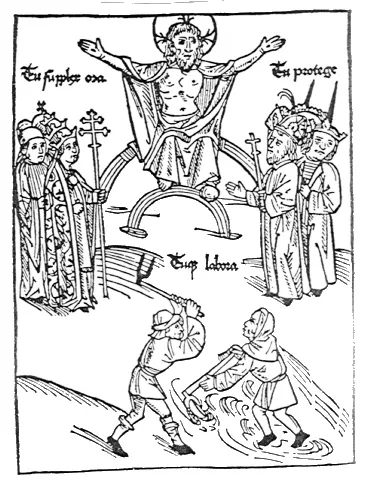
Fig.: Representation of the class division of the European Middle Ages (woodcut from the late 15th century).
(Image source: Details)
Labeling:
- Priestly class (~Brāhmaṇa): Tu supplex ora = You pray earnestly!
- Nobility (~Kṣatriya): Tu protege = You protect!
- Peasantry (~Vaiśya/Śūdra): Tuque labora = And you work!
The three estates wear the respective estate attire. Over the – thereby designated as willed by God – estates sits Christ.
Max Weber <1864 – 1920> defines estate as follows:
"Estate" shall mean a multitude of people who, within an association, effectively
a) claim an estate-specific special valuation, - possibly also
b) estate-specific special monopolies.
Estates can arise
a) primarily, through their own estate-specific way of life, particularly through the type of profession (way of life or professional estates),
b) secondarily, hereditary-charismatic, through successful prestige claims based on estate-specific descent (birth estates),
c) through estate-specific appropriation of political or hierocratic lordships as monopolies (political or hierocratic estates).
The birth-estate development is regularly a form of (hereditary) appropriation of privileges to an association or to qualified individuals. Any fixed appropriation of opportunities, particularly [of] lord [ships or acquisition] opportunities, tends to lead to the formation of estates. Any formation of estates tends to lead to the monopolistic appropriation of lordships and acquisition opportunities.
While economic classes grow on the basis of market-oriented economy, estates arise and exist preferably on the basis of the monopolistically directed liturgical or feudal or estate-patrimonial needs coverage of associations.
"Estate-based" shall mean a society if the social division is preferably according to estates, "class-based," if it is preferably according to classes. The "estate" is closest to the "social" class among the "classes," and the "economic class" is furthest. Estates are often formed by possession classes according to their focus.
Every estate-based society is conventional, ordered by rules of life conduct, thereby creates economically irrational consumption conditions and hinders free market formation in this way through monopolistic appropriations and by excluding free disposal over one's own earning capacity.
[Weber, Max <1864 – 1920>: Economy and Society : Outline of Interpretive Sociology. – 5th, revised ed. – Tübingen : Mohr, 1976. – P. 625 f.]
Varṇas are accordingly birth estates.
kavi m. -- कवि : Poet.
agni m. -- अग्नि : Fire, God Agni.
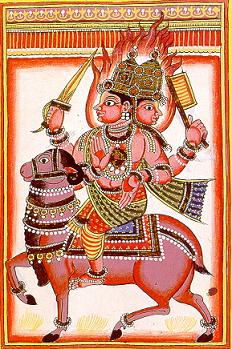
Fig.: God Agni, miniature, 18th century.
(Image source: Details)
sādhu 3 -- साधु : correct, good.
sādhu m. -- साधु : "holy" man, Sādhu.
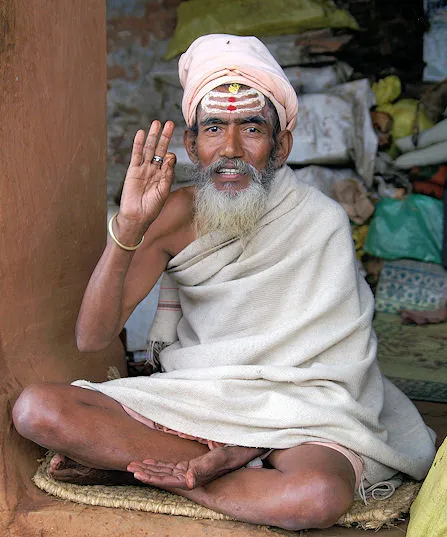
Fig.: Sādhu (साधु), Pashupatinath Temple, Kathmandu.
(Image source: Details)
guru 3 -- गुरु : heavy, significant, worthy of veneration
guru m. -- गुरु : worthy of veneration person: father, mother, older relative, esp. teacher, master
2.6. Exercise
A) Insert considering the Sandhi and form nominal sentences:
- devas ... (Śiva, Agni, Viṣṇu, Gaṇeśa, Kṛṣṇa, Indra)
= देवस् ... (शिव, अग्नि, विष्णु, गणेश, कृष्ण, इन्द्र) - dvijas ... (brāhmaṇa, kṣatriya, vaiśya)
= द्विजस् ... (ब्राह्मण, क्षत्रिय, वैश्य) - gurus ... (brāhmaṇa, Candrakīrti)
= गुरुस् ... (ब्राह्मण, चन्द्रकीर्ति) - vaiśyas ... (Tulādhara)
= वैश्यस् ... (तुलाधर) - sādhus ... (guru, Rāma)
= साधुस् ... (गुरु, राम) - kavis ... (Kālidāsa, Māgha, Bhāravi, Harṣadeva)
= कविस् ... (कालिदास, माघ, भारवि, हर्षदेव)
B) Translate into Sanskrit:
- Rāma is a Brāhmaṇa.
- The teacher is a Vaiśya.
- The Śūdra is a holy man.
- The poet is the teacher.
- Viṣṇu is the LORD.
- The LORD is Śiva.
- The twice-born is a Brāhmaṇa.
- The holy man is a teacher.
- The teacher is a holy man.