
Lektion 16
16.1. Zum Sandhi auslautender Konsonanten
Zur Bildung von Komposita, deren Vorderglied konsonantisch auslautende Stämme bilden, benötigt man folgende Regeln:
Auslautende gutturale, retroflexe, dentale und labiale Verschlusslaute (d.h. keine Nasale und keine Palatale).
| in Pausa und vor stimmlosen Lauten | Ersetzung durch den ihnen entsprechenden stimmlosen nicht-aspirierten Laut: z.B. -g + p- » -kp- -d + ph- » -tph- -dh + p- » -tp- |
| vor stimmhaften nichtnasalen Lauten | Ersetzung durch den ihnen entsprechenden stimmhaften nicht-aspirierten Laut: z.B. -t + g- » -dg- -k + b- » -gb- -dh + d- » -dd- -k + a- » -ga- |
| vor Nasalen | Ersetzung durch den ihnen entsprechenden Nasal: z.B. -t + n- » -nn- -p + n- » -mn- |
Ausnahme zu obiger Regel:
Auslautender dentaler Verschlusslaut (nicht Nasal):
| vor Palatal | Ersetzung durch betreffenden unaspirierten Palatal: d.h. -t + c- » -cc- -d + c- » -cc- -th + c- » -cc- -dh + c- » -cc- -t/-th/-d/-dh + ch- » -cch- -t/-th/-d/-dh + j- » -jj- -t/-th/-d/-dh + jh- » -jjh- |
| + ś | » -cś- oder -cch- |
| vor Retroflex | Ersetzung durch betreffenden unaspirierten Retroflex: d.h. -t/-th/-d/-dh + ṭ(h)- » -ṭṭ(h)- -t/-th/-d/-dh + ḍ(h)- » -ḍḍ(h)- |
| vor l- | Ersetzung durch -l: d.h. -t/-th/-d/-dh + l- » -ll- |
Beispiele:
तद् + फल = तत्फल
पुण्यवत् + ब्राह्मण = पुण्यवद्ब्राह्मण
पुण्यवत् + नर = पुण्यवन्नर
पुण्यवत् + पुरुष = पुण्यवत्पुरुष
सत्यवत् + चैतन्य =सत्यवच्चैतन्य
सुखवत् + लोक = सुखवल्लोक
पुत्रवत् + जन = पुत्रवज्जन
बलवत् + शत्रु = बलवच्छत्रु
16.2. Wortliste
अध्यापन n.: Unterrichten, Unterricht
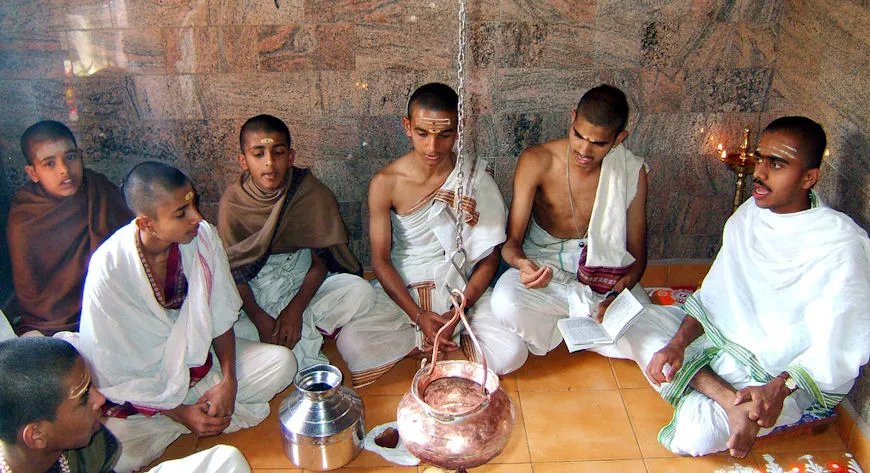
Abb.: अध्यापनम्
"This is a special ceremony in a small temple in Satara (सातारा). It is performed by the students of the Swami Muktananda Vedashala on the celebration of Mahāśivarātri. This is a vedic school, where children by heart the sacred texts called the Vedas. This school teaches the Krishna Yajurveda and some portions of the Samaveda. I'm doing my master's thesis on this school."
(Bildquelle: Details)
अनसूया f.: Nicht-Murren, Neidlosigkeit
नृशंस्य n.: Boshaftigkeit, Niedertracht
davon:
अनृशंस्य n.: Nicht-Boshaftigkeit
जीव् 1 P जीवति ; Pass. जीव्यते ; PPP जीवित : leben
davon:
आजीव m.: Lebensunterhalt
क्षमा f.: Geduld, Langmut, Nachsicht
क्षेम n.: Ruhe, Frieden, Wohlergehen, sicherer Besitz
चित्त n.: Bewusstsein, Denken, Geist
निरोध m.: Stoppen, Zum-Stillstand-Bringen
- bhūta n. (भूत) (PPP zu bhū): Wesen, Gespenst
योग m.: Anschirrung, Verbindung, Vereinigung, Erwerb ; Yoga
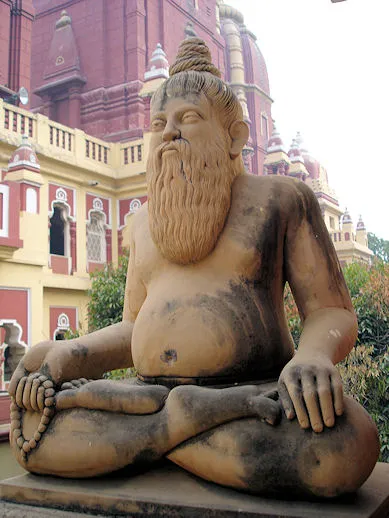
Abb.: योगी
Birla Mandir, Delhi
(Bildquelle: Details)
वृत् 1 Ā वर्तते ; Pass. वृत्यते ; PPP वृत्त : sich drehen, sich wenden, sich (irgendwo) befinden, wohnen
शस्त्र (śastra) n.: Schneidewerkzeug, Schneidewaffe, Schwert, Waffe
शौच n.: Reinigung, Reinheit
साधन m.,n. साधनी साधना f.: zum Ziel führend, bewirkend
अहिंसा f.: das Niemandem-etwas-zu-Leide-Tun, Nichtverletzen, Gewaltlosigkeit

Abb.: अहिंसा
"The hand with a wheel on the palm symbolizes the Jain Vow of Ahimsa. The word in the middle is "ahimsa". The wheel represents the dharmacakra which stands for the resolve to halt the cycle of reincarnation through relentless pursuit of truth and non-violence."
(Bildquelle: Details)
16.3. Übung
A) Wandeln sie folgende Ausdrücke in Tatpuruṣa um und übersetzen Sie sie:
१. देवस्य पुरुषः ।
२. गुणवती ब्राह्मणी ।
३. सत्यवान्ब्राह्मणः ।
४. पशुमन्तो जनाः ।
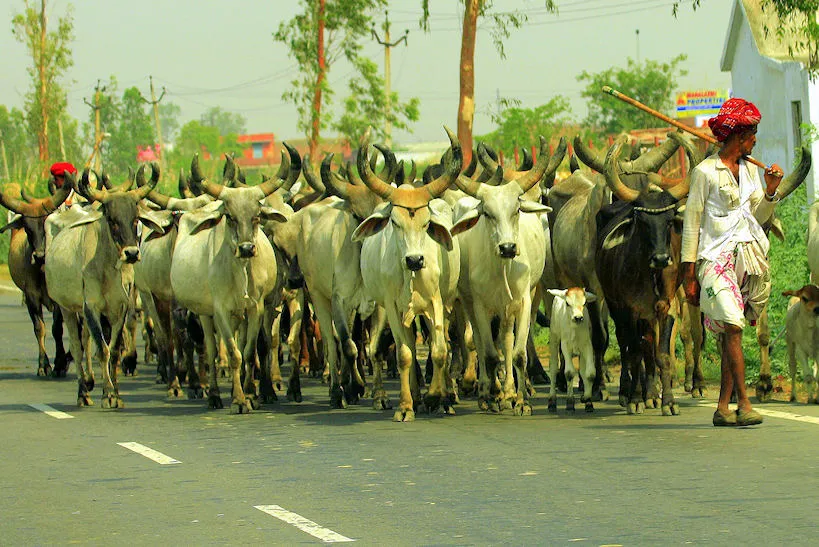
Abb.: पशुमन्तो जनाः
हरियाणा / ਹਰਿਆਣਾ
(Bildquelle: Details)
५. सुखवान्वैश्यायाः पुत्रः ।
६. सुखवत्या वैश्यायाः पुत्रः ।
७. कवेरुक्त्याः सत्यम् ।
८. शिवेन रक्षिता बाला ।
९. रामेण पीतं जलम् ।
१०. फलवांल्लाभः ।
११. इष्टाया देवतायाः पूजा ।
१२. देवानां स्तुतिः ।
B) Lösen Sie in folgenden Sätzen alle Komposita in Sanskrit auf, bilden Sie so Sätze mit flektierten Nomina und übersetzen Sie:
१. पुण्यवद्वैश्यपुत्रो देवेन्द्रलोकं गच्छति ।
२. पुण्यकरणं स्वर्गमार्गः ।
३. न साधुः पशुवन्नरधेनुलोभः ।
४. न पशुयज्ञैर्नराः स्वर्गं गच्छन्ति । धर्मयज्ञैस्तु स्वर्गसुखमाप्नुवन्ति ।
५. द्विजदासा इति शूद्रा उच्यन्ते ।
६. बालब्राह्मणपुत्राः सत्यवन्नरं शृण्वन्ति ।
७. बलवत्क्षत्रिया धनवच्छत्रुनगरं जयन्ति ।
८. ऋष्युक्त्या सत्यमुच्यते ।
९. बलवद्योधा ब्राह्मणग्रामं गताः ।
१०. पुण्यवद्वैश्येष्टदेवतापूजां करोति ।
16.4. Wiederholungsübung
A) Bilden Sie alle bisher gelernten Kasus zu folgenden Wörtern als Beispiele für die bisher gelernten Deklinationsklassen.
Verwenden Sie dazu folgendes Schema, das der Reihenfolge der Kasus bei den indischen Grammatikern entspricht und das wegen seiner - später zu besprechenden - Vorzüge auch von den westlichen Grammatikern übernommen wurde:
| Singular एकवचनम् | Plural बहुवचनम् |
|---|---|
| १. प्रथमा Nominativ | १. प्रथमा |
| २. द्वितीया Akkusativ | २. द्वितीया |
| ३. तृतीया Instrumentalis | ३. तृतीया |
| ६. षष्ठी Genetiv | ६. षष्ठी |
Lernen Sie die Deklinationsmuster nach diesen Beispielen auswendig!!!
१. नर m.
२. फल n.
३. क्षत्रिया f.
४. अरि m.
५. मति f.
६. गुरु m.
७. धेनु f.
८. देवी f.
९. गुणवन्त् m., n., f.
१०. किम् m., n., f.
११. तद् m., n., f.
१२. एतद् m., n., f.
१३. इदम् m., n., f.
B) Übersetzen Sie und lösen Sie alle Komposita in Sanskrit auf:
१. योगश्चित्तवृत्तिनिरोधः ॥योगसूत्र १.२॥
२. स्वधर्मो ब्राह्मणस्याध्ययनमध्यापनं यजनं याजनं दानं प्रतिग्रहश्च ॥५॥
क्षत्रियस्याध्ययनं यजनं दानं शस्त्राजीवो भूतरक्षणं च ॥६॥
वैश्यस्याध्ययनं यजनं दानं कृषिपाशुपाल्ये वणिज्या च ॥७॥
शूद्रस्य द्विजातिशुश्रूषा वार्त्ता कारुकुशीलवकर्म च ॥८॥
सर्वेषामहिंसा सत्यं शौचमनसूयानृशंस्यं क्षमा च ॥१३॥
(कौटिलीयार्थशास्त्र १.३.५-८, १३)
Erklärungen;
Satz 7: कृषिपाशुपाल्ये Dual, Nom. Akk.: Dvandva, das zwei "Sachen" bezeichnet
Satz 8: कर्म Nom., Akk. sg. Neutrum zu कर्मन् "Tat"
Satz 13: सर्वेषाम् Gen. pl. mask. zu सर्व "jeder, alle" (Pronomen, dekliniert nicht wie deva)
३. आन्वीक्षिकीत्रयीवार्त्तानां योगक्षेमसाधनो दण्डः, तस्य नीतिर्दण्डनीतिः ॥कौटिलीयार्थशास्त्र १.४.३॥
lekt1601: Birla Mandir, Delhi [Bildquelle: Deepak / Wikipedia ; Creative Commons Lizenz (Namensnennung, share alike)]
lekt1602: "This is a special ceremony in a small temple in Satara (सातारा). It is performed by the students of the Swami Muktananda Vedashala on the celebration of Mahāśivarātri. This is a vedic school, where children by heart the sacred texts called the Vedas. This school teaches the Krishna Yajurveda and some portions of the Samaveda. I'm doing my master's thesis on this school." [Bildquelle: Shrimaitreya. -- http://www.flickr.com/photos/shrimaitreya/339418301/. -- Zugriff am 2008-12-07. -- Creative Commons Lizenz (Namensnennung, keine kommerzielle Nutzung, keine Bearbeitung)]
lekt1603: "The hand with a wheel on the palm symbolizes the Jain Vow of Ahimsa. The word in the middle is "ahimsa". The wheel represents the dharmacakra which stands for the resolve to halt the cycle of reincarnation through relentless pursuit of truth and non-violence." [Bildquelle: Wikipedia, Public domain]
lekt1604: हरियाणा / ਹਰਿਆਣਾ [Bildquelle: mksfoto. -- http://www.flickr.com/photos/mksfoto/583024679/. -- Zugriff am 2008-12-07. -- Creative Commons Lizenz (Namensnennung, keine kommerzelle Nutzung, keine Bearbeitung)]